Northwest Environmental provides pest control for homes and businesses across Blackburn and Darwen, including Whitebirk, Feniscowles and Hoddlesden. We treat rats, mice, wasps, bed bugs and other insects, run monitoring contracts for commercial sites and fit bird proofing. Visits are planned from our Warrington base; call or send an enquiry to book a survey.
Why do two rivers and a canal shape rat work here?
Both towns are threaded with water, and some of it runs out of sight. The River Blakewater comes off the moors above Guide, passes through Whitebirk, Little Harwood and Brookhouse, then runs in a culvert beneath Blackburn town centre before carrying on west through Wensley Fold to meet the River Darwen outside Witton Country Park. The Darwen flows through Darwen and past Ewood Park, is culverted at Waterfall and near Griffin Park, and passes beneath the Leeds and Liverpool Canal at Ewood Aqueduct. The canal adds a third corridor, cutting diagonally across Blackburn from Feniscowles to Whitebirk, a line it has followed since it arrived in 1810.
Brown rats swim well, burrow into soft banks and use pipes and culverts as runways, so a network like this gives them cover and water along its whole length. Whether the call is about a garden in Brookhouse or a yard behind a trade unit at Whitebirk, we start by asking where the nearest water and drains are, and how the rats are crossing the gap. Rat and mouse control in this borough is as much about tracing those routes as laying bait. We lift inspection chambers, check for broken or disused pipework, fit non-return valves where the drain layout allows, and close any hole wider than about 15 mm, which is all a young rat needs to get through.
What makes the terraces so open to mice?
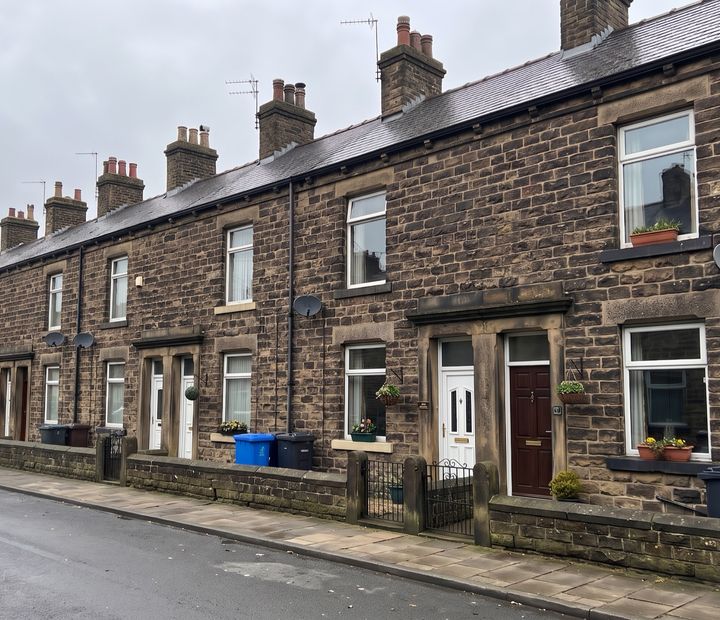
Terraced houses are home to 43.4% of the borough’s 58,766 households, according to the 2021 Census, well ahead of semi-detached homes at 29.5%. Much of Darwen went up between about 1850 and 1900, and that period still shows in date stones on its terraces, in cellars and in local stone and locally made brick.
House mice do well in that kind of building. A terrace shares walls, roof spaces and sometimes underfloor voids along the whole row, so mice cleared from one house can move next door and drift back a few weeks later. Cellars add weak points of their own: old coal chutes, airbricks and pipe runs where the mortar has crumbled. On a terrace job we look along the row as well as at the one property, explain to neighbours why a joined-up approach lasts longer, and seal the places that matter most: where services enter, where skirting meets a suspended floor, and where the cellar wall meets the street. The same thinking applies to a shop or takeaway that shares a wall with houses, where stock and food waste give mice a reason to stay.
Landlords, tenants and a growing rented sector
Private renting rose from 15.7% of households in 2011 to 20.2% by 2021, and social renting stood at 18.8%. With close to two in five households renting, many jobs here involve a landlord or housing provider as well as the person living in the home, and that changes how a pest job is arranged.
Landlords and letting agents usually want a written record they can keep on file, while tenants want the problem dealt with without weeks of back and forth. We work with both, booking access with the occupier and sending findings to whoever is arranging the work. Bed bugs show why that matters. They travel in luggage and second-hand furniture, so they often surface in a rented room after a change of occupant, and treatment works best when the tenant can prepare the room and give access for the follow-up visit, usually two to three weeks later.
Trade parks, retail and the market beneath The Mall
Whitebirk, on the east side of Blackburn, is largely industrial. Greenbank Business Park sits west of the A6119 bypass, and the Peel Centre retail park was built east of it in the 1980s, on the site of the old Whitebirk Power Station. Drumstone Trade Park lies close to the town centre, and in Darwen, India Mill is now home to many companies.
In the centre, Blackburn Market moved in June 2011 to a site beneath The Mall and opens six days a week. Wherever many traders work under one roof, a rodent or cockroach problem in one unit rarely stays put, because walls, ceiling voids, service runs and bin areas are shared. Commercial pest control for premises like these means a planned schedule of inspections, monitoring points marked on a site plan, and records that stand up when an environmental health officer asks for them. Food businesses are required by food hygiene law to have adequate pest control in place, and inspectors look for evidence that the risk is being managed rather than reacted to once something is spotted.
Pigeons, gulls and the roofs above them
The broad roofs of the retail and business park units at Whitebirk, and the ledges, signs and canopies of the town centre, are the kind of places feral pigeons and gulls use to roost and nest. Pigeons are the usual complaint on shop frontages. Gulls range well inland in search of food and water, and a borough with several reservoirs, including Wayoh and Ward’s, and a town-centre market offers both.
Every wild bird and its active nest is protected under the Wildlife and Countryside Act 1981, so lethal control or nest removal is limited to what a general or specific licence permits. That is why proofing is normally the lasting answer: netting over plant decks and loading bays on commercial roofs, spikes or sprung wire along shop-front ledges, and mesh around solar panels on houses, all fitted once we have checked that no active nest is in the way. Heavy fouling is cleared using suitable protective equipment before any proofing goes up.
Parks, woods and late-summer wasps
Blackburn’s larger green spaces include Corporation Park, opened in 1857, Queen’s Park with its lake and the 190-hectare Witton Country Park to the west, while Darwen has Sunnyhurst Wood and Bold Venture Park. Wasps chew wood from fences, sheds and trees to build their nests and hunt insects across gardens and parkland, so homes and businesses beside green space get their share each August and September, from loft nests to workers crowding a beer garden.
Not every home here is a terrace. Semi-detached and detached houses make up around 45% of households, and their lofts, eaves and garden sheds are common nest sites. By August a single nest can hold several thousand workers. Wasp nest removal is usually a single visit. We identify the insect first, because bumblebees and honeybees need a different approach, then treat the nest entrance so returning workers carry the insecticide inside. Activity usually stops within a day or two.
Booking from our Warrington base
Both towns are covered from Warrington, and the M65, with junctions from Feniscowles in the south-west round to Intack in the east, makes the borough straightforward to reach. We agree a time window with you, confirm it ahead of the day and set any follow-up dates on the first visit, so a treatment does not stall halfway. Business contracts have their inspection dates planned across the year. The same planning covers Preston to the west, and homes and businesses further south around Bolton are booked in the same way.
Blackburn with Darwen Borough Council is the local authority for both towns. Council services and terms change, so check its website for its current position on pest control before deciding who to call.
Our services in Blackburn & Darwen
Rat & Mouse Control in Blackburn & Darwen
The Blakewater and the River Darwen both run through culverts in places, and the canal crosses Blackburn from Feniscowles to Whitebirk, giving brown rats sheltered corridors to travel and drink along through both towns.
Domestic Pest Control in Blackburn & Darwen
With 43.4% of households in terraced houses and many of Darwen's older homes built over cellars, mice move along shared walls, roof spaces and voids, so proofing has to take the whole row into account.
Commercial Pest Control in Blackburn & Darwen
Multi-unit sites such as the market beneath The Mall, Drumstone Trade Park and the industrial area at Whitebirk need planned monitoring, because pests travel between neighbouring units through shared walls and services.
Bird Control & Proofing in Blackburn & Darwen
Retail and business park roofs at Whitebirk, along with ledges and canopies in the town centre, can give pigeons and gulls secure roosts and nest sites unless they are netted, spiked or wired.
Wasp & Hornet Nest Removal in Blackburn & Darwen
Green spaces such as Witton Country Park and Sunnyhurst Wood give wasps wood fibre and insect prey, so lofts, eaves and sheds close by are common nest sites from mid to late summer.
Bed Bug Control in Blackburn & Darwen
Private renting reached 20.2% of households in 2021, and bed bugs often arrive with a change of occupant or second-hand furniture, so landlords and tenants both need a clear treatment plan.
Other services available in Blackburn & Darwen:
Local factors behind pest problems in Blackburn & Darwen
- The Leeds and Liverpool Canal arrived in Blackburn in 1810 and crosses the town on a south-west to north-east line between Feniscowles and Whitebirk. [Wikipedia]
- The River Blakewater comes down from the moors above Guide, passes Whitebirk, Little Harwood and Brookhouse, is culverted under the town centre and joins the River Darwen outside Witton Country Park. [Wikipedia]
- The River Darwen passes through Darwen and past Ewood Park, crosses beneath the canal at Ewood Aqueduct and is culverted at Waterfall and near Griffin Park; in 2012 a section at Shorey Bank was uncovered after a century underground. [Wikipedia]
- At the 2021 Census, 25,507 of the borough's 58,766 households (43.4%) lived in terraced houses, with 29.5% in semi-detached homes, 15.2% in detached homes and 9.4% in purpose-built flats. [Nomis (ONS Census 2021, table TS044)]
- Between 2011 and 2021 the share of households renting privately in Blackburn with Darwen went from 15.7% to 20.2%, social renting stood at 18.8% and home ownership slipped from 64.2% to 60.5%. [Office for National Statistics]
- Darwen was largely built from around 1850 to 1900, and the period still shows in terrace date stones, cellars, local stone and locally made brick and tiles. [Wikipedia]
- Blackburn Market relocated in June 2011 to a new site underneath The Mall shopping centre and opens Monday to Saturday. [Wikipedia]
- Whitebirk, on Blackburn's east side, is largely industrial: Greenbank Business Park lies west of the A6119 bypass, and the Peel Centre was built east of it in the 1980s on the former Whitebirk Power Station site. [Wikipedia]
- Little Harwood, at Blackburn's northern edge, is a mix of housing, industrial units and open land, with Blackburn Cemetery among the open land. [Wikipedia]
- Reservoirs in the borough include Wayoh, Ward's, Dingle, Belmont and Turton & Entwistle, and its rivers include the Blakewater, the Darwen and the Roddlesworth. [Wikipedia]
Pest control in Blackburn & Darwen: frequently asked questions
Do you cover Darwen and the edges of the borough, such as Feniscowles, Whitebirk and Hoddlesden?
Yes. We work across all three postcode districts: BB1 on Blackburn's east side, including Whitebirk and Shadsworth; BB2 to the west, taking in Feniscowles, Cherry Tree, Mill Hill and Witton; and BB3 for Darwen itself, Lower Darwen and Hoddlesden. Homes and businesses are booked in the same way in each district. If you are not sure whether your street falls inside our area, give us the postcode when you get in touch and we will confirm it.
Why do rats keep turning up in gardens and yards near the canal or the rivers?
The Leeds and Liverpool Canal runs right across Blackburn, the Blakewater flows through the town centre and the River Darwen through Darwen, and both rivers are culverted in places. Brown rats use these corridors for shelter, water and travel, then move into gardens and yards where food and cover are easy to find. Bait alone rarely solves it for long. We find the entry route, often a broken drain or a gap beneath a wall or shed base, treat the active colony and proof that route so more rats cannot simply follow.
I have mice in a Darwen terrace with a cellar. Where are they getting in?
In older terraced houses the usual routes are gaps around pipes and cables, crumbling mortar in cellar walls, old vents and coal chutes, and the spaces under suspended floors that connect to next door. An adult mouse needs a gap of only about 6 mm. We trace droppings and gnaw marks back to the entry points, place bait or traps where children and pets cannot reach them, and seal gaps with materials mice cannot chew through. If the neighbouring house is affected too, treating both together works far better.
Can you look after a unit at Greenbank Business Park, the Peel Centre or Drumstone Trade Park?
Yes. We set up commercial contracts for warehouses, trade counters, shops and food businesses, with a site plan marking every monitoring point, scheduled inspections through the year and a written report after each visit. That paperwork is what an environmental health officer or an auditor will ask to see. Where a building is shared, we can work with the landlord or facilities manager so that proofing on common areas such as loading bays and bin stores is not overlooked.
I let a terraced house in Blackburn. How do you run a pest job with a tenant living there?
We book access directly with the tenant, agree any preparation they need to do, and send you or your letting agent a written report of what we found, treated and proofed. In a terrace the cause is often shared, such as a gap under a party wall or a drain serving several houses, so the report says where the problem sits. If the way in is disrepair, such as damaged brickwork, the fix usually falls to the landlord, because rented homes in England must be kept fit to live in.
Do homes near Witton Country Park or Sunnyhurst Wood get more wasp nests?
Houses and businesses beside woodland and large parks often see more wasps in late summer, because workers chew wood fibre from fences, sheds and trees to build their nests and find plenty to feed on nearby. Nests are usually in lofts, under eaves, in wall cavities or in sheds. We confirm whether they are wasps or bees before doing anything, deal with most nests in a single visit and explain what to expect afterwards. Old nests are not reused, so there is no need to pull one out of the loft in winter.
How do you schedule visits to Blackburn and Darwen from Warrington?
Visits are planned from our Warrington base. When you book, we agree a time window with you, confirm it before the day and set any follow-up dates before we leave, so a rat or bed bug treatment is not left half-finished. Business contracts have their inspection dates planned across the year in advance. Let us know about access, pets, parking or tenants who need notice when you call, and we will plan the visit around them.
Nearby areas we also cover
Sources (8)
Last updated: