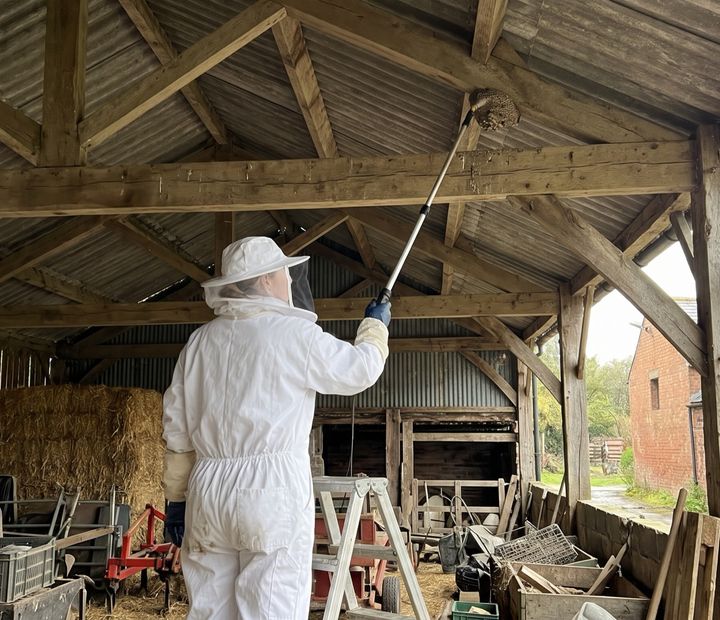
Northwest Environmental treats wasp and hornet nests at homes and business premises across Cheshire, Merseyside, Lancashire and Greater Manchester, working out from Warrington. A technician finds the nest, treats the entrance with a professional-use insecticide, usually in one visit, and activity normally dies down within a day. Call or use the contact form to book.
How do you know you have a wasp or hornet nest?
Most people notice the traffic before the nest. A steady line of wasps flying in and out of one point, busiest on warm mornings, nearly always means a colony behind it. On a house that point is often a gap under a roof tile, a soffit vent, an open mortar joint or an airbrick. In a garden it can be an old mouse burrow in a lawn or bank, a compost bin, a shed or a bird box.
Other signs worth checking:
- wasps turning up in one upstairs room, around a light fitting, a downlighter or the loft hatch, which usually points to a nest in the roof space or ceiling void;
- a papery, grey-beige ball in the loft, garage or shed, which can reach the size of a football or larger by late summer;
- a faint scratching or crackling inside a wall or ceiling, which is the sound of wasps chewing to enlarge the nest;
- pale, scraped lines on fence panels, sheds and garden furniture, where wasps collect wood fibre to make nest paper;
- large insects bumping against lit windows after dark, which is typical of European hornets.
Is it a wasp, a hornet or a bee?
It matters, because the answer changes what we do. Common and German wasps, behind most nests we see, are smooth and bright yellow and black. European hornets are bigger, chestnut-brown and yellow; they have spread northwards through England in recent decades but are far less common here than wasps. Bees are rounder and furrier, and we do not treat them. A suspected yellow-legged (Asian) hornet should be reported, not disturbed; the FAQs below explain how.
Why are wasp nests so common across the North West?
A queen looks for somewhere dry, sheltered and close to food and building material. Working out from Warrington across four counties, we see how differently the region provides it. In the older terraced streets of the Lancashire and Greater Manchester mill towns, slipped slates, open joints in brickwork and worn timber eaves let queens into roof spaces. Interwar semis often have boxed eaves with gaps behind the fascia. On newer estates, vented soffits and dry-fix ridges and verges can leave small openings that a queen will use in spring.
Away from the towns, outbuildings matter more. Stables, hay barns and farm buildings across the dairy country of the Cheshire Plain and rural Lancashire give wasps undisturbed cavities, and hornets favour hollow trees, old chimneys and wooden outbuildings near woodland. Canal-side gardens and pub terraces along the Bridgewater Canal through Lymm and Stockton Heath draw foraging wasps in late summer. Businesses see the same pattern at a larger scale: cladding gaps and loading canopies on warehouses along the motorway corridors, including the Omega warehousing beside the M62, landscaped borders around the offices on Birchwood Park, and bin stores behind takeaways.
The timing follows the calendar. Queens come out of hibernation in spring and start a nest the size of a golf ball. Through June and July the first workers take over the building, and by August and September a nest can hold several thousand wasps. That is when they become a nuisance: the colony switches to raising new queens and males, and workers with fewer grubs to feed go looking for sugar. The colony declines through autumn and the first hard frosts finish it; only the newly mated queens survive the winter, hibernating elsewhere.
How do we deal with a wasp or hornet nest?
Every visit starts with identification. Our technician confirms the insect is a wasp or hornet rather than a bee, finds the entrance by following the flight line, and checks who and what is nearby: children, neighbours in their gardens, pets, a fish pond, horses in the next paddock, or staff and customers on a business site.
Treatment goes into the entrance, not into the air. We apply a professional-use insecticide dust or foam directly into the hole or gap, from the ground with an extension lance wherever the nest allows, which avoids ladder work beside an active colony. Returning foragers walk through it and carry it inside, so the colony is treated even when the nest is buried in a cavity wall, under loft insulation or underground. Hornet nests are handled the same way, with more thought given to timing, because hornets fly later into the evening.
For a few hours afterwards there will be more wasps around the entrance, not fewer, as foragers return to a disturbed nest. The entrance must be left open: blocking it can push wasps to chew their way into the house instead. Activity normally falls away within a day, and the dead nest is usually left in place, since wasps never reuse one.
Is treatment safe for children, pets, livestock and staff?
Yes, when it is done as described. The product is placed in the nest entrance at the rate on the label, not sprayed across the garden or building. The main risk on the day comes from the wasps, so children and pets should stay indoors with nearby windows shut while we work, anyone with a known allergy should keep well away, and everyone should stay clear of the treated entrance for the rest of the day.
Many wasp insecticides are toxic to fish and bees, so we take care near ponds, watercourses and flowering plants, and horses or livestock should be kept away from a treated stable or barn wall until activity stops. If anyone stung has difficulty breathing, swelling of the face, lips or throat, or feels faint, call 999.
How many visits does wasp nest removal take?
One, for most nests, and the treatment usually takes well under an hour. A second visit is occasionally needed where a large nest sits deep in a roof space, the entrance could not be fully reached first time, or a second nest turns up nearby, which is not unusual in late summer. If wasps are still using the entrance after a couple of days, tell us.
Can you stop wasps nesting in the same place again?
Not entirely, because a new queen picks a fresh site every spring, but you can make a property much less inviting. Once a nest is dead, seal the gaps it used: re-bed slipped tiles, fit insect mesh over soffit vents and airbricks without blocking the ventilation, repoint open joints and close gaps around pipes and cables. Check lofts, sheds and garages in April and May, while a new nest is still small. In late summer, keep bins lidded and food waste covered; on food premises, fly screens on kitchen windows and doors help.
When does DIY stop being enough?
A small nest at ground level, in a garden you can keep clear of people, can be tackled with an amateur wasp nest powder used exactly as the label says. Beyond that, DIY tends to go wrong in predictable ways. Spraying a visible nest at close range provokes the colony. Blocking the hole sends wasps looking for another way out, sometimes indoors. Pouring petrol, boiling water or anything flammable into a nest is dangerous and rarely reaches the colony, and jam-jar traps catch foragers without touching the nest.
Get professional help if the nest is in a loft, eaves, chimney or wall cavity, above ground-floor height, beside a door, path or play area, or inside a building; if anyone nearby is allergic to stings; if you think it is hornets; or if you simply cannot find it.
What should businesses and landlords record?
For employers, a wasp nest beside an entrance, fire exit, beer garden or playground is a foreseeable risk to staff and the public, and your general duties under the Health and Safety at Work etc. Act 1974 mean dealing with it so far as is reasonably practicable. Food hygiene law also requires food businesses to have adequate procedures to control pests, so wasps around open food are likely to interest an environmental health officer. Keep a short note of each nest: the date, location, treatment and product used, any area closed off and whether activity stopped, filed with your pest control or food safety records.
For landlords and letting agents, a single seasonal nest is usually handled according to the tenancy agreement. Where wasps return year after year through the same defect in the roof or eaves, the repair may fall within the landlord’s duty for the structure and exterior under section 11 of the Landlord and Tenant Act 1985. Who pays depends on the agreement and the cause, so record what was treated and what was fixed.
Neither wasps nor European hornets are legally protected in England, so a nest can lawfully be treated with an approved product used as its label directs. The yellow-legged hornet is the exception: report it and leave the nest to the National Bee Unit.
How we deal with it
- 1
Identify the insect and find the nest
We confirm it is wasps or hornets rather than bees, then follow the flight line back to the entrance, whether that is a gap under a tile, a soffit vent, an airbrick or a hole in the lawn.
- 2
Check the surroundings
Before treating we check for children, neighbours, pets, fish ponds, horses or livestock, staff and customers nearby, and ask whether anyone has a known sting allergy.
- 3
Treat the entrance
A professional-use insecticide dust or foam goes directly into the entrance, from the ground with an extension lance where possible. Returning wasps carry it inside, so hidden nests are reached too.
- 4
Leave the entrance open
We explain why the hole must not be blocked, how long to keep people and pets clear, and that a short burst of extra activity is normal while foragers return.
- 5
Remove the nest where it matters
Dead nests are usually left, because wasps never reuse them. Where a nest is in a living space, a well-used shed or a loft where it could draw other insects, we can take it out once inactive.
- 6
Confirm it has worked
Activity normally stops within 24 hours. If wasps are still using the same entrance after a couple of days, or a second nest appears, tell us and we will reassess.
Typical visits: One visit for most nests, with the treatment itself usually taking well under an hour. A second visit is occasionally needed for a large nest deep in a roof space, an entrance that could not be fully reached, or a second nest found nearby.
Safety: Insecticide is placed in the nest entrance, not sprayed around the garden or building. Keep children and pets indoors with nearby windows shut while we work, keep everyone clear of the entrance for the rest of the day, and tell us about fish ponds, horses or livestock close by.
Wasp & Hornet Nest Removal: frequently asked questions
Will my council remove a wasp nest for free?
Probably not. Councils across Cheshire, Merseyside, Lancashire and Greater Manchester handle wasps differently: many charge for the work, some do not treat wasps in homes at all (Cheshire East, for example, treats only rats and mice), and free wasp treatment is uncommon. Where a council does offer it, appointments may be harder to get in late summer, when demand peaks, and there may be limits on the nests it will treat. Your council's pest control page will say what is available. If it does not cover your nest, or you need it dealt with sooner, we can treat it privately.
What kills a wasp nest instantly?
Nothing reliably does. Sprays that promise instant results knock down the wasps you can see, not the colony inside, and spraying a visible nest at close range mainly provokes it. Professional treatment works by placing insecticide dust or foam in the nest entrance; foragers carry it in and spread it through the nest. Expect a burst of activity for an hour or two, then a steady decline. Most nests are dead within 24 hours, although a large nest in a roof space can take a little longer.
Is it a wasp, a hornet or a bee, and will you treat bees?
Wasps are smooth, bright yellow and black, with a narrow waist. European hornets are larger, chestnut-brown and yellow, and often turn up at lit windows after dark. Bees are rounder and hairier. We do not treat honeybees, because insecticide in a honeybee nest can be carried away by bees from other colonies; a local beekeeper may be able to collect a swarm. Bumblebee nests die off naturally by late summer and are usually best left alone. If you are unsure, send us a clear photo before booking.
Can I just leave the nest until winter?
Sometimes. A nest at the bottom of the garden, in a hedge or in a loft nobody goes into, and causing no trouble, can be left: the colony dies in autumn and wasps do not reuse an old nest. It is harder to justify if the entrance is beside a door, path, patio or play area, if anyone in the household has reacted badly to a sting, or if wasps are getting indoors. Nests keep growing all summer, so the colony you notice in June will be far larger by late August.
What if I cannot see where the nest is?
Watch from a safe distance on a warm morning and follow the flight line. Wasps fly a fairly direct path to and from the entrance, so a steady stream heading for one gap under a tile, an airbrick, a soffit or a hole in the lawn usually gives it away. Inside the house, wasps appearing in one room, around a light fitting or the loft hatch, often mean a nest in the roof space or ceiling void. If you still cannot pin it down, our technician will trace it on the visit.
Do I need to leave the house or move pets during treatment?
No. The treatment goes into the nest entrance from outside, or into the nest itself in the loft, so there is no need to move out. While we work, keep children and pets indoors with nearby windows shut, and anyone with a sting allergy well away. Afterwards, keep everyone clear of the treated entrance for the rest of the day while returning wasps are still about. Cover a fish pond close to the nest, because many wasp insecticides are harmful to aquatic life, and keep horses and livestock away from a treated stable or barn wall until activity stops.
Do you remove the nest, and will wasps come back to it next year?
Most treated nests are left in place. Once the colony is dead the nest is just chewed wood paper, and wasps never reuse an old one: each spring a new queen starts from scratch. We can take a nest out once it is inactive if it is in a living space, in a shed or garage you use every day, or in a loft where dead grubs could attract other insects. A new queen may still choose the same sheltered spot, so sealing the entrance after the season is worth doing.
What should I do if I think I have seen an Asian hornet?
Do not go near the nest or try to treat it. The yellow-legged hornet, also called the Asian hornet, is an invasive species that preys on honeybees. It is darker than our native hornet, mostly black or dark brown with one yellow-orange band near the tip of the body and legs that are yellow at the ends. Take a photo from a safe distance and report it through the Asian Hornet Watch app or the online reporting form. Confirmed nests are dealt with by the National Bee Unit. Most confirmed sightings so far have been in southern England, but a few have been further north.
Can you treat a nest at our business premises without closing?
Usually, yes. Most nests on commercial sites are in eaves, cladding gaps, canopies, signage, hedges or landscaped borders, and the treatment itself is quick. We agree timing with whoever runs the site, so a nest above a pub garden, school entrance, staff smoking shelter or warehouse door can be treated before opening, after closing or with the area briefly coned off. Afterwards we set out where we treated, the product used and how long to keep the area clear, ready for your records.
Wasp & Hornet Nest Removal by county and town
Last updated: