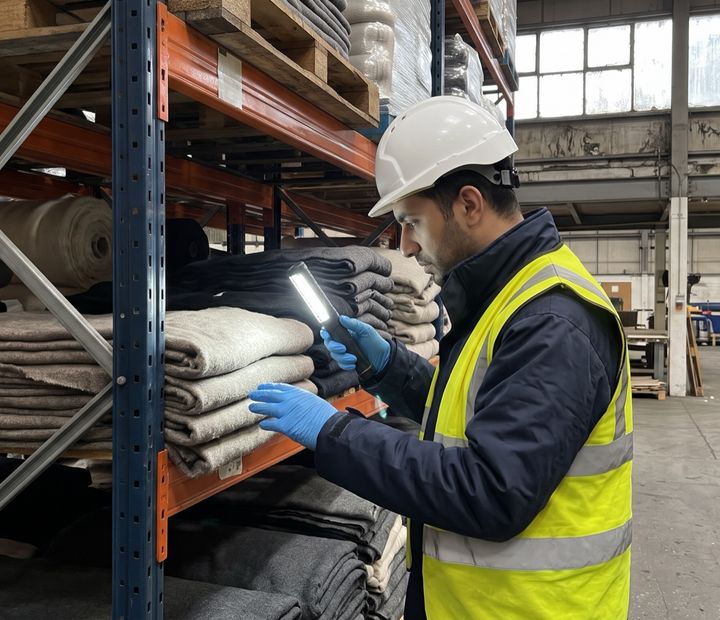
Northwest Environmental treats clothes and carpet moths in homes, hotels, holiday lets and shops across Cheshire, Merseyside, Lancashire and Greater Manchester, working out from Warrington. We confirm the species, find where larvae are feeding, treat carpets, wardrobes and voids, then return a few weeks later for hatching eggs. Call or use the contact form to book.
What are the signs of clothes moths?
Most people find the damage before they find the moth. Small, irregular holes in a wool jumper, a thinning patch of carpet at the edge of a room or under the bed, or a fur collar that sheds at a touch are the usual first clues. Look closely and you will often find what caused it:
- Larvae: creamy-white grubs up to about a centimetre long with a darker head. They feed in the dark and are the only stage that does any damage.
- Silk tubes or webbing stuck to the fabric, often speckled with droppings the same colour as the wool being eaten. This points to the common clothes moth.
- Small flattened cases, roughly the size of a grain of rice, on fabric or crawling up a wall. The case-bearing clothes moth carries one around with it.
- Adults: narrow, golden-buff or greyish-brown moths under a centimetre long that scuttle into folds rather than fly towards a light. Those you see fluttering are mostly males.
- Carpet damage that follows the skirting board or stops where furniture stands, because larvae avoid light and footfall. What people call carpet moths are usually these same clothes moths.
Hairy, banded larvae and shed skins point instead to carpet beetles, often called woolly bears. Little moths around the kitchen cupboards are usually food moths living in dry goods, not fabric.
Why do moths take hold in North West homes and hotels?
Clothes moth larvae feed on keratin, the protein in wool, fur, feathers, silk and hair. They do best where those materials sit undisturbed somewhere warm and dark, and clothes stained with sweat or food are more attractive still. Central heating lets larvae keep feeding through the winter, so in a heated house this is not just a summer problem, even though adults are most noticeable from late spring into autumn.
The region’s housing gives them plenty of choice. Older terraced houses in the mill towns and in Warrington, where more than a fifth of homes were terraced at the 2021 Census, often have lofts used for boxed clothes, old rugs and bedding, sometimes alongside the remains of old bird nests, which can sustain moths and carpet beetles for years. Larger period houses across rural Cheshire and Lancashire tend to hold wool carpets, rugs, heavy curtains and antique upholstery, often in rooms that are rarely used. On newer estates the problem is more often a single wardrobe, or a rug, second-hand furniture or vintage clothing brought in from elsewhere.
Businesses see a different pattern. Hotels, guest houses and wedding venues have long runs of wool or wool-mix carpet under beds and wardrobes that the vacuum rarely reaches, plus linen stores and upholstered headboards. Costume stores, vintage shops, carpet and furniture warehouses and heritage properties hold what moths eat in quantity, and an outbreak noticed on one rack has usually been building somewhere quieter for months.
How do we treat a moth infestation?
We start by confirming what the insect is. Clothes moths, house moths, food moths and carpet beetles are easily confused, and treating the wrong one wastes time. Larvae, cases, webbing or a damaged item are often enough to tell.
Next we look for the source, which is rarely where the damage was first spotted. That means lifting carpet edges at the gripper strip, checking under beds, sofas and fitted wardrobes, opening drawers and storage boxes and, where access is safe, looking in the loft for stored textiles and old nests. In a hotel we also check neighbouring rooms, corridors and linen stores.
Before treatment, you prepare the rooms using our checklist: launder, clean or freeze what can be saved, clear wardrobe and under-bed floors, and vacuum thoroughly, edges first, emptying the cleaner outdoors. Badly damaged items are often better thrown away.
We then apply a professional residual insecticide to carpet edges, the insides of emptied wardrobes and drawers, under furniture and, where needed, floor voids and loft boards, so larvae hatching over the following weeks meet treated surfaces. Pheromone monitors afterwards show whether adult males are still about.
Is moth treatment safe for children, pets and guests?
Most of the risk sits in the few hours after treatment, while surfaces are still wet. Treated rooms are kept clear of people and animals until they are dry, which usually takes a few hours. Children’s bedding, toys and pet beds are lifted before we start. Fish tanks are covered and pet birds and reptiles moved to another part of the house, since they are more sensitive to sprays in the air. Tell us if you have cats, because some insecticides are more harmful to cats than to dogs, and we choose and apply products with that in mind.
In hotels and holiday lets, rooms are taken out of use while they dry and aired before guests return, and housekeeping should not go in until we confirm it is safe. We provide safety data sheets for your COSHH assessment.
How many visits does moth treatment take?
Most homes need two visits: a survey and first treatment, then a second treatment a few weeks later for larvae hatching from eggs that survived the first. Monitoring continues for several months. Larger houses, lofts packed with stored textiles and multi-room hotel outbreaks can take more, especially where rooms are treated in phases around bookings. Moths develop more slowly in the cold, so an unheated loft can show activity later than a heated bedroom.
How can you stop clothes moths coming back?
Moths do best in textiles that are left alone, so regular disturbance is the most effective prevention:
- Vacuum carpet edges, under beds and inside wardrobes regularly, including rooms that are rarely used.
- Wash or dry-clean wool and silk before putting it away for the season; worn, unwashed garments draw larvae.
- Store clean woollens, furs and feather items in sealed bags or lidded plastic boxes rather than cardboard.
- Launder or freeze second-hand clothing, rugs and vintage textiles before they come into the house.
- Clear old bird nests and debris from lofts, and look at bird proofing if birds are still getting in.
- In hotels and holiday lets, move wardrobes and beds now and then so the floor beneath can be cleaned.
Cedar and lavender offer little more than a mild deterrent, and neither will protect a carpet that larvae are already eating.
When does DIY moth control stop being enough?
A few holes in one jumper, with no other signs, can usually be handled at home. Wash or freeze the affected clothes, vacuum the wardrobe thoroughly and put a pheromone monitor inside to see whether more males turn up.
Get help when damage appears in more than one room, when carpets are being eaten at the edges, when you are still catching moths months after a clear-out, when the source may be a loft, floor void or fitted unit you cannot reach safely, or when valuable rugs, textiles or antiques are at risk. For hotels, holiday lets and retailers the threshold is lower: a pattern across several rooms needs a planned response, not a can of spray.
What should hotels, landlords and businesses record?
There is no single law on clothes moths. Part I of the Prevention of Damage by Pests Act 1949 deals with rats and mice, so it is not a route for complaints about clothes moths. Employers who use or commission insecticides should keep product details and safety data sheets with their COSHH assessments. Hotels and holiday lets benefit from a simple log: rooms affected, dates, what was seen, when rooms went out of use, treatment reports and monitor counts. It shows a complaint was taken seriously and helps us see where an outbreak is spreading.
If moths turn up in stored food in a kitchen or food business, the position changes. Food hygiene law, under the Food Safety Act 1990 and the Food Safety and Hygiene (England) Regulations 2013, requires adequate procedures to control pests, so the infested stock, the treatment and the follow-up belong in your HACCP or Safer Food Better Business records. Our commercial pest control service can cover this as part of routine visits.
For landlords, moths in a tenant’s own clothing are usually the tenant’s matter, but an infestation in carpets or furnishings supplied with the let, or one present at move-in, may fall to the landlord. Section 11 of the Landlord and Tenant Act 1985 covers repairs to the structure, exterior and installations, pests can be assessed as a hazard under the Housing Health and Safety Rating System, and the Homes (Fitness for Human Habitation) Act 2018 gives tenants a route to act on an unfit home. Textile moths rarely reach that level, so who pays usually depends on the tenancy agreement and where the problem started. Inventories and check-in photographs help settle it.
How we deal with it
- 1
Identify the insect
We look at larvae, cases, webbing, adults and damaged fabric to confirm whether it is the common clothes moth, the case-bearing clothes moth, a house moth, a food moth or carpet beetle larvae, because each needs a different approach.
- 2
Find the source
We trace the damage back to where larvae are feeding: carpet edges, the floor under beds, sofas and fitted wardrobes, stored wool and fur, upholstery, and lofts holding boxed textiles or old bird nests.
- 3
Prepare the rooms
You receive a short checklist: clear wardrobe and under-bed floors, launder, clean or freeze what can be saved, bag it, vacuum edges thoroughly and empty the cleaner outdoors, then move pets out of the rooms.
- 4
Treatment
A professional residual insecticide is applied to carpet edges, under furniture, inside emptied wardrobes and drawers and, where needed, floor voids and loft boards. Rooms stay clear until surfaces are dry.
- 5
Follow-up and monitoring
We return a few weeks later to treat larvae that hatched from surviving eggs, and leave pheromone monitors so you can see whether adult males are still active over the following months.
Typical visits: Most homes need two visits: a survey and first treatment, then a second treatment a few weeks later. Large houses, lofts full of stored textiles and outbreaks across several hotel rooms can need more, with pheromone monitoring between and after visits.
Safety: Treated rooms are kept clear of people and pets until surfaces are dry, usually a few hours. Bedding, toys and clothing are lifted first. Fish tanks are covered, pet birds and reptiles moved elsewhere, and cat owners should tell us, as some insecticides are more harmful to cats. We follow each product label and supply safety data sheets for workplaces.
Moth Treatment: frequently asked questions
How can I tell clothes moths from carpet beetles?
Look at the larvae and what they leave behind. Clothes moth larvae are smooth, creamy-white grubs with a darker head, and they spin silk tubes, webbing or small portable cases on the fabric. Carpet beetle larvae, often called woolly bears, are hairy and banded brown, and tend to leave shed skins rather than silk. Adult carpet beetles are tiny, rounded and mottled, and often turn up on windowsills in spring. Both eat wool, fur and feathers, and plenty of homes have both, so we confirm which is present before treating.
Why are my clothes damaged when I hardly ever see a moth?
Because the adults are not the problem. Adult clothes moths do not feed; the larvae do all the damage, and they stay hidden in folds, seams, carpet edges and the dark spaces under furniture. Adults avoid light and tend to scuttle rather than fly, so the few you notice fluttering in the evening are mostly males looking for females. By the time holes appear, larvae may have been feeding for weeks or months, often somewhere other than the wardrobe where the damaged jumper was hanging.
Do pheromone moth traps get rid of clothes moths?
Not on their own. A pheromone trap uses a lure that mimics the scent of a female to draw in adult males, so it tells you moths are present and whether numbers are falling. It does nothing to the larvae eating a carpet or the eggs already laid, and lures are species-specific, so a trap set for the common clothes moth can miss other species. We use monitors to judge where activity is and whether treatment has worked. On larger sites, mating-disruption products can support treatment, but they do not replace it.
Will washing or freezing my clothes kill moth eggs and larvae?
Usually, if it is done properly. A hot wash at 60°C, where the care label allows, or professional dry cleaning should deal with eggs and larvae. For wool and delicate items that cannot take heat, seal them in a plastic bag with the air pressed out and freeze them at -18°C or colder for two to three weeks, counted from when the item is fully chilled. Let it thaw inside the bag so condensation forms on the outside, then brush it and store it sealed. Freezing treats the item, not the room it came from.
Do I need to leave the house while you treat for moths?
Normally only the rooms being treated need to be empty, and only until the surfaces have dried, which usually takes a few hours. You can stay in the rest of the house. Children and pets should be kept out of treated rooms until we say they can go back in, pet birds and fish tanks need extra precautions, and you should mention cats when you book. Bedding, toys and clothing are lifted beforehand so nothing that will be handled or worn is sprayed. We go through the timings with you on the day.
Why have moths come back after I cleaned out the wardrobe?
Most often because the wardrobe was not the source. Larvae spread along carpet edges and into rugs under beds, upholstered furniture, storage boxes and lofts, and a single old bird nest or a box of forgotten woollens can keep a population going for years. Eggs are also easily missed when cleaning and less affected by insecticide than larvae, and in a centrally heated house they can hatch at any time of year. Shop-bought sprays rarely reach voids or the floor under fitted furniture. Finding every feeding site and treating twice, a few weeks apart, is what breaks the cycle.
Can you treat moths in a hotel or holiday let without closing it?
In most cases, yes. We survey the affected rooms and those around them, including corridors and linen stores, then treat room by room, so only the rooms being treated and drying are out of use. Treatment can be timed between check-out and check-in or at quieter points in the week, with the follow-up planned around bookings. You receive a report after each visit showing which rooms were treated and what housekeeping should do next, which also gives you something to point to if a guest has complained about damage.
Is it still legal to use sticky moth traps now that rodent glue traps are banned?
Yes, with some care. The Glue Traps (Offences) Act 2022 is aimed at rodents: in England it is an offence to set a glue trap to catch a rodent, or to set one in a way that risks a rodent getting caught. Sticky pheromone monitors for moths are not banned, but one left flat on a floor or in a loft where mice run could create exactly that risk. Keep monitors in wardrobes and drawers or hung off the ground, and if you also have mice, tell us so the monitoring can be planned around them.
Are the small moths in my kitchen cupboards clothes moths?
Probably not. Moths around kitchen cupboards are usually food moths, such as the Indian meal moth, whose larvae live in cereals, flour, dried fruit, nuts, pet food and bird seed, often leaving webbing inside the packet. The fix is to find and bin the infested food, vacuum the cupboard including the corners and shelf-peg holes, and keep dry goods in sealed containers. Insecticide is rarely needed in a home kitchen. In a food business, the find should be recorded and dealt with under your pest control procedures.
Moth Treatment by county and town
Last updated: