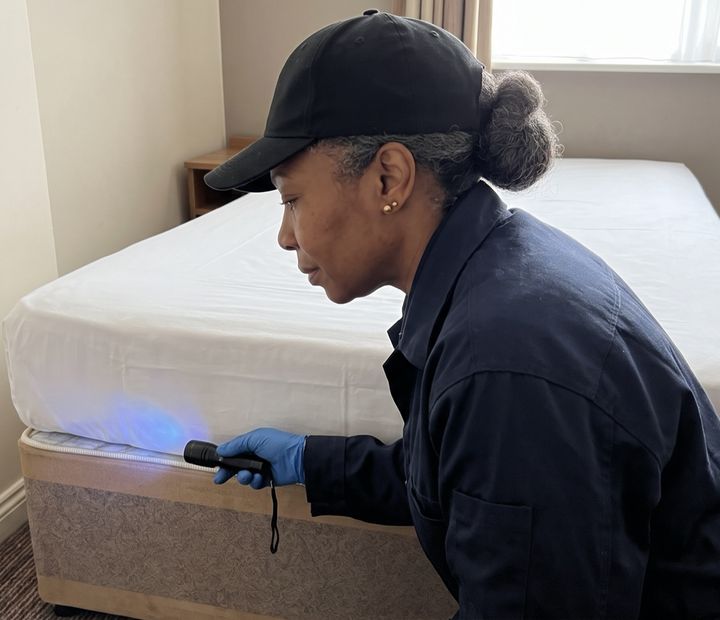
Northwest Environmental treats bed bugs in homes, hotels, HMOs and student lets across Cheshire, Merseyside, Lancashire and Greater Manchester, working out from Warrington. We confirm the insect, send preparation notes, then treat twice, with a fortnight to three weeks between visits so newly hatched bugs are caught. Call or use the enquiry form to book an inspection.
What are the signs of bed bugs?
Bites are often noticed first, yet on their own they prove very little. They tend to appear on skin left uncovered at night, in a row or a cluster, and can take a day or more to show. Some people hardly react, so one partner can wake up bitten and the other unmarked. Flea bites and heat rash can look much the same.
The insects themselves leave more reliable clues:
- tiny black-brown dots, like ink from a fine pen, along mattress seams, slats and bed-frame joints (this is digested blood);
- reddish-brown streaks on sheets or pillow covers from bugs squashed in the night;
- pale, empty casings left behind each time a young bug moults;
- pearly white eggs roughly 1 mm long, tucked into cracks;
- live adults around 5 mm long, flat, oval and brown when hungry, rounder and redder after a meal;
- with a heavy infestation, a sweet, musty odour in the room.
Look along the headboard, under the bed base, around skirting boards and sockets close to the bed, and in the seams of any sofa that doubles as a bed. Bed bugs shelter close to where people sleep and feed mainly at night. If you catch one, seal it in a bag or take a clear close-up photograph; that is often enough for us to say whether a visit is needed.
What brings bed bugs into homes and premises across the region?
Bed bugs are hitchhikers. They arrive in suitcases, handbags, coats and second-hand beds or sofas, and they do as well in a spotless house as in a cluttered one. Across the four counties, infestations follow people and their belongings.
Warrington sits inside a box formed by the M6, M56 and M62, roughly halfway between Liverpool and Manchester, so hotels and short-stay lets around the town take a steady flow of travellers and contractors. Liverpool’s two large universities bring tens of thousands of students, and each autumn mattresses, cases and furniture change hands between halls, shared houses and family homes. Seafront hotels in Southport and guest houses in the Lancashire resorts see constant turnover in season. Care homes and supported housing welcome residents who bring their own furniture and bedding.
The buildings play a part as well. Victorian houses divided into flats, large HMOs and blocks with shared service risers are linked by wall cavities, pipe runs and gaps beneath skirting, so a problem that begins in one bedroom can spread to the rooms beside, above and below it without anyone noticing for weeks.
In heated buildings bed bugs breed all year. Summer travel and the autumn student move can bring new infestations in, and many populations have become resistant to the pyrethroid insecticides common in shop-bought sprays, which is one reason a home treatment can appear to work for a week before the bites return.
How does Northwest Environmental treat bed bugs?
The first job is confirming what we are dealing with. Bat bugs look almost the same but live with bats, and because bats and their roosts are protected by law, they need a different plan. Bird mites from a nest by a window, and carpet beetle larvae, can also cause itching and bite-like marks, and an active wild bird’s nest is protected too. Once we know it is bed bugs, we map the spread, next door included where we can get in.
Written preparation notes follow, setting out what to wash, bag and leave in place, so we can reach the bed and room edges and nothing infested is carried elsewhere.
On the first visit we treat the places bed bugs shelter: seams and piping on the mattress, joints in the bed frame and headboard, skirting boards, carpet edges, the backs of picture frames, curtain tops and voids behind fittings. Depending on the room, that means a residual insecticide that carries on working for some weeks, an insecticidal dust in voids and cracks, and steam on the mattress and upholstered furniture. Zipped mattress encasements and interceptor monitors under the bed legs help any survivors show up early.
Heat is the other main approach. Raising a room and everything in it to a lethal temperature kills eggs, young and adults alike, and can clear a room in a day without insecticide. It needs thorough preparation, heat-sensitive belongings have to come out first, and it leaves no residual protection, so bugs returning from an untreated flat next door will survive. We will explain whether heat, insecticide or both suits your property, and why.
Eggs are why a single visit rarely finishes the job. At room temperature they hatch in about a week, longer in a cool room, so we come back two to three weeks after the first treatment, once the eggs have hatched but before the young are mature enough to breed.
Is it safe for households, guests, staff and pets?
Yes, when treatment is planned around the people and animals in the building. We use professional insecticides authorised for use in Great Britain, applied into seams, cracks and voids rather than sprayed over bedding or open floors. Nobody should go back into a treated room until the surfaces have dried, and we will give you a time on the day. Cover aquariums and turn off their air pumps, and take caged birds, reptiles and small mammals out of the room, as they can be more sensitive than cats and dogs.
Let us know in advance if anyone in the home is pregnant, has a young baby or has asthma, as we may change the products we use or the order we work in. In hotels and care homes, a treated room stays closed until it is dry and aired.
How many visits will it take?
Most homes need an inspection and two treatments, with the second two to three weeks after the first. A third follows if live bugs or fresh spotting turn up at the second visit. Blocks of flats, HMOs and hotels usually need neighbouring rooms checked as well, which can add visits. The number of rooms, how long the infestation has been building, clutter and access to the units next door decide the length of the job.
What stops bed bugs coming back?
Away from home, keep cases on a luggage rack, never on the bed, and look along the seams and headboard before unpacking. Back home, give travel clothes a 60°C wash and a hot tumble dry of at least 30 minutes, and bag and freeze anything unwashable for two to three weeks. Look over second-hand beds and sofas before they come indoors, and fit encasements if you have had bed bugs before.
For hotels, HMOs and care providers, early detection is the best defence. Housekeeping and support staff who know what spotting looks like, check seams whenever beds are changed and report concerns the same day will usually catch a problem while it is still confined to one room.
At what point should you call in a professional?
Hot washing, tumble drying and thorough vacuuming lower numbers and are worth doing while you wait for an inspection, but they will not clear an established infestation. Shop sprays and foggers can drive bugs deeper into walls and through to neighbouring rooms.
Get professional help if bites carry on after two weeks of your own efforts, if signs turn up in a second room, if you live in a flat or HMO, or if someone in the household is elderly, unwell or very young.
Who pays in a rented home, and what should businesses keep on file?
In rented homes, responsibility turns on how the bed bugs got in and what the tenancy agreement says. In England, the hazards that can make a rented home unfit under the Homes (Fitness for Human Habitation) Act 2018 include domestic hygiene, pests and refuse, although a landlord may not be liable where a tenant’s own conduct caused the problem. Councils can assess pests as a hazard under the Housing Health and Safety Rating System, and the Public Health Act 1936 lets them require verminous premises to be cleansed. Section 11 of the Landlord and Tenant Act 1985 covers repairs to structure and services, not pests, so it seldom settles a bed bug dispute by itself. In shared buildings, whoever manages the whole property is usually best placed to arrange treatment of every affected room.
Hotels, guest houses, HMO managers and care providers should log every report: the room, the date, who raised it and what they saw, what the inspection found, the treatment dates, which neighbouring rooms were checked and when the room was put back into use. Our written reports file alongside that log, so you can show a guest, tenant or environmental health officer what was done.
How we deal with it
- 1
Confirming it is bed bugs
We make sure the insect is a bed bug and not a bat bug, bird mite or carpet beetle larva, then check each bed, sofa and chair where people rest, plus adjoining rooms in shared buildings.
- 2
Your preparation checklist
You get written instructions on laundering bedding and clothes, clearing space around the bed, bagging belongings and what to leave where it is, so treatment can reach every hiding place.
- 3
Treating beds and room edges
Mattress seams, bed frames, headboards, skirting boards, carpet edges and voids are treated with targeted insecticide, dusts and steam as each room needs. If heat would suit the property better, we explain why.
- 4
Return visit for hatched eggs
Two to three weeks later we treat again, killing young bugs that have hatched since the first visit before they are old enough to breed.
- 5
Final inspection and written record
We look for live bugs and fresh spotting, suggest encasements or monitors where useful, and leave a written record of the rooms inspected, treated and cleared.
Typical visits: Most homes need an inspection and two treatments, the second coming two to three weeks after the first, plus a third visit if live bugs are still found. Hotels, HMOs and blocks of flats often need adjoining rooms inspected too, which can add visits.
Safety: We use professional insecticides authorised for use in Great Britain, applied to seams, cracks and voids rather than sprayed over bedding. Keep children, pets and anyone with asthma out of a treated room until it has dried, cover aquariums and turn off their air pumps, and move caged birds and small pets to another room.
Bed Bug Control: frequently asked questions
Can anything kill 100% of bed bugs?
Nothing sold in a shop can promise that, and any product sold on that claim is worth doubting. Many bed bug populations now resist common insecticides, and eggs often survive treatments that kill adults. Heat kills every stage provided the whole room and everything in it reaches a lethal temperature, but it leaves nothing behind to stop bugs coming back from next door. A residual insecticide goes on working for weeks yet still needs a return visit for the eggs. What clears an infestation in practice is a careful inspection, the right combination of methods and a follow-up treatment.
Should I move to the sofa or spare room until the bed bugs are gone?
Generally, no. Bed bugs track people by body heat and the carbon dioxide in their breath, so when someone switches rooms the bugs tend to follow, and two rooms become infested rather than one. It is usually better to stay in your own bed, on freshly laundered sheets, with the frame a few centimetres from the wall and the bedding kept off the floor. Once the room has been treated, this also means bugs coming out to feed must cross treated surfaces. If anyone reacts badly to the bites, a pharmacist or GP can advise.
Is an overnight fix for bed bugs realistic?
Not usually. An insecticide treatment begins killing active bugs within hours, but eggs laid before the visit can go on hatching for about a week afterwards, and that is why a second treatment two to three weeks later is standard practice. Heat can kill every life stage in a room in a single day, although that room still needs checking afterwards and the rooms around it should be inspected. If an infestation has been building for months, be cautious of anyone who promises it will be gone after one overnight visit.
Will I have to get rid of my mattress?
Rarely. A mattress can normally be checked and treated along its seams and piping, then zipped into a bed bug encasement, which seals in any survivors and leaves a smooth surface that is easy to check. Discarding it early often spreads the problem, because carrying an infested mattress through a hallway or communal stairs sheds bugs and eggs as it goes, and a replacement put into an untreated room soon becomes infested itself. If it is torn or heavily infested and must go, wrap it in plastic, mark it clearly and ask the council or a licensed waste carrier to collect it.
What do I need to do before a bed bug treatment?
You will get our preparation notes before the visit, but the essentials hardly change from home to home. Take the bedding off and put it, with clothes kept near the bed, through a 60°C wash and then a hot tumble dry of at least 30 minutes, and store everything in clean, sealed bags. Clear the floor around and under the bed, bag up the contents of bedside drawers and ease furniture a little way from the walls so we can get at the skirting. Keep belongings in that room instead of carrying them through the house, and avoid shop sprays in the meantime.
Are bed bugs the landlord's or the tenant's responsibility?
There is no single answer, because it depends on how they got in and what the tenancy says. A tenant who carries bed bugs home from a holiday may be asked to cover the cost, whereas bugs that were already there when the tenancy began, or that are moving between rooms in an HMO or block, are more likely to be the landlord's or managing agent's to deal with. In England, pests are among the hazards that can make a rented home unfit under the Homes (Fitness for Human Habitation) Act 2018, and councils can assess them under the Housing Health and Safety Rating System. Our findings go in writing to both sides.
A guest has reported bites in our hotel or guest house. What should we do?
Stop letting the room, bag the bedding inside it instead of sending it down the usual laundry route, and write down the room number, the date and what the guest told you. If you move the guest, offer to launder their clothes before they unpack, since bugs travel in luggage. We inspect the room in question and its neighbours, including those above and below, confirm whether bed bugs are present and treat wherever we find them. Your log will then show what was found, when each room was treated and when it was let again.
Will you treat the flats or rooms next door?
With the occupier's or owner's permission, yes, and we often advise it. In flats, HMOs, student houses and hotels, bed bugs travel along pipe runs, cable routes and gaps beneath skirting boards, so an infestation that looks limited to one room may already have spread. We inspect the adjoining rooms first and treat only where there is evidence. If we cannot get in, our report says so, because an untreated room next door is one of the commonest reasons bed bugs reappear in a room that was treated properly.
Does having bed bugs mean my home is dirty?
No. Bed bugs live only on blood, so crumbs, dust and dirty dishes have no bearing on whether they survive. They appear in tidy family homes, well-kept hotels, care homes and new-build flats alike. Clutter matters once they have arrived, because it creates more hiding places and makes it harder for treatment to reach every crack. If you have found them, the questions worth asking are where they came from and how far they have spread, not whether you clean enough.
Bed Bug Control by county and town
Last updated: