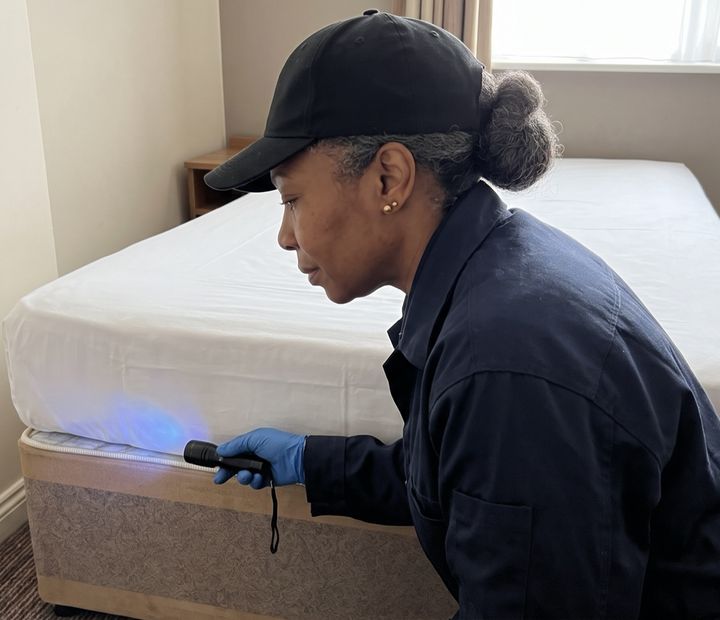
From the town centre to Great Sankey, Birchwood and Lymm, Northwest Environmental clears bed bugs from Warrington homes, flats, rented rooms and workplaces. We confirm the insect, treat beds and room edges, then come back two to three weeks on for newly hatched bugs. Phone our Warrington team or fill in the website form for a visit.
Why do bed bugs turn up in Warrington?
Bed bugs travel with people, so where they appear has more to do with movement than with how well a home is kept. Warrington is a town shaped by travel. Three motorways, the M6, M56 and M62, wrap partly around it, Liverpool and Manchester are each about 16 miles away, and Bank Quay is one of its two main railway stations. Every work trip, holiday or night spent away is a chance for an adult bug or a batch of eggs to come home in a bag, a case or the seam of a coat.
Furniture is the other usual route. A second-hand bed frame, headboard or sofa can hide a small colony, and a single mated female is enough to start an infestation. The number of people in the borough has more than doubled since Warrington became a new town in 1968, reaching about 210,900 by 2021, and in a place that size beds and sofas change hands constantly through house moves and online listings.
What turns up in a typical Warrington house?
Close to two-thirds of the town’s homes are semis or detached houses, and terraces add a little over a fifth. In a house, bed bugs keep close to one sleeping place: the stitched corners of a divan base, the screw holes of a bed frame, the gap behind a headboard. They reach a second bedroom when a child climbs into a parent’s bed, when someone moves to the spare room to escape the bites, or when bedding is carried across the landing. Found early, a house job is usually limited to one or two rooms and is simple to plan.
Where a semi or terrace shares a party wall, we pay attention to the bedroom on that side. Spread between houses is much rarer than between flats, but gaps around pipes and cables can link one bedroom to the next.
What changes in rented rooms and flats?
Just over 15% of Warrington households rent privately, and a similar share rent from the council or a housing association. Purpose-built flats account for roughly a tenth of households, and about 1.3% live in a converted or shared house, bedsits included. These are the homes where bed bugs travel furthest, through floor voids, service routes and shared sofas, and where the person reporting bites is often some distance from where the problem began.
Check Warrington Borough Council’s website for current pest control services and charges. Council and housing association tenants should report bites to their landlord first. In every case we ask for access to the rooms or flats either side, above and below, and our report notes any we could not get into.
What happens on a Warrington bed bug job?
We follow the same method as everywhere else we work. The first step is confirming the insect, because bat bugs, bird mites and carpet beetle larvae can all leave similar marks, and written preparation notes follow. The first treatment covers the bed, soft furnishings and room edges using whichever methods suit the room, and we talk through heat where it makes more sense. The return visit is booked at the first one, two to three weeks later, so it falls after the eggs have hatched and before the young can breed. A final check closes the job, and you keep a written record of it.
Being based in Warrington helps with that second visit. Homes across WA1 to WA5 and Lymm sit within easy reach, so the follow-up can be booked for the right week rather than whenever a long journey fits the diary.
Does the council treat bed bugs too?
Many councils run a pest control service for residents, but what is covered, who can book and the charges all vary and can change, so check the council’s own pest control pages before you book. If you rent, report the problem to your landlord first. If you would rather book a private firm, call or message us to arrange a visit.
What about offices and other workplaces?
Around 4,200 people work across Birchwood Park’s 123 acres. Bed bugs rarely breed in a workplace, because nobody sleeps there, but they are carried in and can settle in fabric chairs, staff-room sofas and quiet rooms. We inspect outside working hours where that suits, treat any seating where bugs are found and leave a report for the facilities team.
How do you keep bed bugs out afterwards?
Look over any second-hand bed or sofa outdoors before it crosses the doorstep, paying attention to seams, joints and staples. Leave mattresses and sofas dumped outside a block alone; on private or housing association land they are for the landowner to remove. After a trip, unpack straight into the washing machine rather than onto the bed. Keep mattress encasements on for at least a year after treatment, and in a block of flats tell the managing agent at the first sign, because one early report saves several rooms later.
Bed Bug Control in Warrington: what we see locally
- Purpose-built flats house about one Warrington household in ten, and in those blocks we ask to inspect the flats beside, above and below the one that reported bites.
- Converted houses and bedsits are a small share of the town's homes, at around 1.3%, but where rooms are let one by one we check every bedroom and the shared sofa, because the person with bites is often not the one whose room started it.
- Semis and detached houses account for close to 65% of Warrington homes, and in houses like these bed bugs usually stay in one or two bedrooms, so a house job is normally quicker to scope than a block.
- Birchwood Park employs around 4,200 people, and in offices and staff rooms a bug carried in on a bag tends to settle in upholstered chairs and break-room sofas, which we inspect as closely as any bed.
How we deal with it
- 1
Confirming it is bed bugs
We make sure the insect is a bed bug and not a bat bug, bird mite or carpet beetle larva, then check each bed, sofa and chair where people rest, plus adjoining rooms in shared buildings.
- 2
Your preparation checklist
You get written instructions on laundering bedding and clothes, clearing space around the bed, bagging belongings and what to leave where it is, so treatment can reach every hiding place.
- 3
Treating beds and room edges
Mattress seams, bed frames, headboards, skirting boards, carpet edges and voids are treated with targeted insecticide, dusts and steam as each room needs. If heat would suit the property better, we explain why.
- 4
Return visit for hatched eggs
Two to three weeks later we treat again, killing young bugs that have hatched since the first visit before they are old enough to breed.
- 5
Final inspection and written record
We look for live bugs and fresh spotting, suggest encasements or monitors where useful, and leave a written record of the rooms inspected, treated and cleared.
Bed Bug Control in Warrington: frequently asked questions
Does Warrington Borough Council treat bed bugs?
Many councils run a pest control service for residents, but what is covered, who can book and the charges all vary and can change, so check the council's own pest control pages before you book. If you rent, report the problem to your landlord first. If you would rather book a private firm, call or message us to arrange a visit.
I let rooms in a shared house in Warrington. How do you handle the inspection?
Access is agreed with you or your letting agent, and tenants are told in advance what the visit involves. Starting with the room where bites were reported, we check every bedroom, the lounge sofa, any spare beds and the routes between rooms. Each tenant gets the same preparation notes so belongings stay where they are until treatment. Your written report then shows which rooms were affected, which were clear and which we could not enter, so you can plan the follow-up and keep a record for the property file.
Can bed bugs get into an office or staff room on a Warrington business park?
They can, although it is far less common than at home. Bed bugs prefer places where people sleep, but they are carried into workplaces in bags, coats and laptop cases and can hide in fabric chairs, staff-room sofas and soft seating used for long periods. On a large site such as Birchwood Park, one report usually means checking nearby chairs and soft furnishings and suggesting the staff member has their home inspected, since that is the likelier source. We can visit outside working hours and send the report to your facilities team.
Someone has left a mattress outside our block. Could it carry bed bugs?
It could, so leave it where it is and do not let anyone carry it indoors. Bed bugs and their eggs can survive for weeks in a discarded mattress or sofa, and bringing dumped furniture inside is a common way for a problem to start. In Warrington the council expects private landowners and housing associations to clear dumped items from their own land, so tell your landlord or managing agent. If you know which flat it came from, mention it when reporting bites, because it points to where the problem began.
Do bed bugs spread between neighbouring semis or terraced houses?
Less readily than between flats, but it can happen. Semi-detached and terraced homes make up most of Warrington's housing, and each shares a party wall, and sometimes a loft space, with the house next door. Bed bugs stay close to sleeping people, so spread between houses usually follows gaps around pipes and cables on a shared wall, or belongings moved from one household to another. If the bedroom with bites backs onto a party wall, we look closely at that side and may suggest the neighbours have their own bedrooms checked.
Can anything kill 100% of bed bugs?
Nothing sold in a shop can promise that, and any product sold on that claim is worth doubting. Many bed bug populations now resist common insecticides, and eggs often survive treatments that kill adults. Heat kills every stage provided the whole room and everything in it reaches a lethal temperature, but it leaves nothing behind to stop bugs coming back from next door. A residual insecticide goes on working for weeks yet still needs a return visit for the eggs. What clears an infestation in practice is a careful inspection, the right combination of methods and a follow-up treatment.
Should I move to the sofa or spare room until the bed bugs are gone?
Generally, no. Bed bugs track people by body heat and the carbon dioxide in their breath, so when someone switches rooms the bugs tend to follow, and two rooms become infested rather than one. It is usually better to stay in your own bed, on freshly laundered sheets, with the frame a few centimetres from the wall and the bedding kept off the floor. Once the room has been treated, this also means bugs coming out to feed must cross treated surfaces. If anyone reacts badly to the bites, a pharmacist or GP can advise.
Is an overnight fix for bed bugs realistic?
Not usually. An insecticide treatment begins killing active bugs within hours, but eggs laid before the visit can go on hatching for about a week afterwards, and that is why a second treatment two to three weeks later is standard practice. Heat can kill every life stage in a room in a single day, although that room still needs checking afterwards and the rooms around it should be inspected. If an infestation has been building for months, be cautious of anyone who promises it will be gone after one overnight visit.
More in Warrington
Last updated: