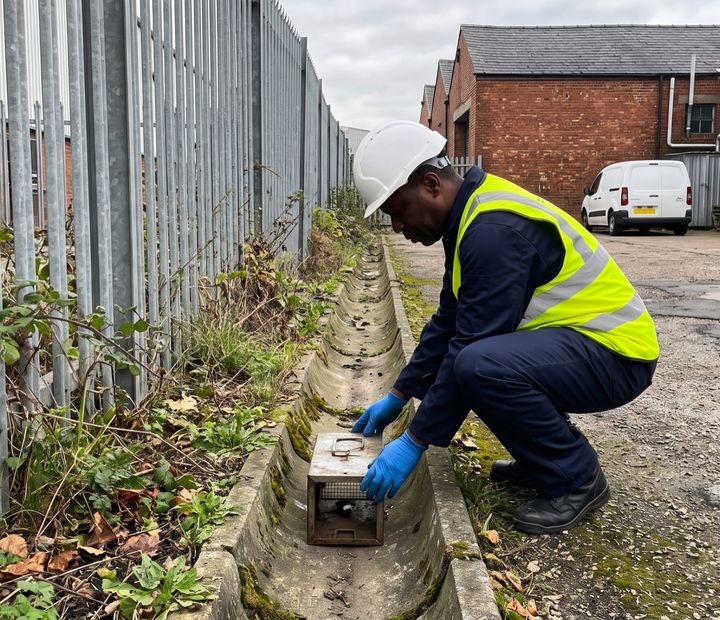
Northwest Environmental deals with rats and mice in homes, farms and business premises across Cheshire, Merseyside, Lancashire and Greater Manchester, working out from Warrington. We survey, trace how rodents get in, trap or bait in secured stations and proof the gaps, usually over two to four weekly visits. Call us or use the contact form to book.
How do you know whether it is rats or mice?
Most people hear rodents before they see them: scratching in a ceiling void after dark, gnawing in the loft, or a dog that keeps returning to the same skirting board. The evidence that tells the two apart is mostly on the floor.
Rat droppings are dark, capsule-shaped and roughly the length of a fingernail, left in small groups along a regular route. Mouse droppings are a few millimetres long, pointed at the ends and scattered wherever the mouse has been. Rats leave greasy smear marks along walls and dig burrows about the width of a tennis ball under decking, sheds and compost bins. Mice leave a musty smell and shredded paper or insulation used as nesting.
In a business, the signs often turn up during stock rotation: chewed cartons at the bottom of a pallet, droppings along the base of racking, or nibbled cable insulation in a plant room. In the countryside, autumn brings a third suspect, the wood mouse, larger-eyed and larger-eared than the house mouse, which moves into rural homes and outbuildings as the weather cools. Each species is controlled differently, so identification comes first.
Why do rats and mice get in across the North West?
Water runs through almost all of the region. The Mersey and the Manchester Ship Canal cut through Warrington, the Bridgewater Canal winds along the town’s southern side, and the Leeds and Liverpool Canal links Liverpool, Wigan and east Lancashire. Rats burrow into canal and river banks, and towpaths where people feed ducks give them a reliable meal.
The housing changes from county to county, and so does the way rodents get in. In the mill towns of Lancashire and Greater Manchester, and the older districts of Merseyside, Victorian and Edwardian terraces share back alleys and old clay drains. A cracked joint, or a redundant pipe left when an outside toilet was removed, can let a rat walk from the sewer into a cavity wall or under a kitchen floor. Mice move between terraced houses through shared roof spaces and floor voids, so one house is rarely the whole story.
In rural Cheshire and Lancashire, farmland, mossland, stables and garden hen houses put homes close to feed and cover. Newer estates on former fields see both problems: field-edge rodents in the gardens, and populations displaced by groundworks on the next phase of building.
Businesses see the same patterns at scale. Warehouses along the M6, M62 and M56 corridors handle a constant flow of pallets, and roller doors left open during loading are an easy way in. Town-centre food businesses often share bin stores, so a problem next door soon becomes yours.
How do we deal with rats and mice?
Every job starts with a survey rather than a box of bait. We identify the species, follow the runs back to where the animals are living and work out how they are getting in, checking airbricks, pipe entries, door thresholds and the ground under decking and sheds. Where the signs point to drainage, we lift inspection covers to look for activity, displaced joints or missing caps, and tell you if a drain survey or repair is needed.
You then get a plain explanation of what we propose and why. For mice indoors, and for small or sensitive rat problems, trapping is often the first choice: break-back traps inside enclosed boxes, which keep the trigger away from pets and children. Where rodenticide is the right tool, it goes into tamper-resistant stations fixed on the active runs. The active ingredient is chosen on the evidence, because resistance to some older anticoagulants is established in brown rats in parts of England.
Clearing the rodents inside achieves little if their way in is still open, so we seal or screen entry points, or set out what a builder or drainage contractor needs to do. When activity stops, we take everything away: stations, traps, uneaten bait and any carcasses we can reach.
Is rodent control safe for families, staff, pets and livestock?
It can be, provided the method suits the setting. The main risks with rodenticide are a child or animal eating bait, and secondary poisoning, where a cat, owl or other predator eats a poisoned rodent. That is why the UK Rodenticide Stewardship Regime, run through the Campaign for Responsible Rodenticide Use (CRRU UK) with government oversight, restricts professional products to certified users and expects baiting to be justified, checked and ended once the job is done. We never bait in the open, keep stations away from feed stores, hen runs and stables, and lean on trapping in homes with young children or free-roaming pets and on farms with working dogs.
We do not use glue traps. Since April 2024, using one to catch a rodent in England has been an offence under the Glue Traps (Offences) Act 2022 unless Natural England has issued a licence, and those are reserved for exceptional cases.
You will be told where every station is and what has been used, and on business premises staff are shown them too. If a pet reaches bait, call your vet straight away with the product details from our report.
How many visits will it take?
Most domestic rat jobs need two to four visits about a week apart, until catches or bait take stop and fresh signs disappear. Mice are often similar, though a terrace can take longer unless the neighbours treat too. A drain-related problem is solved when the defect is fixed, not when the last rat is caught. Food premises, warehouses and farms with an ongoing risk are usually better served by scheduled monitoring than by repeated call-outs.
How do you keep rats and mice out for good?
Proofing and housekeeping do more than any product. Look at the building the way a rodent would:
- fit fine metal mesh over damaged airbricks and vents without blocking ventilation;
- seal gaps around pipes and cables with wire wool or mesh and mortar, not expanding foam alone, which rats chew through;
- fit brush strips to external doors, garage doors and roller shutters;
- keep drain covers seated and intact, and ask about a rat blocker where rats use the sewer;
- store bird seed, pet food and animal feed in metal bins with tight lids;
- keep compost bins closed, leave cooked food out of them, and clear clutter from under decking and behind sheds.
A mouse needs a gap no wider than a pencil and a young rat one about the width of a thumb, so a good survey pays attention to small things.
When does DIY stop being enough?
A single mouse in a garage, caught with a couple of well-placed snap traps, is a reasonable DIY job. The picture changes when there are droppings in more than one room, noise in the walls or loft, rats seen in daylight, a burrow next to the house, or signs that keep coming back. Rats out in the day can point to a larger population competing for food.
Shop-bought rodenticides have their limits too: small packs, and use only where the label allows. If a problem keeps returning, the cause is usually an entry point or a drain defect that no amount of bait will fix.
What should businesses and landlords record?
Food businesses must have adequate procedures to control pests under food hygiene law, enforced in England through the Food Safety Act 1990 and the Food Safety and Hygiene (England) Regulations 2013. An environmental health officer will expect evidence: a site plan of monitoring points, visit reports, sightings logged by staff, what was used and where, and whether recommended proofing was done. Keep this with your HACCP plan or Safer Food Better Business pack. Where pests pose an imminent risk to health, officers can close premises, so act on a sighting the same day.
Every occupier, business or household, should know that the Prevention of Damage by Pests Act 1949 expects notice to the council where rats or mice are present in substantial numbers (agricultural land is treated differently), and lets the council require an owner or occupier to deal with them. Council services vary across the region; our town pages explain each one.
For rented homes, responsibility depends on the tenancy and the cause. Section 11 of the Landlord and Tenant Act 1985 makes most landlords responsible for keeping the structure and exterior in repair, including drains and external pipes, so a broken drain letting rats in is usually the landlord’s to fix. Pests are also a hazard under the Housing Health and Safety Rating System, and the Homes (Fitness for Human Habitation) Act 2018 gives tenants a route to act if a home is unfit. Where an infestation stems from how the home is kept, the tenancy may put the cost on the tenant, so keep our reports as a record of what was found and fixed.
How we deal with it
- 1
Survey and identification
We confirm whether it is rats, house mice or wood mice, follow runs and droppings back to where they are living, and map the ways in, from airbricks and pipe entries to drains and door thresholds.
- 2
A plan you understand
We explain what we found, which method we recommend and why, where traps or stations will go, and anything you need to do first, such as clearing a cupboard or moving pet food and animal feed.
- 3
Trapping or secured baiting
Enclosed traps or tamper-resistant bait stations are fixed on the active runs and every position is recorded. Products are used strictly to their label and to the CRRU UK code of best practice.
- 4
Proofing and drain checks
Gaps are sealed or meshed and door brushes fitted where needed. If drainage is the source, we show you the defect and recommend a rat blocker or repair so the route is closed.
- 5
Follow-up visits
We return, usually about a week apart, to check activity, remove any carcasses, move stations or traps to where the rodents are now working and confirm the proofing is holding.
- 6
Close-out and report
When activity stops, every station, trap and scrap of bait is taken away, and you receive a written summary of what was found, what was done and what to watch for.
Typical visits: Usually two to four visits about a week apart for a rat or mouse problem in a home. Drain defects, connected terraces and large commercial or farm sites can take longer, and premises with an ongoing risk often move on to scheduled monitoring visits.
Safety: Bait is never laid loose. Where rodenticide is needed it goes in locked, tamper-resistant stations fixed in place, away from children, pets, livestock and feed stores. We favour enclosed traps in sensitive settings, record every position, search for carcasses on each visit and remove all bait when the job ends. On business premises we brief staff on where stations sit and why they must not be moved. We do not use glue traps.
Rat & Mouse Control: frequently asked questions
Will rats leave on their own if I ignore them?
Rarely. While a building offers food, water and somewhere warm to nest, rats have no reason to move on, and they breed quickly: a female can mate again within a day or so of giving birth, and her young can breed within two to three months. Left in a loft or wall cavity, rats gnaw cables, which is a fire risk, foul insulation and stored belongings, and find their way to the kitchen through service voids. A problem that starts with a few droppings in autumn is often much larger by spring.
Can I legally put rat poison down in my garden?
Only in the way the product label allows. Rodenticides sold to householders are authorised for particular uses, usually indoors or outdoors close to buildings, and many may only be used inside a tamper-resistant bait station. Laying bait loose on open ground, in a hedge or by a compost heap risks poisoning pets, hedgehogs and birds of prey, and using a product against its label conditions can be an offence. Stronger professional products and larger packs are restricted to certified users under the UK rodenticide stewardship regime. In a garden used by children, dogs or hens, trapping is often the safer route.
Why do I keep getting rats under my decking or shed?
Decking and sheds give rats dry, hidden ground to burrow into, and most gardens have food nearby: bird feeders, dropped seed, compost bins, pet food or a hen run. Across much of the North West, a canal, brook or railway embankment close by adds a steady supply of new arrivals. Treating the burrows clears the current group, but others will move in unless the food is removed and the space under the structure is closed with buried mesh or a solid edge. We check the drains as well, because a broken pipe under a patio is often the real source.
Rats are coming from the drains. Who is responsible for fixing them?
It depends where the defect is. A drain within your boundary that serves only your property is normally the owner's responsibility. Since October 2011, most shared drains and sewers in England, including many that run under neighbouring gardens, have been the water company's responsibility, and across most of the North West that is United Utilities. If a survey shows rats are getting in through a shared section, report it to them. Meanwhile, a non-return valve, often called a rat blocker, can be fitted to stop rats travelling up from the sewer while repairs are arranged.
Is treatment safe with a baby, dogs or cats in the house?
Yes, with the right method. Indoors we often use enclosed traps, which carry no poisoning risk. Where bait is needed it goes into locked stations fixed to the floor or wall, so a curious dog or toddler cannot open or move them. We place them out of reach and away from food preparation areas, show you where each one is and remove everything at the end. There is a small risk that a cat catches a weakened rodent and is poisoned in turn, which is another reason we search for carcasses on every visit.
Can you deal with rats on a farm, stable yard or smallholding?
Yes. Rural sites need a different approach from a house. Feed stores, bedding, hay barns and hen runs give rats plenty of cover, and livestock, working dogs, yard cats and wild birds of prey all need protecting. We survey the whole yard, concentrate on where feed is stored and spilled, use traps and secured stations sited away from animals, and set out the proofing that feed rooms and outbuildings need. Permanent baiting as a precaution is restricted under the stewardship rules, so treatment is planned to end once the rats have gone, followed by monitoring.
Does a business have to tell anyone it has rats or mice?
Possibly. The Prevention of Damage by Pests Act 1949 expects an occupier who knows rats or mice are living on or visiting their land in substantial numbers to notify the council in writing, and the council can require action. Food businesses must also have adequate pest-control procedures, must not sell food that pests have made unfit, and can expect inspectors to check their pest records. In a warehouse or office, a written log of what was seen, when and what was done protects you if a client, landlord or auditor asks questions later.
What time of year are rats and mice worst in the North West?
Activity rises from late September into winter, when falling temperatures and harvested fields push rodents towards buildings. Rural homes in Cheshire and Lancashire also see wood mice coming in from hedgerows and field edges at this time. Rats living by rivers and canals can be displaced by heavy rain and high water in any month, and groundworks or demolition nearby often move them on into new gardens. In town centres, where food waste is available all year, there is no truly quiet season, so it is worth proofing whenever you spot a gap.
Do ultrasonic plug-ins or peppermint oil keep rats and mice away?
Not reliably. Ultrasonic devices may cause a brief change in behaviour, but rodents soon get used to the sound, and it does not pass through walls, furniture or stored goods, so the places where they nest are unaffected. Peppermint oil and similar scents fade within days and do nothing about the food or shelter that drew the animals in. The lasting deterrent is to deny them entry and food: close the gaps, repair drains, keep food and feed in sealed containers and keep clutter down. Repellents are no substitute for that work.
Rat & Mouse Control by county and town
Last updated: