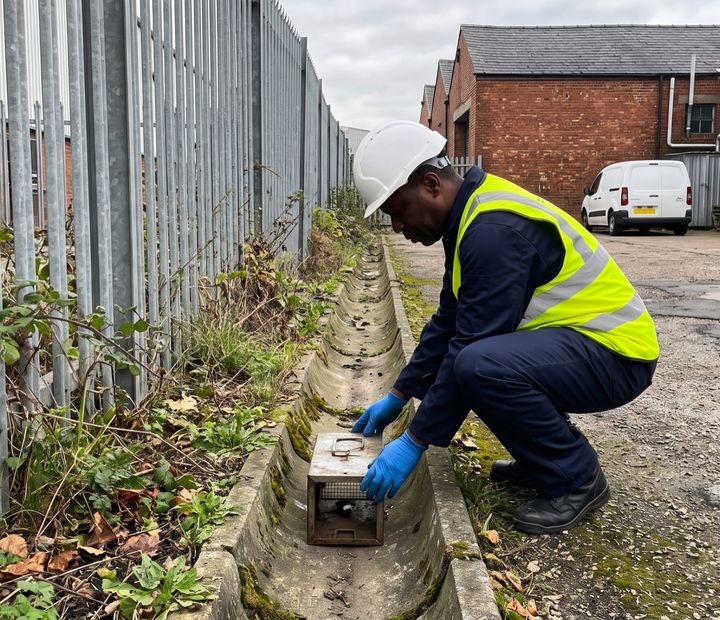
Northwest Environmental tackles rats and mice in Chester houses, shops, cafés and offices, from Blacon and Upton to Hoole and Handbridge. A survey finds where they live and get in, whether drains, riverside banks or shared floor voids; then traps or locked bait stations go down, gaps are sealed and we revisit about weekly. Book by phone or online.
Why does Chester give rats and mice so many routes in?
Water and old infrastructure shape most rodent work in the city. The Dee curls around the southern and western edge of the centre, and to the north the Shropshire Union Canal passes the walls in a sheer-sided red sandstone channel, with a branch dropping down to the river. The river’s banks give brown rats soft ground to dig into, while the canal corridor gives them a line of travel through the built-up area. Away from the water, the Blacon line and the Millennium Greenway in Hoole follow former railway trackbeds that are now green corridors, and rats use cover like that to move between streets.
Below ground the city is older still. Around 20 medieval stone undercrofts survive beneath the Rows, much of the centre is listed, and buildings of very different ages stand shoulder to shoulder. Old cellars, drains and voids rarely line up neatly with the property boundaries above them, which is why tracing a rat back to its entry point in the centre can take longer than in a modern street.
What do we find in Chester homes?
The answer depends on the suburb. In Hoole’s Victorian terraces, the usual call is about mice: scratching in a ceiling at night, droppings behind the kitchen units, or a pet fixated on a stretch of skirting. Where lofts and floors connect from house to house, a mouse sees the whole row as one building, and treating a single house without looking at the neighbours often brings them straight back. Across the Dee, Handbridge’s Victorian housing raises the same issue, with the riverbank close by for rats.
Hoole’s 1930s semis, the post-war estates of Upton-by-Chester and the council-built housing of Blacon tend to bring rats rather than mice. Longer gardens with decking, sheds, compost bins and bird feeders give them food and somewhere dry to burrow, and a cracked drain under a patio can let them reach the house itself. Housing built over the former Chester General marshalling yard is no exception: mice still find gaps where pipes and cables enter.
How do the Rows and Hoole’s guest houses change the job?
Commercial work in the centre is shaped by the Rows. Shops trade on two levels, at the street and behind the first-floor walkways, with cafés and restaurants among them and often an undercroft below. Mice in one kitchen are frequently nesting under the next unit, so we monitor the routes between premises, look at drainage in the cellars and, where neighbours agree, treat several businesses together. On listed buildings, proofing uses materials that can be removed without damaging the fabric, and the owner confirms before anything is fixed.
Hoole’s hotels and guest houses need the same thoroughness with less disruption. We concentrate on kitchens, stores and roof voids, keep traps and stations out of sight and fit visits around service times. Offices on Chester Business Park are a different exercise again: perimeter stations around buildings and bin stores, attention to loading doors and a monitoring plan that suits a large site.
How does a Chester rodent job run?
Every job begins with a survey. The technician confirms whether it is rats or mice, follows droppings, smears and runs to the nest site, and checks airbricks, pipe entries and door thresholds. If the evidence leads to the drains, inspection chambers are opened and checked for activity and failed joints. Before any treatment, we talk you through the plan, including where each trap or station will sit and what you need to do beforehand.
Enclosed traps are usually the first choice indoors. Where rodenticide is justified, it goes only into secured bait boxes anchored to the floor or wall. Gaps are sealed with mesh, mortar or brush strips, and drain defects are reported with a recommendation for repair or a rat blocker. Follow-up visits, normally about a week apart, are booked as part of our Chester round from Warrington, and when activity stops we remove every station and trap and leave a written summary.
Keeping rodents out of Chester properties
Near the river, the canal and the old railway paths, a steady supply of new rats is a fact of life, so prevention matters more than any single treatment. Feed birds from a tray rather than scattering seed, keep compost bins closed and cooked food out of them, and stop rats getting under sheds and decking with a skirt of buried mesh. In terraces, ask neighbours whether they have seen signs too, and seal gaps around pipes under sinks and behind appliances. For traders on the Rows, closed bins, prompt removal of food waste and a quick report to us at the first dropping keep a small problem from spreading along the street.
Rat & Mouse Control in Chester: what we see locally
- In terraced housing such as Hoole's Victorian rows, lofts and floor voids are often linked from house to house, so a mouse problem reported in one home may be fed and housed partly next door; the suburb's 1930s semis, by contrast, have the gardens, decking and sheds where rats burrow.
- The Dee's loop around the city centre gives brown rats soft banks to burrow into, while the Shropshire Union Canal, running beside the walls in its sandstone cutting with a branch down to the river, gives them a line of travel through the city.
- The former Blacon railway line and the Millennium Greenway through Hoole are now green corridors, so homes along them can see rats arriving from cover that sits outside any one owner's boundary.
- About 20 medieval undercrofts survive below the Rows, where shops trade on two levels with cafés and restaurants among them, so rodent work in the centre means monitoring the cellars and the routes between units, not a single kitchen.
- Chester Business Park spreads offices across about 175 acres between Wrexham Road and the A55, so rodent work there is about perimeter stations, bin stores and loading doors around each building.
How we deal with it
- 1
Survey and identification
We confirm whether it is rats, house mice or wood mice, follow runs and droppings back to where they are living, and map the ways in, from airbricks and pipe entries to drains and door thresholds.
- 2
A plan you understand
We explain what we found, which method we recommend and why, where traps or stations will go, and anything you need to do first, such as clearing a cupboard or moving pet food and animal feed.
- 3
Trapping or secured baiting
Enclosed traps or tamper-resistant bait stations are fixed on the active runs and every position is recorded. Products are used strictly to their label and to the CRRU UK code of best practice.
- 4
Proofing and drain checks
Gaps are sealed or meshed and door brushes fitted where needed. If drainage is the source, we show you the defect and recommend a rat blocker or repair so the route is closed.
- 5
Follow-up visits
We return, usually about a week apart, to check activity, remove any carcasses, move stations or traps to where the rodents are now working and confirm the proofing is holding.
- 6
Close-out and report
When activity stops, every station, trap and scrap of bait is taken away, and you receive a written summary of what was found, what was done and what to watch for.
Rat & Mouse Control in Chester: frequently asked questions
Does the council's rat service cover my shop as well as my home?
Not through its domestic service, whose charges apply to homes only and which includes up to three visits for rats or mice within one calendar month. Businesses are handled by a separate council team selling single jobs or annual contracts on weekdays, with invoicing on request. A private contract gives you scheduled monitoring, proofing advice and a report after each visit, which a food business can keep with its hygiene records. Either way, act on the first droppings: an inspector will expect a business to show what it did about a sighting and when.
Can you rat-proof a listed building on the Rows without damaging it?
It can be done, provided the materials and permissions are right. The Rows run through 95 or more listed buildings, and in October 2025 the council warned about a rise in unauthorised works to historic fabric there, so we do not drill or fix into old stone or timber without agreement. Most rodent proofing can be done with removable mesh, wire wool packed into gaps, brush strips on doors and fittings held in mortar joints rather than masonry. Where a permanent change is needed, such as a new grille over an undercroft vent, we specify it for the owner to clear with the council first.
We found rat droppings in our Handbridge cellar after the Dee ran high. Is the river to blame?
It may well be. Handbridge sits on the south bank, and the crossing there has a long history of flood damage, so rats living in riverbank burrows are pushed uphill when the water rises and look for the nearest dry shelter. A cellar with an old drain, a loose grating or gaps around pipes is an obvious choice. We check the drains first, because a broken or uncapped pipe is a common way in, then set traps or secured bait boxes and close the gaps. A non-return valve keeps sewer rats from climbing back up the pipe.
We run a guest house in Hoole. Can you treat mice without guests noticing?
Largely, yes. Guest accommodation clusters in Hoole because it is so close to the station, and most rodent work in this kind of building happens in kitchens, stores, cellars and roof voids rather than guest rooms. Enclosed traps and locked stations are small, sit behind or beneath fittings and keep bait and triggers out of reach of guests, children and pets. We book visits around your breakfast service and changeovers, and the written report after each one gives you a clear record if an environmental health officer asks about pest control.
Will rats leave on their own if I ignore them?
Rarely. While a building offers food, water and somewhere warm to nest, rats have no reason to move on, and they breed quickly: a female can mate again within a day or so of giving birth, and her young can breed within two to three months. Left in a loft or wall cavity, rats gnaw cables, which is a fire risk, foul insulation and stored belongings, and find their way to the kitchen through service voids. A problem that starts with a few droppings in autumn is often much larger by spring.
Can I legally put rat poison down in my garden?
Only in the way the product label allows. Rodenticides sold to householders are authorised for particular uses, usually indoors or outdoors close to buildings, and many may only be used inside a tamper-resistant bait station. Laying bait loose on open ground, in a hedge or by a compost heap risks poisoning pets, hedgehogs and birds of prey, and using a product against its label conditions can be an offence. Stronger professional products and larger packs are restricted to certified users under the UK rodenticide stewardship regime. In a garden used by children, dogs or hens, trapping is often the safer route.
Why do I keep getting rats under my decking or shed?
Decking and sheds give rats dry, hidden ground to burrow into, and most gardens have food nearby: bird feeders, dropped seed, compost bins, pet food or a hen run. Across much of the North West, a canal, brook or railway embankment close by adds a steady supply of new arrivals. Treating the burrows clears the current group, but others will move in unless the food is removed and the space under the structure is closed with buried mesh or a solid edge. We check the drains as well, because a broken pipe under a patio is often the real source.
More in Chester
Last updated: