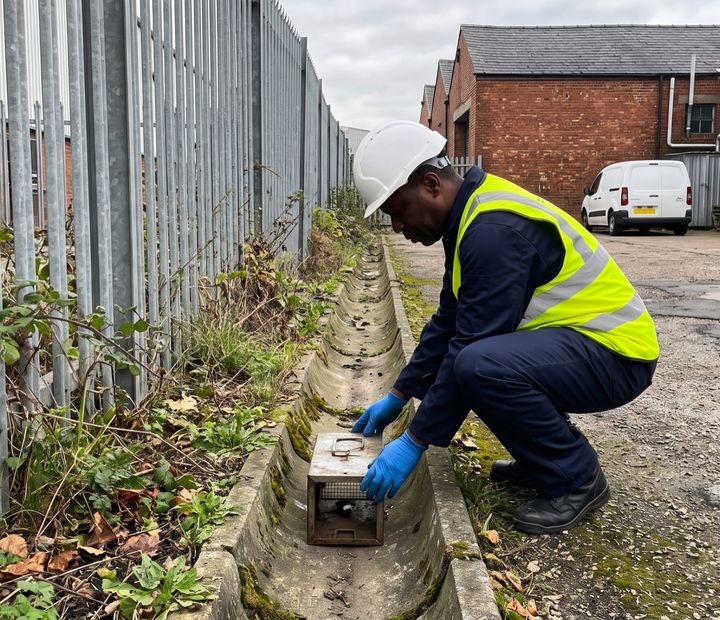
Northwest Environmental deals with rats and mice in Northwich homes, rented houses and business premises, including Leftwich, Barnton and Kingsmead. We survey first, trace each run to the riverbank, drain or wall void behind it, then set enclosed traps or locked bait stations and seal gaps over weekly visits. Phone the office or use the website form to book.
Why are rats so settled along the Northwich waterways?
Few towns of this size have as much water running through them. The Weaver and the Dane meet in the centre, the Trent and Mersey Canal loops around the north, and the boat lift at Anderton connects the two systems. Brown rats swim well and dig their burrows into soft banks just above the waterline, so a riverside garden or a yard backing onto the towpath is within easy reach of an established colony.
The canal side of town shows this clearly. Between the tunnels west of Barnton and the wharf at Wincham, the water runs close behind houses and business yards. Rats there tend to show at the boundary first: a hole under a shed base, a run worn through a border, droppings around a bird table or beside a compost bin that has no base.
The rivers also flood. Storm Christoph left most of the town centre under water in January 2021, and when burrows fill, rats move to the nearest dry ground. In the riverside streets, a rat in a cellar or garage after a wet week is rarely a coincidence, and we start those jobs by checking drain chambers and boundary walls.
What do we find inside Northwich homes?
Mice are more often the indoor problem, and the town’s housing gives them plenty of routes. In the centre, timber-framed houses and those built on jackable girders to cope with subsidence have hollow floors and stud walls. Mice travel through them unseen, so scratching in one wall and droppings in a cupboard may belong to a single run that only makes sense once floor voids and boxed-in pipes have been checked.
On the post-war Leftwich Green estate and the council-built streets of Barnton, the causes are usually simpler but repeat from house to house: worn door thresholds, gaps where waste pipes leave the wall and airbricks that have lost their mesh. The back-to-backs on Bell’s Brow share walls on more than one side, so proofing one house without its neighbours rarely holds for long.
New-build estates are not exempt. Kingsmead was built on former greenfield land beside the Weaver, and in the first few winters mice from the field edges and river corridor try every service entry and weep vent. That is often when new owners first get in touch.
How does a rat or mouse job run in Northwich?
The first visit is a survey: which species, where the runs go, how the animals get in and where they are coming from, which here is often a drain chamber, a riverbank boundary or a void inside the structure. We then agree the plan, fix enclosed traps or locked bait stations on the active runs and record each position. Follow-ups are booked about a week apart from our Warrington base and adjusted as activity moves. Proofing is done during the visits where it can be, or set out in the report for a builder. If a drain defect is the cause, we show you where it is and whether a repair or a rat blocker is the answer.
What about food, retail and distribution premises?
Rudheath’s food sites, including the supermarket distribution centre on the A530 and the bakery operations along the A556, handle exactly the goods and packaging rodents want, and their loading bays stay open for long stretches. In the town centre, about half the retail space at Barons Quay was empty in January 2023, and vacant units beside cafés and restaurants let mice build up without anyone seeing droppings. On commercial jobs we fix monitoring points to a site plan, agree visit times with the manager and leave a report after every visit, so the record stands up to an audit or an environmental health inspection.
How can you keep rats and mice out of a Northwich property?
Prevention here starts at the edges. If your garden backs onto the river or canal, raise or mesh the bases of sheds and decking, feed birds from a tray that catches spilt seed and stand compost bins on a mesh base. After high water, walk the boundary and look for fresh burrows. Indoors, check the junctions in older timber-framed houses where frame meets brick, and on newer estates look at the pipe entries under sinks and behind appliances. Every gap closed before the colder weather arrives in October is one less route to deal with over the winter.
Rat & Mouse Control in Northwich: what we see locally
- Rats burrowing in the banks where the Weaver and the Dane meet are pushed towards town-centre gardens and cellars when the rivers rise, and most of the centre went under water during Storm Christoph in 2021.
- Timber-framed houses and homes built on jackable girders to ride out salt subsidence have hollow floors and stud cavities, so mouse droppings in one room often trace back to a run in a void elsewhere.
- Kingsmead's roughly 2,000 homes were built on greenfield land beside the Weaver, and mice from the field edges and river corridor test new-build pipe entries and weep vents in the first few winters.
- Between the Barnton and Saltersford tunnels and the wharf at Wincham, the Trent and Mersey Canal runs close to homes and yards, and rat activity there usually shows at the boundary before it reaches the house.
- Food distribution and bakery sites at Rudheath, and the empty units that made up about half of Barons Quay's shop space in early 2023, need monitoring points recorded on a site plan.
How we deal with it
- 1
Survey and identification
We confirm whether it is rats, house mice or wood mice, follow runs and droppings back to where they are living, and map the ways in, from airbricks and pipe entries to drains and door thresholds.
- 2
A plan you understand
We explain what we found, which method we recommend and why, where traps or stations will go, and anything you need to do first, such as clearing a cupboard or moving pet food and animal feed.
- 3
Trapping or secured baiting
Enclosed traps or tamper-resistant bait stations are fixed on the active runs and every position is recorded. Products are used strictly to their label and to the CRRU UK code of best practice.
- 4
Proofing and drain checks
Gaps are sealed or meshed and door brushes fitted where needed. If drainage is the source, we show you the defect and recommend a rat blocker or repair so the route is closed.
- 5
Follow-up visits
We return, usually about a week apart, to check activity, remove any carcasses, move stations or traps to where the rodents are now working and confirm the proofing is holding.
- 6
Close-out and report
When activity stops, every station, trap and scrap of bait is taken away, and you receive a written summary of what was found, what was done and what to watch for.
Rat & Mouse Control in Northwich: frequently asked questions
Should I book the council or a private firm for rats in Northwich?
Either can work, and it helps to know what each includes. Cheshire West and Chester Council charges for rat and mouse treatment, takes bookings online for a weekday morning or afternoon slot and includes up to three visits within a calendar month, with business premises priced separately. With us, the number of visits follows what the survey finds, and drain checks, proofing and a written report are part of the same job. If your address is in the part of CW9 covered by Cheshire East, a different council service applies, so check before you compare.
We have just moved into a Kingsmead new-build. Why are there mice already?
It happens often on estates built on former fields. Construction disturbs the rodents that lived there, and new homes have small gaps around pipe entries, boiler flues and weep vents until snagging work closes them. Mice from the field edges and the river corridor find those gaps as the weather cools. We work out where they are getting in, trap them inside and seal the entry points. If the gaps turn out to be building defects, our report gives you the detail to raise with the developer.
Rats come from the canal behind our garden. Can you treat the towpath?
No. We can only work on land you own or control, and the Trent and Mersey Canal and its towpath are looked after by the Canal & River Trust, which you can contact about rodents on its land. What we can do is make your side of the boundary unattractive: clear the burrows in your garden, deny rats the space under sheds and decking with buried mesh, and take away the food that draws them across, such as spilt bird seed or an open-bottomed compost bin. New arrivals then tend to pass by rather than move in.
Our café at Barons Quay is next to an empty unit. Could mice be coming through?
Quite possibly. Mice move between units through shared ceiling voids, service risers and the gaps around pipes and cable runs, and an empty shop gives them a quiet place to nest with nobody noticing droppings. We inspect the shared walls and ceilings from your side, place monitoring points along them and tell your landlord or managing agent which proofing is needed in common areas or the vacant unit. Every visit is written up, so the records are ready for an environmental health inspection.
Will rats leave on their own if I ignore them?
Rarely. While a building offers food, water and somewhere warm to nest, rats have no reason to move on, and they breed quickly: a female can mate again within a day or so of giving birth, and her young can breed within two to three months. Left in a loft or wall cavity, rats gnaw cables, which is a fire risk, foul insulation and stored belongings, and find their way to the kitchen through service voids. A problem that starts with a few droppings in autumn is often much larger by spring.
Can I legally put rat poison down in my garden?
Only in the way the product label allows. Rodenticides sold to householders are authorised for particular uses, usually indoors or outdoors close to buildings, and many may only be used inside a tamper-resistant bait station. Laying bait loose on open ground, in a hedge or by a compost heap risks poisoning pets, hedgehogs and birds of prey, and using a product against its label conditions can be an offence. Stronger professional products and larger packs are restricted to certified users under the UK rodenticide stewardship regime. In a garden used by children, dogs or hens, trapping is often the safer route.
Why do I keep getting rats under my decking or shed?
Decking and sheds give rats dry, hidden ground to burrow into, and most gardens have food nearby: bird feeders, dropped seed, compost bins, pet food or a hen run. Across much of the North West, a canal, brook or railway embankment close by adds a steady supply of new arrivals. Treating the burrows clears the current group, but others will move in unless the food is removed and the space under the structure is closed with buried mesh or a solid edge. We check the drains as well, because a broken pipe under a patio is often the real source.
More in Northwich
Last updated: