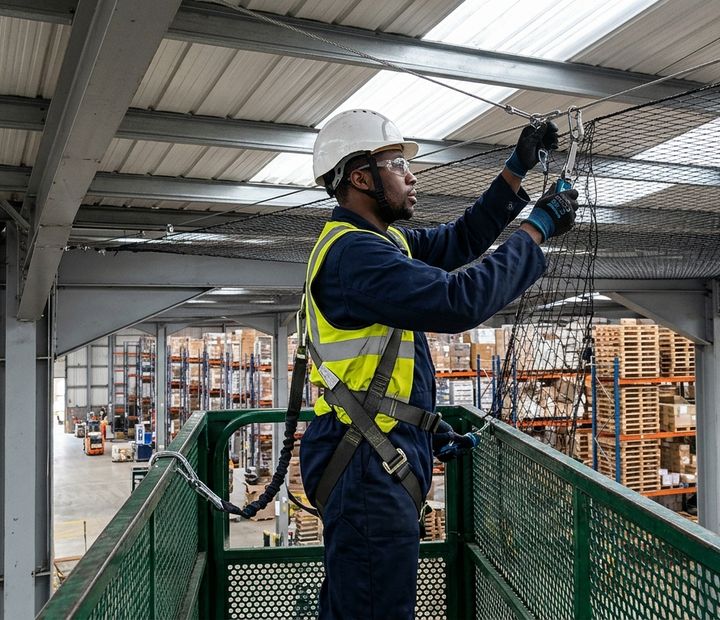
Northwest Environmental surveys and fits bird proofing for homes and businesses across Cheshire, Merseyside, Lancashire and Greater Manchester, working out from Warrington. We check the species and any active nests, then fit netting, spikes, wire, gel or solar panel mesh within wildlife law, usually in one installation visit. Call or use the contact form to book a survey.
How can you tell birds have moved in rather than passing through?
Birds that drop in to feed leave little behind. Birds that roost or nest leave a pattern. At home it tends to be droppings building up on a conservatory roof beneath one spot, twigs poking out from under solar panels, cooing above a bedroom ceiling at dawn, or a gutter overflowing because nest debris has choked the outlet. On commercial premises it is fouling across a loading bay or walkway, birds lined along a parapet as the light fades, and staff or drivers being swooped at near a flat roof in late spring.
Some signs matter more than others:
- the same birds on the same ledge at dusk, night after night, which tells you the building is a roost;
- nest material, eggshell or young birds in gutters, under panels, inside plant enclosures or behind signage;
- gulls calling and diving from one roof through late spring and summer, which usually means eggs or chicks nearby;
- feathers and droppings inside a loft, warehouse or store, which means there is a way in;
- mites or small beetles around a window or loft hatch, often moving out of an old nest.
A few pigeons pecking at a car park is a housekeeping issue. A flock that sleeps on your roof every night is a building issue.
Why do pigeons and gulls do so well across the North West?
Herring gulls and lesser black-backed gulls feed along the Mersey estuary and the coast, but they have also learned that a wide flat roof, out of reach of foxes and people, is as good a nesting ledge as a cliff, and that retail parks, takeaways and open bins make a reliable larder. The large distribution and manufacturing units along the motorway corridors around Warrington offer exactly that kind of roof, with plant and box gutters for shelter. Gulls defend their nests hard, which is usually when staff start to complain.
Feral pigeons follow older buildings and human food. Liverpool’s dockside warehouses and commercial streets, the former mills of the Lancashire and Greater Manchester towns, and the bridges and canal-side buildings along the Manchester Ship Canal, the Bridgewater and the Leeds and Liverpool canals all offer deep ledges, voids and arches. Historic town and city centres, Chester’s among them, add listed buildings where every fixing needs thought. In the suburbs and villages, the usual problems are pigeons nesting under rooftop solar panels, jackdaws filling chimneys and small birds getting into lofts through gaps at the eaves.
Feral pigeons can breed in any month, and a pair will keep raising young while the nest site is there. Removing birds seldom solves anything on its own: the building stays attractive and new birds move in.
How do we deal with a bird problem?
Every job starts with a survey on site rather than a quote from a photograph. The technician identifies the species, works out what the birds are doing in each area (feeding, resting, roosting or nesting), checks what any fixings would go into and decides how to reach the work safely, whether by ladder, tower scaffold or mobile elevating work platform. We look for active nests, because they set the timetable, and ask whether the building is listed or in a conservation area, because fixings into historic fabric may need consent from the council first.
You then receive a written specification with photographs; business premises also get a risk assessment and method statement for the facilities team or landlord to approve. Before anything is enclosed, we check that no birds are inside.
Choosing the system is most of the skill. Netting closes off a space and suits loading canopies, courtyards, light wells and roof plant. Spikes stop birds standing on ledges, signs and lamps. Post-and-wire is lower in profile and suits stone ledges and frontages where appearance matters. Low-profile gel, of a kind that cannot trap small birds, and low-voltage track suit features where nothing else fixes neatly. Tensioned wires across a flat roof stop gulls landing, chimney cages keep jackdaws out, and mesh guards close the gap under solar panels. Mesh is matched to the smallest bird you need to exclude: roughly 50 mm stops pigeons and around 75 mm gulls, but neither will keep out starlings or sparrows.
What does wildlife law allow?
In England, every wild bird, its eggs and any nest in use or being built are protected under the Wildlife and Countryside Act 1981. Proofing and deterring birds are lawful as long as no bird is injured, killed or trapped and no active nest is damaged or destroyed. Rarer species listed on Schedule 1 of the Act, such as peregrine falcons on some tall buildings, are also protected from disturbance while nesting. Anything beyond that needs a licence.
For feral pigeons, Natural England’s general licence GL41, reissued for 2026, lets the owner or occupier, or someone they authorise, act for specific public health and safety reasons, provided its conditions are met. Jackdaws are covered only where nesting causes a safety problem, and only after reasonable efforts with lawful alternatives such as proofing. Herring gulls and lesser black-backed gulls are not covered by it, so dealing with an active gull nest on a building needs an individual licence, which depends on showing a genuine risk to health or safety. For most sites the practical answer is to proof between one breeding season and the next.
Is bird proofing safe for families, staff, pets and livestock?
Proofing is physical exclusion with no poison or bait, so once installed there is nothing toxic for a child, a dog, a site cat or farm stock to find. On barns, stables and livestock sheds, netting is tensioned so it cannot sag within reach of animals or trap birds.
The hazards sit with the work itself. Dried droppings can carry organisms linked to illnesses such as psittacosis and cryptococcosis, so we damp fouling down rather than dry-sweeping it, remove it wearing respiratory protection, bag it and disinfect the surface. Work at height is planned under the Work at Height Regulations 2005, with an exclusion zone below and timing agreed around residents, shoppers or forklift traffic. If you find dead wild birds, particularly gulls or waterfowl, do not pick them up; check Defra’s current bird flu guidance on which finds to report.
How many visits does bird proofing take?
A typical job is one survey and one installation visit, and pigeons under a house’s solar panels are often dealt with in a day. Large roofs, phased work around tenants, heavy fouling or an active nest take longer. Netting and wires should then be inspected periodically and after storms, because one torn panel lets a pigeon in and can trap it.
How do you keep birds away once the proofing is in?
Proofing removes the places to roost and nest, but food keeps birds hanging around. Keep bins lidded and bin stores closed, clear food waste from yards promptly, and ask staff, tenants and neighbours not to feed gulls or pigeons. On retail parks, litter-picking around seating and drive-through lanes removes much of what draws gulls in. Clear gutters each autumn, report damaged netting early, and book gull proofing for winter so it is finished before birds return. The same waste that feeds gulls feeds rats, so on many sites bird work sits alongside our rat and mouse control.
When does DIY stop being enough?
A strip of spikes on a low ledge is a fair DIY job. It stops being enough once the work is above first-floor height, once birds are actually nesting, when panels or a listed frontage are involved, or when a business needs records an inspector will accept. Fake owls, reflective tape and spinners lose their effect quickly, cheap garden netting sags and traps birds, and sticky pastes can trap small birds by the feet. Using bird-lime or anything like it to take a wild bird is an offence under the 1981 Act.
What should businesses and landlords keep on record?
Food businesses must have adequate pest control procedures under food hygiene law, enforced in England through the Food Safety Act 1990 and the Food Safety and Hygiene (England) Regulations 2013, and an inspector is likely to treat birds in a loading bay or store as a pest problem. File the survey, specification, photographs and inspection reports with your HACCP records or Safer Food Better Business pack. Premises registered for Natural England’s CL03 licence must also keep its records and send an annual return, and anyone taking action under GL41 is advised to keep records for at least three years.
For landlords and managing agents, the roof gaps that let birds in, and gutters blocked by nests, can become repair issues under section 11 of the Landlord and Tenant Act 1985, and pests can be assessed under the Housing Health and Safety Rating System, so keep dated reports of what was found and fixed.
How we deal with it
- 1
Site survey
We identify the species, what the birds are doing in each area, where any active nests are, what the fixings would go into and how the work can be reached safely.
- 2
Written specification
You receive photographs and a plan for each area: the system, mesh size, access method and timing, plus a risk assessment and method statement for business premises.
- 3
Timing around nests
Any area with an active nest waits until the young have left; the rest can go ahead. For gulls we aim to finish the roof before the next breeding season starts.
- 4
Clearance and installation
Empty nests and fouling are damped down, bagged and the surface disinfected. We check no birds are inside, then fit the netting, spikes, wire, gel or panel mesh.
- 5
Handover and upkeep
You get a record of what was fitted and where, including the access points in any netting, and we can return to inspect fixings periodically and after storms.
Typical visits: Usually one survey visit and one installation visit; a house with pigeons under solar panels is often finished in a day. Large roofs, phased work, heavy fouling or an active nest add visits, followed by periodic checks of netting and wires.
Safety: Proofing keeps birds out without harming them and uses no poison or bait, so there is nothing toxic for children, pets or livestock to find. Fouling is damped down and bagged by operatives wearing respiratory protection, work at height is planned with an exclusion zone below, and we check for live birds and active nests before closing off any space.
Bird Control & Proofing: frequently asked questions
Can you remove gulls nesting on our warehouse roof?
Not while the nest is in use, unless Natural England has issued a licence. Herring gulls and lesser black-backed gulls are not covered by the general licence for public health and safety, so taking a nest that is being built or holds eggs or chicks needs an individual licence. These are normally granted only where there is evidence of a real risk to people's health or safety, not for noise, mess or damage to a building. Once the young have fledged and the nest is empty, it can be cleared. The lasting answer is to proof the roof over autumn and winter so gulls find nowhere to nest next spring.
When is the best time of year to gull-proof a roof?
Between breeding seasons: broadly from late summer, once chicks have fledged, through to early spring. Gulls pair up and start building on roofs in spring, and from then until the young leave an active nest limits what can be done near it. Booking a survey in autumn leaves time to plan access, agree a method statement with your facilities team or landlord and fit the system before the birds come back. If gulls are already nesting, we can still survey, proof the parts of the roof well away from the nest and return for the rest once it is empty.
Is it legal to get rid of pigeons, and can I shoot them in my garden?
Keeping pigeons off a building with proofing is lawful as long as no bird is harmed or trapped and no active nest is destroyed. Killing feral pigeons or taking their nests needs a licence. Around homes and other buildings the relevant one is usually Natural England's general licence GL41, which the owner or occupier, or someone they authorise, may use only for its listed purposes: preventing slips and falls, the spread of disease to people and safety problems caused by nesting. Pigeons eating bird seed or sitting on a fence do not fit those purposes, and firearms law and safety apply too. In a built-up street, proofing the roof and removing the food source is the realistic route.
How do you stop pigeons nesting under solar panels?
Pigeons like the dry, sheltered gap between the panels and the roof tiles, and their nests and droppings soon block gutters and stain the glass. Once any nest is empty, we clear the debris from under the array and fit a mesh guard around its edges, held by clips onto the panel frame so nothing is drilled through the panels or the roof covering. It is worth checking your installer's warranty terms first if you are unsure. If eggs or young are present, that part of the array waits until they have gone.
Jackdaws are nesting in our chimney. What can we do?
Jackdaws drop sticks into a chimney until enough wedge to build on, and the finished nest can block the flue and stop smoke and fumes escaping. If the chimney serves a fire or stove, do not use it until a sweep has confirmed the flue is clear. An active jackdaw nest is protected; GL41 covers jackdaws only where nesting causes a safety problem, and only after reasonable efforts with lawful alternatives such as proofing, unless those would be impractical or ineffective. In most homes the practical answer is to wait until the young have fledged, have the chimney swept and then fit a cage or cowl so the birds cannot return.
Do fake owls, reflective tape or oil sprays keep birds away?
Rarely for long. Pigeons and gulls soon learn that a plastic owl never moves, and tape, discs and spinners lose their effect within weeks. Oil and grease sprays wash off, mark stone and brick, and anything that coats a ledge can foul feathers. These products tend to move birds a short distance along the same roof rather than away from it. What works is physical: removing the ledge or gap the birds use, or making it impossible to land on, with netting, spikes, wire or gel chosen for that spot.
A bird has got inside our warehouse or food store. What should we do?
Open a door to the outside, keep people back and avoid chasing the bird further into the building. If it stays put, call us. Natural England's class licence CL03 lets food premises catch certain species trapped inside, such as house sparrows, starlings and blackbirds, to protect public health or safety, and release them alive and unharmed outdoors. You must register with Natural England before using it, keep proofing maintained, keep records and send an annual return. Feral pigeons are not on that list and are dealt with differently. Either way, the bird got in somewhere, so we find and proof the entry point.
Will netting or spikes spoil the look of our building?
They should not, if the system is chosen with the building in mind. Netting comes in colours that blend with brick, stone or render and disappears into a shaded canopy or light well. Post-and-wire sits low on a ledge and is barely visible from the street. On older or listed buildings we fix into mortar joints rather than stone where we can, keep fixings to a minimum and check whether listed building consent is needed before any work starts. The specification shows you what will be visible before you agree to it.
Who pays for bird proofing on a rented home or a block of flats?
It depends on the tenancy, the lease and the cause. Under section 11 of the Landlord and Tenant Act 1985, landlords of most homes let on short leases must keep the structure and exterior in repair, so repairing a broken soffit, an open roof gap or gutters blocked by nests can fall to them. Pests can also be assessed under the Housing Health and Safety Rating System, and the Homes (Fitness for Human Habitation) Act 2018 gives tenants a route to act if a home is unfit. In managed blocks, the lease usually decides whether proofing is a service charge item. Keep written reports either way.
Bird Control & Proofing by county and town
Last updated: