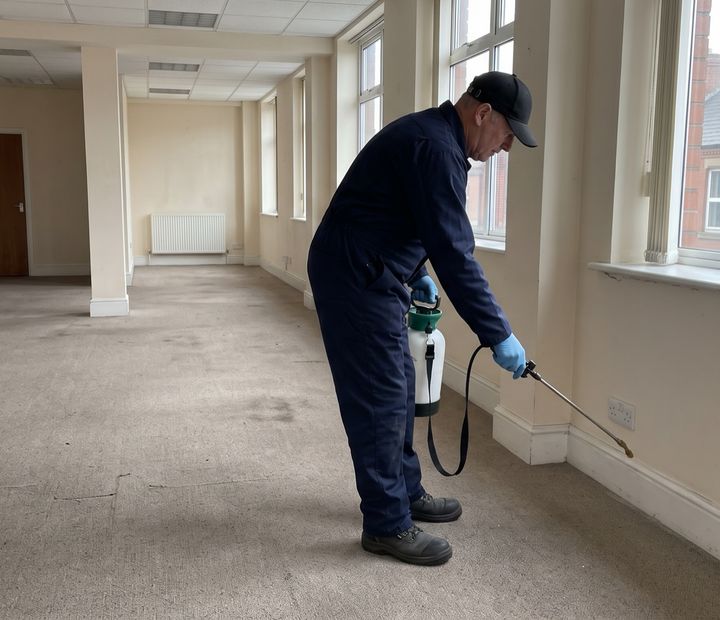
Northwest Environmental treats flea infestations in homes, rented properties and holiday lets across Cheshire, Merseyside, Lancashire and Greater Manchester, working out from Warrington. We send preparation notes when you book, treat floors and soft furnishings in one visit, and return after two to three weeks if fleas are still hatching. Call or use the enquiry form to book.
How can you tell whether it is fleas?
Most people notice the bites before they see a flea. Flea bites are small, red and very itchy, often in clusters, and usually around the ankles and lower legs, about as high as a flea jumping from the floor can reach. Other signs:
- a cat or dog scratching, nibbling at the base of its tail or thinning along its back;
- tiny dark specks in pet bedding or the coat that turn reddish-brown when pressed onto damp white kitchen roll, which is flea dirt made of digested blood;
- small, dark brown insects around 2 mm long that jump rather than crawl, easiest to spot against white socks or a pale floor;
- bites that start soon after moving into a property, or after coming home from a holiday, even though nobody in the house owns a pet.
Bites in rows on the arms, shoulders and neck point more towards bed bugs. If you are not sure, catch an insect on clear sticky tape or photograph the specks, and we can usually tell you over the phone.
Why do fleas turn up in homes and lets across the region?
Most household infestations in Britain are the cat flea, which lives happily on dogs as well as cats. Dog fleas and the human flea are far less common, and the hedgehog flea stays on hedgehogs, so a hedgehog crossing the garden is rarely the cause. Pets usually pick them up outdoors, where neighbourhood cats and foxes have been, and carry them inside.
The adults on the animal are only a small part of the picture. Eggs laid on the pet drop off wherever it sleeps, and the larvae move deep into carpet pile, between floorboards and under cushions, feeding on flea dirt. They then spin cocoons, and the pupae inside can wait for weeks or even months until warmth, vibration or the carbon dioxide in someone’s breath signals a host.
That waiting stage matters most in homes that have just changed hands or tenants, from terraced streets in Wigan and the old mill towns to Warrington’s new-town estates and student lets in Liverpool. When a tenant moves out with a cat and the property stands empty for a few weeks, the pupae wait in the carpets for the next occupants. Dog-friendly holiday cottages, guest houses and serviced flats see the same pattern between bookings.
Season plays its part. Flea numbers build through late summer, and many households first notice them in autumn, when the heating goes on and warm rooms speed up the life cycle. In older houses and on rural edges, birds nesting in the eaves or roof space are another source: when the young birds leave the nest, the bird fleas left behind look for a new host and sometimes find their way down through a loft hatch or a gap around a ceiling light.
How does a flea treatment work?
A few questions on the phone about pets, bites and recent moves usually point to the source. When you book, we send preparation notes, because a flea treatment is only as good as the preparation behind it. The main points are to have every cat and dog in the house treated with a product your vet recommends, ideally shortly before the visit; to vacuum every floor thoroughly, including under beds and sofas, and empty the vacuum outside; to wash pet bedding, throws and cushion covers on a hot cycle; and to clear the floors so the carpets can be reached.
On the day we confirm what we are dealing with, then apply a residual insecticide combined with an insect growth regulator to carpets, rugs, soft furnishings, pet sleeping areas and the gaps along skirtings and floorboards. The insecticide kills adult fleas and the larvae it reaches, and the growth regulator stops surviving eggs and larvae developing into breeding adults. Where an old bird nest is behind it, we check the roof space too.
Before we leave you get written aftercare notes on re-entry, vacuuming and what to expect over the following weeks.
Is flea treatment safe for children, pets and other animals?
It is when the household follows the timings. People and pets keep out of the treated rooms until every surface has dried, which usually takes a few hours; the exact time depends on the product, the floor coverings and the ventilation, so we confirm it on the day. Babies and crawling children should stay off treated floors until then.
Fish are very sensitive to these insecticides, so cover tanks and switch off the pumps, and move caged birds, reptiles and small pets out of the rooms being treated. One rule matters above the rest: never use a dog flea product on a cat. Some dog treatments contain permethrin, which is highly toxic to cats. We treat the property; the animals themselves are a matter for your vet.
How many visits will it take?
Most homes need one treatment. Because pupae are protected by their cocoons, adult fleas keep emerging for around two to three weeks afterwards and die once they land on the treated surfaces, so seeing a few during that time is normal. If you are still being bitten after three weeks, or the infestation was heavy to begin with, a second treatment is arranged.
How do you stop fleas coming back?
Most repeat infestations arrive on the pet. Keep each cat and dog on the flea control your vet recommends for that animal, rather than stopping the moment the bites do. Vets increasingly take a risk-based view of each animal, and the policy the British Veterinary Association updated with other veterinary bodies in 2025 advises avoiding spot-on products, where reasonable, for pets likely to swim or be bathed. Fipronil and imidacloprid, used in many spot-ons, have been detected in English rivers. If your dog’s walk along the Bridgewater Canal, the Leeds and Liverpool Canal or the Mersey usually ends with a swim, ask your vet about a tablet or another option.
Around the house, wash pet bedding often, vacuum regularly where pets sleep, and clean out the car or van if the dog travels in it. Where birds nest in the roof, have old nests removed once they are no longer in use and the entry points proofed before the next breeding season begins.
When does DIY flea treatment stop being enough?
A single pet with a few fleas, caught early, can often be sorted with a vet product, a hot wash and regular vacuuming. Shop-bought foggers are less dependable: they settle on the tops of surfaces and miss larvae under furniture and deep in carpet pile, and many people stop after a week, just before the next batch hatches.
It is time to call someone when bites continue for more than a couple of weeks despite treating the pets, when you are being bitten in a house with no animals, when the problem started the day you moved in, when a rental or holiday let has to be clear before the next occupant, or when someone in the house reacts badly to bites.
Who is responsible, and what should landlords and businesses record?
In a rented home, it depends on where the fleas came from. If the infestation was there when the tenancy started, for example from a previous tenant’s pet, it is generally for the landlord to deal with: a rented home must be fit to live in under the Homes (Fitness for Human Habitation) Act 2018, and councils can assess pests as a hazard under the Housing Health and Safety Rating System. If a tenant’s own pet brought fleas in during the tenancy, treatment usually falls to the tenant. Section 11 of the Landlord and Tenant Act 1985 covers repairs to the structure and exterior, so it rarely applies to fleas directly, although a defect behind them, such as a slipped tile letting birds nest in the roof, may be the landlord’s to repair.
Since 1 May 2026 the Renters’ Rights Act 2025 has given private tenants in England the right to ask to keep a pet, and landlords must not unreasonably refuse. The Tenant Fees Act 2019 stops a landlord requiring a professional clean at the end of a tenancy, and generally a professional flea treatment too, but a deposit claim may succeed where check-in and check-out evidence shows the tenant’s pet caused an infestation. Dated inventories and a written treatment report make that far easier to settle.
Holiday lets, hotels and care homes should record each treatment, the rooms covered and any follow-up, alongside the complaint that prompted it. Food businesses must have adequate procedures to control pests under food hygiene law, so any flea treatment in a café, pub kitchen or shop belongs with the pest-control records an environmental health officer may ask to see.
How we deal with it
- 1
Phone assessment
We ask which animals live in the house, where the bites are happening and whether you have just moved in or come back from time away, so we know whether the source is a pet, the property or birds in the roof.
- 2
Preparation notes
Before the visit you receive a short checklist: treat every cat and dog with a product your vet recommends, vacuum all floors and furniture, hot-wash pet bedding and throws, and clear the floors.
- 3
Inspection
We confirm the fleas and find where the larvae are concentrated, usually where pets sleep, under furniture and along skirtings, and check the loft hatch and roof space if bird fleas are suspected.
- 4
Treatment
Carpets, rugs, soft furnishings, pet resting areas and gaps in floorboards are treated with a residual insecticide combined with an insect growth regulator that stops surviving larvae becoming breeding adults.
- 5
Aftercare and follow-up
You get written notes on re-entry times, when to vacuum and what to expect over the next three weeks, a follow-up treatment if fleas keep appearing, and a record you can share with a landlord or agent.
Typical visits: Most homes need one treatment, with a second about two to three weeks later if fleas are still hatching from pupae. Heavy infestations, large or multi-pet households and fleas from a bird nest in the roof can add a visit.
Safety: Everyone, pets included, stays out of treated rooms until surfaces are fully dry, usually a few hours; we confirm the time on the day. Cover fish tanks and switch off their pumps, move caged birds, reptiles and small pets out first, and never put a dog flea product on a cat.
Flea Control: frequently asked questions
Why am I still seeing fleas after the treatment?
Because the pupae were never exposed to it. Flea pupae sit inside sticky cocoons that insecticide does not get through, and they keep hatching for around two to three weeks after a treatment. Each new adult that lands on a treated carpet or sofa picks up the insecticide and dies, usually before it can lay eggs. Seeing a few fleas in that period, often near the floor, is normal and a sign the treatment is working. If numbers are not falling after three weeks, or you are still being bitten regularly, call us and we will arrange a follow-up.
How long do we need to stay out of the house after a flea treatment?
Only out of the treated rooms, and only until surfaces are fully dry, which is usually a few hours. We confirm the time on the day, because it depends on the product, the type of carpet and how well the rooms can be ventilated. Pets stay out for the same period, and babies and crawling children should keep off treated floors until they are dry. Many families book the visit around school or work and come back in the late afternoon. Open the windows when you return to air the rooms.
Should I vacuum before and after a flea treatment?
Before, thoroughly: every floor, under beds and sofas, along skirting boards and over upholstery, then empty the vacuum or bin the bag outside. That lifts eggs and larvae and lets the treatment reach the base of the carpet. Afterwards, the right interval depends on the product: many work best if treated carpets are left unvacuumed for a week or more, so the residual layer stays where the fleas will hatch, and your aftercare notes give the exact timing. After that, vacuum often, because the vibration encourages any remaining pupae to hatch onto treated surfaces rather than waiting.
We have just moved into a rented house with no pets, so why are we being bitten?
Almost certainly because a previous occupant had a cat or dog. Flea pupae can lie dormant in carpets for weeks or even months while a property is empty, then hatch together when footsteps and body heat tell them someone has arrived. With no pet to feed on, hungry fleas bite people, mostly around the ankles. Tell your landlord or letting agent in writing straight away: an infestation that was there when the tenancy started is generally the landlord's to deal with, because a rented home has to be fit to live in from the first day. We can put our findings in writing for both of you.
Who pays for flea treatment in a rented home, the landlord or the tenant?
It depends on where the fleas came from. If they were there before the tenancy began, the landlord would normally pay. If a tenant's own pet brought them in, the cost usually falls to the tenant. The Tenant Fees Act 2019 generally stops a landlord insisting on a professional de-flea service at the end of a tenancy, but a landlord may be able to claim from the deposit if dated check-in and check-out evidence shows the tenant's pet caused an infestation. Now that the Renters' Rights Act 2025 lets tenants ask to keep a pet, a clear pet clause, dated inventories and a treatment report help avoid disputes.
Can fleas come from birds nesting in the roof?
Yes. Pigeons, starlings and sparrows nesting in lofts, eaves and gaps under roof tiles often carry bird fleas. When the young leave the nest, the fleas left behind go looking for a new host and can work their way into the rooms below, which is why people are sometimes bitten in late spring and summer in a house with no pets. Under the Wildlife and Countryside Act 1981 it is generally an offence to damage or remove a wild bird's nest while it is in use or being built, so we treat the fleas, remove the nest once the birds have gone and can proof the gap before the next breeding season.
Are flea drops from the vet enough on their own?
They are essential, but not usually enough once fleas are established. A pet treatment kills the adult fleas on the animal, while most of an infestation is in the home as eggs, larvae and pupae that keep producing new adults for weeks. Treat every cat and dog in the house, not just the one scratching, using the product and schedule your vet recommends. If your dog swims in a canal, the Mersey or a Cheshire mere, mention it: veterinary bodies now advise avoiding spot-on products, where reasonable, for pets likely to swim or be bathed, because the chemicals can wash off into rivers and ponds.
Can fleas live on people or spread disease?
Cat fleas bite people but do not breed on us; they rely on a cat or dog to keep their life cycle going, so they do not set up home on a person. For most people the bites are an itchy nuisance and flea-borne illness is rare in Britain, though some react strongly and scratching can lead to infection, so speak to a pharmacist or GP if bites become swollen or sore. The greater health risk is to pets: fleas can pass on tapeworm, cause allergic skin disease and, in heavy infestations, leave young kittens and puppies anaemic. That is why the animals and the home need treating together.
Do you treat holiday lets, hotels and care homes?
Yes. Dog-friendly holiday cottages, guest houses, hotels and care homes all get fleas from time to time, usually from a visiting pet or a resident's animal. The priority is clearing the affected rooms between bookings or around residents' routines, so we plan the visit with whoever manages the property, treat only the rooms that need it and give clear re-entry times. You receive a written record of what was treated and when, which is worth keeping alongside guest or resident complaints and any follow-up visits.
Flea Control by county and town
Last updated: