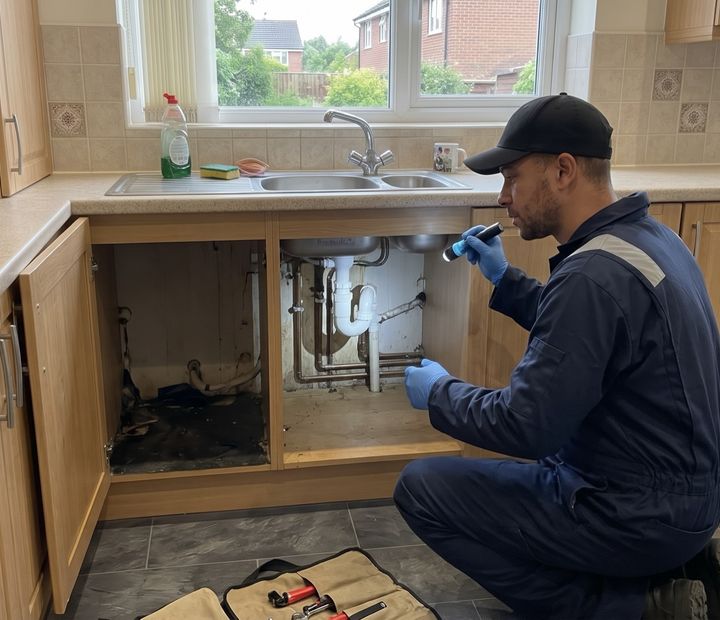
Northwest Environmental deals with rats, mice, wasps, insects and squirrels in homes across Cheshire, Merseyside, Lancashire and Greater Manchester, working out from Warrington. We assess the problem on the phone, prioritise the most urgent cases, then inspect, treat, proof entry points and return to confirm it has gone. Call or use the enquiry form to book.
What are the signs of pests in your home?
Most people hear or find something before they see the animal. Signs worth acting on:
- Rats: dark droppings around a centimetre long, scratching under the floor or in the loft at night, greasy smear marks along skirting boards and burrows beside sheds, decking or compost bins.
- Mice: spindle-shaped droppings a few millimetres long in kitchen cupboards and behind the cooker or fridge, nibbled packaging and a stale, musty smell.
- Wasps: a steady line of insects going in and out of one gap under the eaves, an airbrick or a hole in the lawn, usually from midsummer.
- Fleas and bed bugs: bites around the ankles (fleas) or in rows on the arms and shoulders (bed bugs), pets scratching more than usual, and tiny dark spots along mattress seams.
- Squirrels: thudding and scratching in the loft in the early morning rather than at night, chewed fascia boards and insulation dragged into heaps.
- Moths and carpet beetles: irregular holes in woollens and bare patches at the edges of carpets under furniture.
One mouse in a garage in October is not the same as droppings in a kitchen drawer. If you are not sure what you have, a photograph of the droppings or damage is often enough for us to tell you whether it needs a visit.
Why do homes across the North West get pests?
Housing and landscape vary widely across the region, and so do the problems.
Much of Greater Manchester’s older housing is terraced, built for workers in mill towns such as Wigan, and terraced streets still cover large parts of north and east Liverpool. In a terraced row the roof voids and under-floor spaces are often linked, so mice can move along the row and return to a house treated on its own. Older streets often have clay drains, and a cracked or disused pipe behind a yard is a common route for rats into a kitchen or bathroom.
Water shapes the picture too. The Mersey, the Manchester Ship Canal and the Bridgewater Canal all pass through Warrington, and the Leeds and Liverpool Canal runs through Wigan and into Liverpool. Towpaths, overgrown banks and canal-side gardens with decking and sheds give rats cover and water within a short run of houses.
The new-town estates of Warrington and Runcorn have their own weak points: gaps where pipes and cables enter, boxed-in pipework and cavity walls that let mice move unseen between rooms. Out on the rural edges of Cheshire and Lancashire, and beside the mossland around Risley Moss and Chat Moss, rats and mice often move from fields into houses and outbuildings once crops are cut and the weather turns. Where mature trees stand close to rooflines, as in many leafier Cheshire suburbs, grey squirrels find their way into lofts more often.
Season matters as much as place. Rodent activity indoors tends to rise through autumn as temperatures drop, wasp nests are at their largest in late summer, and fleas often show up when the heating goes on and dormant pupae hatch. Bed bugs follow people rather than the seasons: they travel in luggage and second-hand furniture and have nothing to do with how clean a home is.
How does a domestic pest control visit work?
It starts with a conversation. We ask what you have seen and where, who lives in the house and whether there are pets, so the visit is planned before we arrive and the most pressing cases go first.
At the inspection we confirm the pest and, just as important, find out why it is there: the gap by the waste pipe, the broken airbrick, the open drain, the branch touching the roof. We then explain what we propose and agree it with you before anything is put down.
Treatment is chosen for the pest and the household. For rodents that may mean enclosed traps, bait in locked stations, or both. Professional rodenticides are sold only to users who can show proof of competence, under the UK stewardship regime run by CRRU UK, which expects them to survey before baiting, use bait only where it is justified and remove it when the job ends, so we do not leave poison down as routine. Wasp nests are treated with an insecticide dust at the entrance, and activity usually stops within a day or two. Flea, bed bug and cockroach treatments come with written notes on preparation and aftercare.
Where we can, we proof the entry point on the same visit. Where the repair is a job for a builder, a drainage contractor or your landlord, we write down exactly what needs doing and why.
Is treatment safe for children, pets and livestock?
It is when it is planned around who and what lives at the property. Bait stations are locked, fixed in place where possible and positioned where children and animals cannot reach them, and every station is recorded so nothing is left behind. In homes with toddlers, cats or dogs we often rely on traps inside the house and keep any bait outside, in stations, against the walls.
For insect treatments we tell you which rooms to keep people and pets out of, and for how long. On smallholdings and farms we look at where hens, horses and other stock feed and shelter before deciding on a method, because spilled feed that draws rats also brings animals close to anything we put down. We do not use glue traps, which are now unlawful for rodents in England except under a licence that is rarely granted.
How many visits will it take?
A wasp nest is normally dealt with in one visit. Rats and mice usually take two or three, roughly a week apart, so we can see activity fall before removing the equipment. Fleas need one or two treatments, bed bugs usually two, and cockroaches or squirrels more, over a longer period.
How do you stop pests coming back?
Treatment clears the pests you have; proofing keeps the next ones out. Typical work includes steel mesh behind damaged airbricks, sealing gaps around pipes and cables, brush strips on doors and garage doors, and repairs to fascias and soffits where squirrels or wasps have found a way in. Before sealing eaves we check for bats, which are protected by law along with their roosts, and for active bird nests, which must not be damaged while in use.
Drains that serve only your home and sit within your boundary are generally your responsibility, while shared sewers and drains beyond the boundary generally belong to the water company, which is United Utilities across most of the North West. A drainage survey, followed by a repair or a one-way rat valve, often ends a problem that treatment alone keeps returning to.
At home, keep bins lidded, store bird food in sealed tins, use feeders with seed-catching trays, and keep the space under decking and sheds clear. Treat pets for fleas all year round, not just when bites start.
When does DIY stop being enough?
Traps for a single mouse in a garage, or a strip of brush on a door, are reasonable things to try yourself. It is time to call someone when droppings or noises carry on after a couple of weeks, when you hear activity inside walls or ceilings, when a wasp nest is in a roof space, a cavity or near a door the family uses, or when the problem is bed bugs or cockroaches, which shop-bought sprays and foggers tend to scatter rather than kill. It is also worth calling earlier if anyone in the house is very young, elderly, pregnant or unwell.
Avoid blocking a hole while animals are still behind it: trapped rodents gnaw a new way out or die in the void. And do not handle droppings or nests without gloves.
Who is responsible, and what should you keep on file?
Under the Prevention of Damage by Pests Act 1949, councils can require an owner or occupier to deal with rats or mice on their land, which matters where a neighbouring garden or empty property is the source. In rented homes, responsibility depends on the cause and the tenancy: disrepair that lets pests in usually falls to the landlord, while an infestation caused by how the home is kept may fall to the tenant. Where the two sides disagree, a dated report from an independent visit helps settle it.
Keep the written report from every job. It is useful if the problem returns, if you rent the property out, or if you sell. If you prepare food for sale from home or run a holiday let, file the reports with your food safety or property records: food law expects any food business, including one run from a home kitchen, to keep pests out and to show how it does so.
How we deal with it
- 1
Phone triage
We ask what you have seen, where and for how long, so that wasps by a doorway, rats inside the house or a home with a newborn or someone unwell can be prioritised.
- 2
Inspection
We confirm the pest, find how it is getting in or where it is breeding, and check the loft, drains, outbuildings and garden where they are part of the picture.
- 3
Plan and preparation
You are told what we propose, where any traps, stations or treatments will go, how long to keep children and pets away, and what to do before the next visit.
- 4
Treatment
Enclosed traps, secured bait stations, insecticide or a combination, chosen for the pest and the household and used to the product label and current stewardship rules.
- 5
Proofing
Gaps around pipes, airbricks, doors, eaves and drains are sealed or screened, or written up for your landlord or builder where the repair is a bigger job.
- 6
Follow-up and sign-off
We return to check activity, remove equipment once it has stopped and leave a short written record of what was found, what was done and what we recommend.
Typical visits: A wasp nest usually needs one visit. Rats and mice typically take two or three visits over two to three weeks, fleas one or two treatments, bed bugs usually two treatments two to three weeks apart, and cockroaches or squirrels several visits over a longer period.
Safety: Rodent bait is never laid loose: it goes in locked, tamper-resistant stations or secured points out of reach of children, pets and livestock, and indoors we often use enclosed traps instead. After an insecticide treatment we tell you how long to keep people and animals off treated areas. We never use glue traps.
Domestic Pest Control: frequently asked questions
Should I call the council or a private pest controller?
It depends on where you live and what the pest is. Check your council's website for current pest control services and charges. Some run an in-house service for homes, while others treat only a short list of pests or point residents to private firms. Check your council's pest control page first for what it covers and how long you may wait. If it does not cover your problem, or you want proofing and follow-up visits included in the job, we can help.
What affects the cost of domestic pest control?
We do not publish set prices because jobs vary so much. The main factors are the pest, how established it is, the size and layout of the property, how many visits the treatment needs, how easy the access is (a nest at roof height or a loft with no boards takes longer), and whether proofing is needed to stop the problem returning. We explain the cost before any work starts, and if your council offers a service for your pest, its published charges are worth comparing.
Is treatment safe with children, pets or a baby in the house?
Yes, when it is planned around the household, which is why we ask who lives there before we arrive. Rodent bait goes only in locked stations or secured points where children and animals cannot reach it, and in many homes with young children or pets we use enclosed snap traps indoors instead. For fleas, bed bugs and other insects we tell you how long to stay out of treated rooms and when floors can be cleaned. Cover fish tanks, switch off their pumps and move small caged pets to another room.
Will rats leave on their own if I wait?
Rarely. Rats stay where they have food, water and shelter, and a loft, cavity wall or the space under a floor gives them all three for as long as they can get in. Waiting usually means more droppings, gnawed cables and pipe lagging, soiled insulation and, before long, a breeding group rather than a few animals. If you hear scratching at night or find droppings, it is worth having the entry point found while the problem is still small.
Can I put rat poison down in my own garden?
You can buy amateur rodenticides, but the label conditions are legally binding and typically allow use only in and around buildings, inside a bait station, never scattered on open ground. Poison that pets, birds or other wildlife can reach causes harm well beyond the rats, and a rat that dies under a floor leaves a smell that can last for weeks. Using glue traps on rodents is now an offence in England unless a professional holds a Natural England licence. If rats keep returning, the cause is usually a drain fault or a gap that poison will not fix.
Is it a wasp nest or a bee nest, and will you treat bees?
Wasps are bright yellow and black with a narrow waist and little hair; most bees are hairier and browner, and a honeybee swarm hangs in a tight cluster. We treat wasp and European hornet nests, but we do not destroy bee colonies that can be left alone or moved. A honeybee swarm can often be collected by a local beekeeper, and bumblebee nests in bird boxes or compost heaps usually die out naturally by late summer or early autumn. If you think you have seen an Asian hornet, keep away from the nest and report it through the Asian Hornet Watch app; confirmed nests are dealt with by the National Bee Unit.
Who is responsible for pests in a rented home, the landlord or the tenant?
It depends on the cause and the tenancy. Landlords must keep the structure and exterior in repair under section 11 of the Landlord and Tenant Act 1985, so mice getting in through a broken airbrick or rats from a damaged drain usually point to the landlord. A rented home must also be fit to live in under the Homes (Fitness for Human Habitation) Act 2018, and councils can assess pests as a hazard under the Housing Health and Safety Rating System. Where an infestation follows from how the home is kept, such as fleas from a tenant's pet, it may fall to the tenant. We put our findings in writing for both.
Do you cover farms, holiday lets and businesses run from home?
Yes. Many domestic jobs in the region sit alongside a working property: a farmhouse with rats coming in from the yard after harvest, a holiday cottage that needs turning round quickly after a guest finds bites, or a kitchen registered with the council for home baking. A food business run from home is still a food business, so its food safety records should show how pests are kept out and where the reports are kept. For larger premises we offer commercial pest control with scheduled visits and a site record.
Do I need to be at home for the visit?
For the first visit, yes, or someone who can show us where activity has been seen and let us into the loft, garage and garden. Follow-up visits to check rodent stations outside can sometimes go ahead without you if they are easy to reach and you have agreed it beforehand. Before an insect treatment we give you preparation notes, such as clearing floors, bagging bedding or moving pets, because a treatment in a cluttered room works far less well. Tenants should tell their landlord or agent when a visit is booked.
Domestic Pest Control by county and town
Last updated: