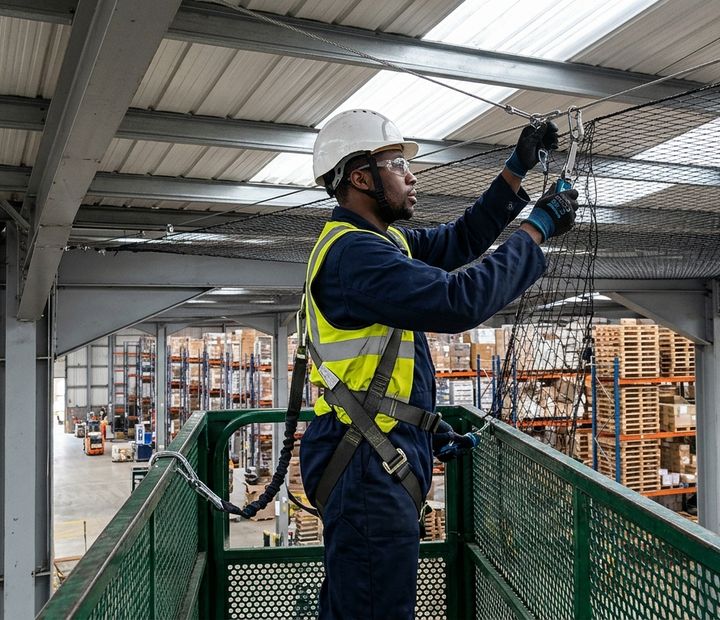
Northwest Environmental proofs Warrington buildings against pigeons and gulls, from Omega warehouses and retail park roofs to Bridge Street shops and suburban homes. A survey identifies the birds and any active nests before mesh, netting, spikes or wire are fitted lawfully. Ring our Warrington team or send the enquiry form to arrange a survey.
Why do pigeons and gulls settle on Warrington buildings?
Water and roofs explain most of it. The town stands on the Mersey, the Ship Canal cuts across the southern part of the borough, the Bridgewater Canal passes Lymm on its way to Walton Hall and Gardens, and on the western side the Sankey Canal follows Sankey Valley Park. Bridges and waterside buildings on those routes give feral pigeons sheltered ledges with water close by. Gulls want something different: wide flat roofs, safe from people and foxes, with food not far away. Motorways enclose much of the town, warehousing has grown up beside them, and the units at Omega show the kind of roof gulls choose.
The town’s industrial history adds older buildings to the mix. Its economy grew on wire-making, steel, textiles, brewing, tanning and chemical works, and when heavy industry fell away through the 1970s and 1980s it left older industrial and commercial buildings with the deep ledges, roof voids and broken lights that pigeons use. Big sites are still being reworked: Fiddlers Ferry Power Station has been decommissioned, and Unilever’s Soapworks is being turned into a data centre. Wherever a large building stands empty during a change of use, pigeons can move in, so a bird survey before demolition or refit is worth building into the programme.
The borough also has protected wildlife sites, including Woolston Eyes beside the Ship Canal and Risley Moss east of Birchwood. They are a useful reminder that every wild bird is protected, which is why every job starts by identifying the species.
What do we see on Warrington homes?
Semis and detached houses together account for nearly 65% of the town’s homes. On those, the usual problems are pigeons nesting beneath solar arrays, jackdaws dropping sticks down chimneys, and starlings or sparrows slipping into eaves and soffits. Terraces, a little over a fifth of homes, more often have pigeons on rear extensions and window ledges. On the rural fringe, with 11,500 hectares of green belt recorded in 2017, the job may be a barn, stable or outbuilding instead, with netting fixed taut so horses and livestock cannot reach or tangle in it.
What about warehouses, business parks and retail?
Commercial roofs are where most gull work happens. Warehouses at Omega and elsewhere near the motorway junctions have large flat roofs, box gutters and plant enclosures. Birchwood Park covers 123 acres, and some 4,200 people work there, many for nuclear-sector companies; sites like that can have strict access and induction rules, and we work within your permit system. Gemini retail park, where IKEA opened its first UK store, Riverside Retail Park and the Golden Square shopping centre all draw crowds, and wherever people eat and drop food near a large roof, gulls take notice.
Gull work follows the breeding calendar. We survey from late summer, once chicks have left, and aim to finish installation over the winter, before pairs return in spring.
How do you protect the historic town centre?
Bridge Street, with its late Victorian terracotta shops, and Church Street both have conservation area appraisals, and the Town Hall, the former Bank Hall of 1750, is Grade I listed. On older buildings we favour low post-and-wire, colour-matched netting and fixings into joints, and check with the council whether consent is needed before anything goes up.
How does a Warrington bird job run?
A technician surveys the building, identifies the species and records any active nests. A written specification with photographs follows, and commercial sites receive a risk assessment and method statement (RAMS) with it. Areas with active nests wait until the young have gone; everything else can go ahead. Droppings and old nest material are wetted, bagged and cleared, and the surface cleaned with disinfectant, before the chosen system goes in. A handover note lists each system and its location, and from our Warrington base we can return to check fixings after storms.
How do you keep birds away afterwards?
Proofing removes places to perch and nest, and removing food stops birds hanging around. Keep food caddies and bin lids shut, ask staff not to feed birds at break areas, and pick up litter around car parks and outdoor seating. Clear gutters each autumn and report torn netting promptly, because a single gap can let a pigeon in and trap it.
Bird Control & Proofing in Warrington: what we see locally
- Omega, next to the M62, developed largely into a warehousing district, and broad flat roofs of that kind, out of reach of people and foxes, are exactly what gulls look for when they choose a nest site.
- The Mersey and three canals, the Ship Canal, the Bridgewater and the Sankey, all cross the borough, and the bridges and waterside buildings along them give feral pigeons sheltered ledges close to water.
- Bridge Street's late Victorian terracotta shopfronts are covered by a conservation area appraisal, so on those buildings we plan discreet systems fixed into joints and check first whether consent is needed.
- In 2017 green belt took in 11,500 hectares of the borough, and on that rural fringe proofing often means barns, stables and outbuildings rather than houses.
How we deal with it
- 1
Site survey
We identify the species, what the birds are doing in each area, where any active nests are, what the fixings would go into and how the work can be reached safely.
- 2
Written specification
You receive photographs and a plan for each area: the system, mesh size, access method and timing, plus a risk assessment and method statement for business premises.
- 3
Timing around nests
Any area with an active nest waits until the young have left; the rest can go ahead. For gulls we aim to finish the roof before the next breeding season starts.
- 4
Clearance and installation
Empty nests and fouling are damped down, bagged and the surface disinfected. We check no birds are inside, then fit the netting, spikes, wire, gel or panel mesh.
- 5
Handover and upkeep
You get a record of what was fitted and where, including the access points in any netting, and we can return to inspect fixings periodically and after storms.
Bird Control & Proofing in Warrington: frequently asked questions
Does Warrington Borough Council handle bird problems?
Many councils run a pest control service for residents, but what is covered, who can book and the charges all vary and can change, so check the council's own pest control pages before you book. If you rent, report the problem to your landlord first. If you would rather book a private firm, call or message us to arrange a visit.
Our shop is on Bridge Street. Can you proof a terracotta frontage without damaging it?
Usually, yes. Bridge Street's late Victorian terracotta shops are covered by a conservation area appraisal, so the starting point is a survey and a written specification you can pass to the council's planning team if consent might be needed. Glazed terracotta can chip or crack if drilled carelessly, so where possible we fix into mortar joints, use low post-and-wire on ledges and colour-matched netting in recesses, and keep anything visible from the street to a minimum. Work is timed around your trading hours.
We run a unit near the M62. Can you work around our shifts and yard traffic?
Yes, and on most warehouse jobs that planning is as important as the installation. We agree access routes, the position of any lift or tower and an exclusion zone below the work with your site team, then book installation days around deliveries, forklift movements and shift changes, using early mornings or weekends where that suits. A risk assessment and method statement reach you before we arrive. Because our base is in Warrington, a large roof can be split into phases over several visits without long travel days.
Who arranges gull proofing on a retail park, the tenant or the landlord?
That depends on the lease. On retail parks such as Gemini and Riverside, the roof, gutters and shared areas are often maintained by the landlord or managing agent and recovered through the service charge, while a tenant may be responsible for its own canopy, signage or plant. Check the repairing and alterations clauses before booking, as fixing anything to the roof may need the landlord's consent. We can survey the whole building once and divide the specification between the parties, so each knows what it is paying for.
Will the new food waste caddies bring gulls into our street?
Not if the lids stay shut. Since 31 March 2026, when Warrington's weekly food waste round began, kitchen scraps go out in a caddy each week on black-bin day. Gulls and crows soon learn where a lid has been left open or a bag sits beside a bin, so keep the caddy lid locked, rinse it now and then and never leave loose bags on the pavement. A street where gulls find nothing to eat gives them less reason to linger on its roofs.
Can you remove gulls nesting on our warehouse roof?
Not while the nest is in use, unless Natural England has issued a licence. Herring gulls and lesser black-backed gulls are not covered by the general licence for public health and safety, so taking a nest that is being built or holds eggs or chicks needs an individual licence. These are normally granted only where there is evidence of a real risk to people's health or safety, not for noise, mess or damage to a building. Once the young have fledged and the nest is empty, it can be cleared. The lasting answer is to proof the roof over autumn and winter so gulls find nowhere to nest next spring.
When is the best time of year to gull-proof a roof?
Between breeding seasons: broadly from late summer, once chicks have fledged, through to early spring. Gulls pair up and start building on roofs in spring, and from then until the young leave an active nest limits what can be done near it. Booking a survey in autumn leaves time to plan access, agree a method statement with your facilities team or landlord and fit the system before the birds come back. If gulls are already nesting, we can still survey, proof the parts of the roof well away from the nest and return for the rest once it is empty.
Is it legal to get rid of pigeons, and can I shoot them in my garden?
Keeping pigeons off a building with proofing is lawful as long as no bird is harmed or trapped and no active nest is destroyed. Killing feral pigeons or taking their nests needs a licence. Around homes and other buildings the relevant one is usually Natural England's general licence GL41, which the owner or occupier, or someone they authorise, may use only for its listed purposes: preventing slips and falls, the spread of disease to people and safety problems caused by nesting. Pigeons eating bird seed or sitting on a fence do not fit those purposes, and firearms law and safety apply too. In a built-up street, proofing the roof and removing the food source is the realistic route.
More in Warrington
- All pest control in Warrington
- Commercial in Warrington
- Rats & Mice in Warrington
- Wasps & Hornets in Warrington
- Cockroaches in Warrington
- Bed Bugs in Warrington
- Bird Control in Widnes
- Bird Control in St Helens
- Bird Control in Runcorn
- Bird Control in Wigan
- Bird Control in Birchwood
- Bird Control & Proofing overview
Last updated: