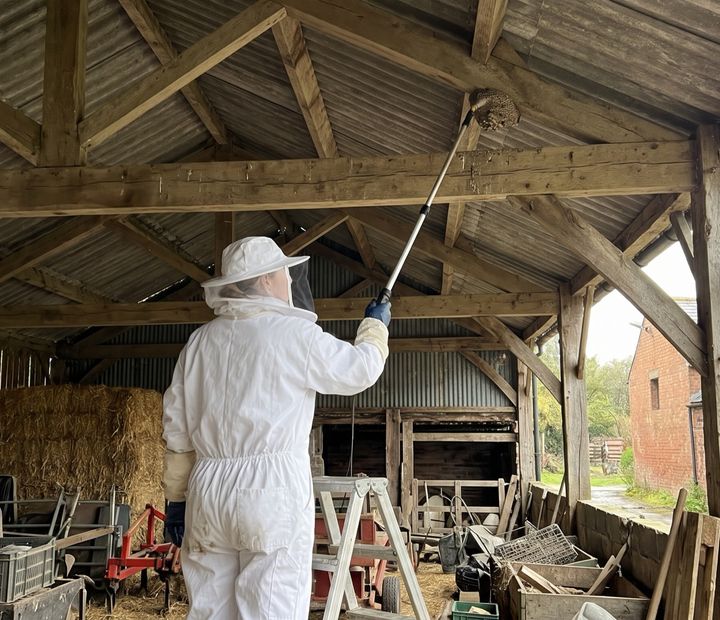
Northwest Environmental deals with wasp and hornet nests on Warrington homes and workplaces, including Stockton Heath, Penketh and Birchwood. A technician traces the flight line, puts a professional insecticide into the nest entrance and explains what to expect, and most nests need a single visit. Call us or use the online form to arrange a time.
Where do wasps nest on Warrington properties?
Semis and detached houses together hold almost two-thirds of the town’s households, so most nests here are in roofs: behind fascias and soffits, under slipped tiles and buried in loft insulation. Warrington has grown to more than twice its population at the 1968 new-town designation, and the boxed eaves and vented soffits on estate housing of that period leave narrow gaps a queen can squeeze through in spring. On a semi the nest may sit close to the party wall, which is why we let the neighbours know before treating.
Lower down, nests turn up in garden sheds, compost bins, bird boxes and old rodent burrows in lawns. On the rural fringe (the borough’s green belt ran to 11,500 hectares in 2017), garages, log stores and outbuildings give queens undisturbed space, and a nest can be football-sized by the time someone opens the door in August. In the town centre, the late Victorian terracotta shops on Bridge Street have decorative brickwork and upper floors where open joints let wasps into wall voids.
Why do the parks and waterways keep wasps busy?
A colony needs insects to feed its grubs in early summer, wood fibre to build with and, later on, sugar. Gardens that back onto Sankey Valley Park, the Bridgewater Canal or larger green spaces such as Walton Hall and Gardens, Victoria Park and Bank Park sit beside hedges, scrub and open grass full of insect prey. Fence panels and sheds near these spaces often carry pale scraped lines where workers have stripped wood for nest paper. By late August, once colonies switch to raising new queens, outdoor tables, bins and windfall fruit in these gardens draw the most attention.
European hornets are larger and chestnut-brown, and are far less common here than wasps. They favour hollow trees and wooden outbuildings near woodland, and a big insect tapping at a lit window after dark is the usual clue. A suspected yellow-legged hornet should be photographed from a distance and reported rather than treated.
How does a wasp visit run in Warrington?
We confirm the insect first. Check Warrington Borough Council’s website for current pest control services and charges. For wasps and hornets, the technician tracks the flight path back to the nest entrance, checks for children, pets, ponds and neighbours in adjoining gardens, then puffs a professional insecticide dust, or applies foam, into the hole, using an extension lance from ground level if the height allows.
The entrance is left open so foragers carry the product inside, activity tails off within a day, and the dead nest normally stays where it is. One visit deals with most nests. Since visits are planned from the Warrington base, you get a time window when you book, and we can plan around school runs, shift changes or opening hours.
What about business premises?
Birchwood Park’s offices, the Omega warehousing and the town’s shopping centres and retail parks offer the same nest sites at a bigger scale: cladding seams, signage, loading canopies, planted borders and bin stores behind shops. We agree timing with the site manager so the area under the entrance can be cleared, treat early or late where that helps, and leave a short note of where we treated, what was used and how long to keep people away, for your health and safety file.
Council or private for a wasp nest in Warrington?
Many councils run a pest control service for residents, but what is covered, who can book and the charges all vary and can change, so check the council’s own pest control pages before you book. If you rent, report the problem to your landlord first. If you would rather book a private firm, call or message us to arrange a visit.
How can you make next spring less inviting?
Once frost has finished the colony, deal with the gap it used. Refix or replace the loose tile, put fine mesh behind vented soffits and over airbricks while keeping them open to air, and fill open mortar joints. A look round the loft, shed and garage in late April or May catches a new queen while her nest is still tiny. In late summer keep bin lids down and the food caddy latched, because foraging wasps scavenge food waste as readily as rats do.
Wasp & Hornet Nest Removal in Warrington: what we see locally
- Semis and detached houses account for almost two-thirds of Warrington homes, and most of the nests we treat on them sit behind eaves, soffits and loose roof tiles.
- Gardens that back onto Sankey Valley Park or the Bridgewater Canal get extra foraging traffic in late summer, and hedges and banks along those boundaries are a common spot for ground nests.
- On business sites such as Birchwood Park and the Omega warehousing beside the M62, nests in cladding gaps, signage and loading canopies are treated at times agreed with the site so staff and drivers stay clear.
- Bridge Street's late Victorian terracotta shopfronts lie within a conservation area, so any gap sealed after a nest has been treated should be made good in matching materials.
How we deal with it
- 1
Identify the insect and find the nest
We confirm it is wasps or hornets rather than bees, then follow the flight line back to the entrance, whether that is a gap under a tile, a soffit vent, an airbrick or a hole in the lawn.
- 2
Check the surroundings
Before treating we check for children, neighbours, pets, fish ponds, horses or livestock, staff and customers nearby, and ask whether anyone has a known sting allergy.
- 3
Treat the entrance
A professional-use insecticide dust or foam goes directly into the entrance, from the ground with an extension lance where possible. Returning wasps carry it inside, so hidden nests are reached too.
- 4
Leave the entrance open
We explain why the hole must not be blocked, how long to keep people and pets clear, and that a short burst of extra activity is normal while foragers return.
- 5
Remove the nest where it matters
Dead nests are usually left, because wasps never reuse them. Where a nest is in a living space, a well-used shed or a loft where it could draw other insects, we can take it out once inactive.
- 6
Confirm it has worked
Activity normally stops within 24 hours. If wasps are still using the same entrance after a couple of days, or a second nest appears, tell us and we will reassess.
Wasp & Hornet Nest Removal in Warrington: frequently asked questions
Wasps are going in under the soffit of our semi. Will treating it affect next door?
It can involve them, because in a pair of semis the loft and eaves run right up to the join and a nest may sit nearer the neighbour's side than the entrance suggests. We treat through the entrance, so returning wasps carry the insecticide in wherever the nest is. Let next door know before the visit so their windows are shut and children and pets stay inside while we work, and keep both gardens away from the treated hole until the following day. If wasps then turn up in their loft, tell us.
Wasps keep coming out of the hedge where our garden meets the canal. Can you treat it?
If the nest is in your hedge or on your side of the boundary, yes. Hedge bottoms and banks are a favourite place for ground nests, often in an old rodent burrow, and the flight line usually gives the entrance away. We treat the hole directly and tell you how long to keep dogs and children off that part of the garden. If the nest turns out to be on the towpath side, it is for the landowner to deal with, so report it to them, since we can only treat land you control.
There is a nest in the brickwork above a shop on Bridge Street. How do you reach it?
We look at the entrance from the pavement first. On many older town-centre buildings an extension lance from the ground or an upstairs window reaches the gap, which keeps us off ladders beside an active nest. Where it is higher, we agree access with the owner and time the work before opening or after closing. Bridge Street is a conservation area, so if the gap is sealed afterwards, use matching brick, mortar or terracotta, and if the building is listed, check whether the repair needs listed building consent.
When is the best time to check a Warrington house for a new wasp nest?
Late April to early June. A queen that has come out of hibernation is building alone at that stage, and her nest is about the size of a golf ball, tucked into a loft, garage, shed, bird box or the underside of the eaves. A quick look then saves a much bigger nest later. By August and September colonies peak and workers switch to sugar, which is when gardens beside the parks and canals see the most traffic. The first hard frosts end the season.
Will my council remove a wasp nest for free?
Probably not. Councils across Cheshire, Merseyside, Lancashire and Greater Manchester handle wasps differently: many charge for the work, some do not treat wasps in homes at all (Cheshire East, for example, treats only rats and mice), and free wasp treatment is uncommon. Where a council does offer it, appointments may be harder to get in late summer, when demand peaks, and there may be limits on the nests it will treat. Your council's pest control page will say what is available. If it does not cover your nest, or you need it dealt with sooner, we can treat it privately.
What kills a wasp nest instantly?
Nothing reliably does. Sprays that promise instant results knock down the wasps you can see, not the colony inside, and spraying a visible nest at close range mainly provokes it. Professional treatment works by placing insecticide dust or foam in the nest entrance; foragers carry it in and spread it through the nest. Expect a burst of activity for an hour or two, then a steady decline. Most nests are dead within 24 hours, although a large nest in a roof space can take a little longer.
Is it a wasp, a hornet or a bee, and will you treat bees?
Wasps are smooth, bright yellow and black, with a narrow waist. European hornets are larger, chestnut-brown and yellow, and often turn up at lit windows after dark. Bees are rounder and hairier. We do not treat honeybees, because insecticide in a honeybee nest can be carried away by bees from other colonies; a local beekeeper may be able to collect a swarm. Bumblebee nests die off naturally by late summer and are usually best left alone. If you are unsure, send us a clear photo before booking.
More in Warrington
- All pest control in Warrington
- Commercial in Warrington
- Rats & Mice in Warrington
- Cockroaches in Warrington
- Bed Bugs in Warrington
- Bird Control in Warrington
- Wasps & Hornets in Widnes
- Wasps & Hornets in St Helens
- Wasps & Hornets in Runcorn
- Wasps & Hornets in Wigan
- Wasps & Hornets in Birchwood
- Wasp & Hornet Nest Removal overview
Last updated: