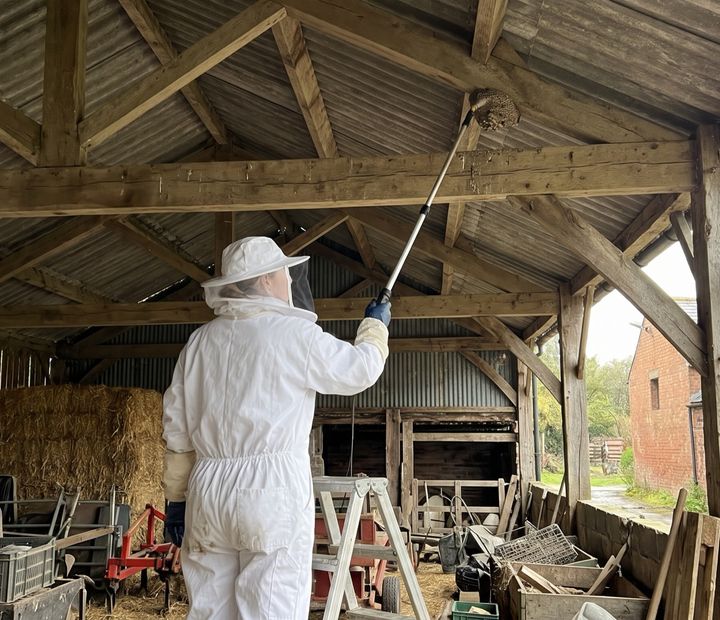
Wasp and hornet nests at Widnes homes and business premises, including Farnworth, Appleton and Ditton, are treated by Northwest Environmental. A technician rules out bees, traces the flight path back to the nest entrance and puts a professional insecticide straight into it, usually in a single visit. Call the office or fill in the enquiry form to book.
Why do Widnes homes suit nesting queens?
A queen leaving hibernation in spring wants a dry, sheltered cavity close to food, and Widnes offers both in quantity. Housing across most of the town is closely packed, so a single street holds dozens of roof spaces, eaves and wall cavities within easy flight of the same gardens. Much of it replaced slum streets cleared between the wars and after 1945, and in homes of that age the usual ways in are slipped tiles, worn mortar and gaps behind fascia boards. On the newer Ditton developments and the estate rising on the old Fairfield High School site, the weak spots shift to the vents and dry-fix systems at the roofline, where a small gap is all a queen needs.
Green space supplies the rest. Victoria Park in Appleton, Hough Green Park and the nature reserves at Clincton Wood and Hale Road Woodlands support the insects wasps catch to feed their grubs, and the fences and sheds around them provide fibre for nest paper. Along the river, the Sankey Canal towpath and the meadows at Pickerings Pasture add more of the same.
What do we usually find, and where?
On houses, most nests sit in roof spaces, under eaves and inside wall cavities, with the entrance at a tile edge, soffit or airbrick. In gardens they turn up in sheds and garages, compost bins, bird boxes, hedges and abandoned mouse or vole holes in lawns and banks, including the banks of the brooks that run through the town. On business premises the cavities are bigger: cladding joints and roller-shutter boxes on the distribution sheds at 3MG and Stobart Park, canopies and signage on shops, and voids in stored materials in the yards along Ditton Road.
Markets, leisure parks and late-summer stings
Through June and July a colony is busy raising workers and rarely bothers anyone. That changes in late August and September, when the nest turns to producing queens and males and the workers, no longer needed for rearing grubs, turn to sugary food instead. Here that means the open stalls at Widnes Market, cafés and bins around the Greenoaks Centre, and outdoor tables at the Hive Leisure Park on the waterfront. Foragers cover a fair distance, so the nest causing trouble may be in a roof nearby rather than on the site itself, and tracing the flight line comes before anything else. Lidded bins and covered food help, but the lasting fix is finding and treating the nest.
How does a nest treatment run here?
Our wasp and hornet nest removal follows the same steps here as anywhere in the region. First the technician rules out bees, then traces the flight path to the entrance and checks what is around it; on tightly built streets that usually means a neighbour’s garden or window a few metres away. Insecticide dust or foam is placed right in the opening, using a lance from ground level wherever the nest position allows, and returning foragers take it in to the colony. Expect a short burst of extra activity, then a steady fall, normally within a day. Leave the hole unblocked; the empty nest can usually stay put, since it will never be reused. Most jobs need one visit, though a big colony buried in a roof void sometimes needs a second.
Where does Halton’s service fit?
Halton Borough Council treats wasps for residents as a paid service, booked online. It does not treat bees, which are better collected by a beekeeper than treated, or flying ants, and its pest control page sets out nothing for businesses. Households are free to use the council; we treat nests for any resident who prefers a private visit, and for the shops, warehouses and works the council’s page does not cover.
Late October and the year ahead
By the end of October most colonies are failing. New queens have already left to hibernate in sheltered corners such as sheds, lofts and loose bark, and the workers left behind die as the nights turn cold. A quiet nest can usually be left alone; treatment still makes sense if wasps are coming indoors or the entrance is beside a door people use every day. Over the winter, close the gap the colony used, whether that means a roofer resetting a tile, fine mesh over a vent or fresh mortar in an open joint, keeping any ventilation clear. Then look into lofts, sheds and garages during April and May: a nest found then is small enough to fit in a cupped hand and quick to treat.
Wasp & Hornet Nest Removal in Widnes: what we see locally
- Housing in Widnes is generally closely packed, so a nest entrance in one roof can sit a few metres from a neighbour's window, and we check adjoining eaves and gardens before treating.
- Gardens bordering Clincton Wood, Hale Road Woodlands, Hough Green Park or Victoria Park in Appleton have plenty of insects for wasps to hunt and fences and sheds to strip for nest paper, so sheds, hedges and bird boxes there are worth checking first.
- Widnes Market's open stalls and the outdoor seating at the Hive Leisure Park are the kind of places late-summer workers go for sugar, so nests near the town centre are best treated before trading starts or after close.
- Halton Borough Council treats wasps for residents as a paid service but does not deal with bees or flying ants, and its pest page offers nothing for businesses, so shops, warehouses and units at 3MG or on Ditton Road book privately.
- On newer estates in Ditton and on the former Fairfield High School site, the places to check are ventilated soffits and dry-fixed ridge and verge systems, where a small gap can let a spring queen into the roof.
How we deal with it
- 1
Identify the insect and find the nest
We confirm it is wasps or hornets rather than bees, then follow the flight line back to the entrance, whether that is a gap under a tile, a soffit vent, an airbrick or a hole in the lawn.
- 2
Check the surroundings
Before treating we check for children, neighbours, pets, fish ponds, horses or livestock, staff and customers nearby, and ask whether anyone has a known sting allergy.
- 3
Treat the entrance
A professional-use insecticide dust or foam goes directly into the entrance, from the ground with an extension lance where possible. Returning wasps carry it inside, so hidden nests are reached too.
- 4
Leave the entrance open
We explain why the hole must not be blocked, how long to keep people and pets clear, and that a short burst of extra activity is normal while foragers return.
- 5
Remove the nest where it matters
Dead nests are usually left, because wasps never reuse them. Where a nest is in a living space, a well-used shed or a loft where it could draw other insects, we can take it out once inactive.
- 6
Confirm it has worked
Activity normally stops within 24 hours. If wasps are still using the same entrance after a couple of days, or a second nest appears, tell us and we will reassess.
Wasp & Hornet Nest Removal in Widnes: frequently asked questions
The nest entrance is on next door's side of the roof. Who books the treatment?
Either household can. In closely built Widnes streets the entrance a colony uses is often on one side of the boundary and the nest on the other, inside a shared roof void or behind a fascia. We treat the entrance the wasps are actually using, so if it is on your neighbour's wall or roof we need their permission and ideally access to their garden. Let them know before the visit, keep children and pets in both houses indoors while we work, and agree between you, or with the landlord, who pays.
Why have wasps got into the roof of our new-build in Ditton already?
A new house offers what a queen wants from an old one: a dry, sheltered cavity. On modern homes the way in is usually a gap at a ventilated soffit, a dry-fixed ridge or verge, or an opening around a pipe or flue. A queen needs only a small gap in spring, and by midsummer the nest behind it can be large. Once the colony is treated and dead, ask the developer to look at the gap under the snagging or warranty arrangements, or fit insect mesh that keeps the ventilation open.
Does Halton Council's wasp service cover businesses in Widnes?
Its pest control page suggests not: it describes chargeable treatments for residents, wasps among them, and a separate route for schools, but nothing for business premises. Shops around Greenoaks and the market, venues at the Hive Leisure Park, and warehouses and works at 3MG, Stobart Park and Ditton Road therefore arrange nest treatment privately. Timing is settled with whoever runs the site, the lance work is done from ground level where the nest allows, and you get a brief record giving the nest's position, the product applied and when the area can reopen.
The nest is in the bank by the brook at the bottom of our garden. Can you still treat it?
Usually, yes, with extra care. Ditton, Steward's and Bower's Brooks all run through the town, and most products used on wasp nests can harm fish and the invertebrates they feed on, so the product has to go precisely into the entrance and nowhere near the water. Our technician looks at how close the nest sits to the channel, chooses a dust or foam that stays where it is put, and treats in dry weather so nothing washes into the brook. If the bank belongs to someone else, we need their agreement before treating.
Will my council remove a wasp nest for free?
Probably not. Councils across Cheshire, Merseyside, Lancashire and Greater Manchester handle wasps differently: many charge for the work, some do not treat wasps in homes at all (Cheshire East, for example, treats only rats and mice), and free wasp treatment is uncommon. Where a council does offer it, appointments may be harder to get in late summer, when demand peaks, and there may be limits on the nests it will treat. Your council's pest control page will say what is available. If it does not cover your nest, or you need it dealt with sooner, we can treat it privately.
What kills a wasp nest instantly?
Nothing reliably does. Sprays that promise instant results knock down the wasps you can see, not the colony inside, and spraying a visible nest at close range mainly provokes it. Professional treatment works by placing insecticide dust or foam in the nest entrance; foragers carry it in and spread it through the nest. Expect a burst of activity for an hour or two, then a steady decline. Most nests are dead within 24 hours, although a large nest in a roof space can take a little longer.
Is it a wasp, a hornet or a bee, and will you treat bees?
Wasps are smooth, bright yellow and black, with a narrow waist. European hornets are larger, chestnut-brown and yellow, and often turn up at lit windows after dark. Bees are rounder and hairier. We do not treat honeybees, because insecticide in a honeybee nest can be carried away by bees from other colonies; a local beekeeper may be able to collect a swarm. Bumblebee nests die off naturally by late summer and are usually best left alone. If you are unsure, send us a clear photo before booking.
More in Widnes
Last updated: