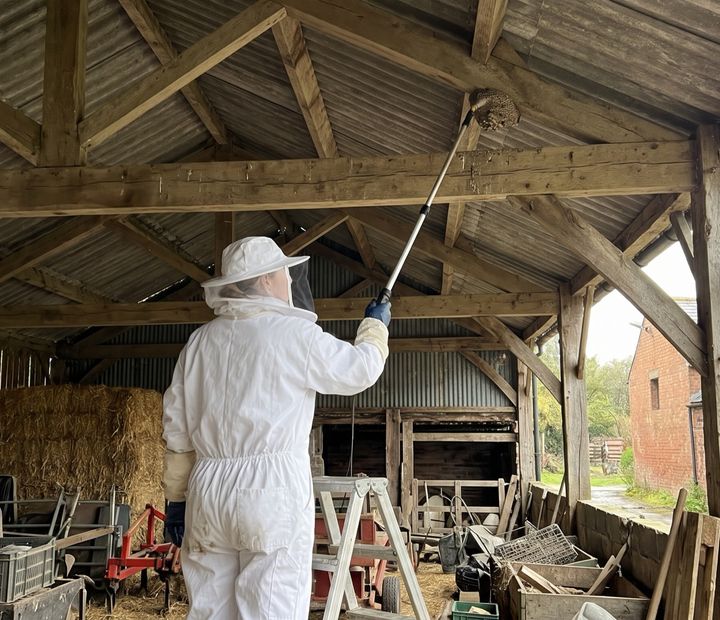
Wasp and hornet nests at Runcorn homes, shops and business premises, including Palacefields, Murdishaw and Sandymoor, are treated by Northwest Environmental. A technician identifies the insect, locates the hole and applies a professional insecticide directly into it, usually in one visit, and the colony normally collapses within a day. Call or use the enquiry form to book.
When does wasp season peak in Runcorn?
The year starts quietly. Queens that hibernated over winter emerge in spring and look for a dry cavity close to food and chewable wood. Through late spring the nest is small, papery and easy to miss. By June the first workers have taken over the building work, and by August a colony in a roof space can number in the thousands.
Late summer is when most Runcorn households notice the problem. As the colony stops raising grubs, workers go looking for sugar, which brings them to bins at Shopping City, open windows on the estates and anyone eating outside near Town Park. The first hard frosts end the colony, and only newly mated queens survive the winter.
Where do we find nests in Runcorn’s homes?
Most domestic nests here are in roofs. The planned estates that spread east from 1964 onwards, such as Castlefields, Palacefields and Murdishaw, repeat the same eaves and soffit details from house to house, and a gap that suits a queen on one roof usually exists on the next. Loft hatches, light fittings and downlighters in upstairs rooms are often where householders first notice wasps getting indoors.
Sandymoor, built mainly after 1990, has its own pattern. Vented soffits, dry-fix ridges and verges on newer homes can leave narrow gaps that a queen squeezes through in spring. Sheds, garages and bird boxes in gardens across the town account for many of the rest, along with abandoned burrows in lawns and grassy banks, which some wasps take over as nest sites.
How does the job run at a Runcorn address?
Identification comes before anything else. Bees are left alone, and Halton does not treat them either, so a photo before booking is useful. Once it is clearly wasps or hornets, the technician watches where the wasps are flying, pins down the hole they use and looks at who might be affected: children, pets, people in next-door gardens or staff on a site.
The insecticide goes into the entrance itself, puffed in on a long pole from ground level whenever the nest position allows. Wasps returning to the nest walk through the dust and spread it among the colony, which reaches nests tucked into cavity walls, under loft insulation or underground. The entrance will look busier for a short while, then quieten, and by the following day the colony has normally collapsed. Leave the hole unblocked, keep people and pets away from it until evening, and tell us if wasps are still going in after a couple of days.
What about businesses, schools and shops?
Commercial sites at Astmoor, Manor Park, Whitehouse and the Heath see nests in cladding joints, roller-shutter housings and the landscaping around car parks. Retail units near Shopping City and Trident Retail Park tend to notice foraging wasps rather than nests, clustering around bin stores and doors from August. We fit the work around the site’s hours, treating before the doors open or after they close if that suits, and send a written note afterwards for your records.
Schools can use the council’s own service for wasps, and we can help where timing or access makes that difficult.
How can you make a Runcorn property less inviting next spring?
Take a look inside the loft, shed and garage during late spring, when a fresh nest is still small and quick to deal with. Once a colony has died, re-fix loose soffit boards, fit mesh behind vents and seal gaps around pipes and cables. From August, keep bin lids shut and rinse recycling, and on food premises close kitchen windows or screen them. A queen will always find somewhere, but those steps make it less likely to be your roof.
Wasp & Hornet Nest Removal in Runcorn: what we see locally
- Halton charges for wasp treatment and does not treat bees, so a clear photo sent before booking helps confirm whether a nest is wasps at all or a bumblebee colony that is better left alone.
- Eaves, soffit boxes and fascia details repeat across the planned eastern estates, so when one Runcorn house has a nest under the soffit, the neighbouring roofs are worth a look the same summer.
- Large green spaces such as Town Park and Phoenix Park, where walking routes follow the Bridgewater Canal, sit right beside housing, and wasps forage across them for wood fibre in spring and sugary food in late summer.
- Around Shopping City and Trident Retail Park, foraging wasps gather at bin stores and entrances in August and September, when colonies switch from feeding grubs to hunting for sugar.
- On industrial sites at Astmoor, Manor Park and the Heath, nests turn up in cladding gaps, loading canopies and landscaped banks, and treatment is timed around deliveries and shift changes.
How we deal with it
- 1
Identify the insect and find the nest
We confirm it is wasps or hornets rather than bees, then follow the flight line back to the entrance, whether that is a gap under a tile, a soffit vent, an airbrick or a hole in the lawn.
- 2
Check the surroundings
Before treating we check for children, neighbours, pets, fish ponds, horses or livestock, staff and customers nearby, and ask whether anyone has a known sting allergy.
- 3
Treat the entrance
A professional-use insecticide dust or foam goes directly into the entrance, from the ground with an extension lance where possible. Returning wasps carry it inside, so hidden nests are reached too.
- 4
Leave the entrance open
We explain why the hole must not be blocked, how long to keep people and pets clear, and that a short burst of extra activity is normal while foragers return.
- 5
Remove the nest where it matters
Dead nests are usually left, because wasps never reuse them. Where a nest is in a living space, a well-used shed or a loft where it could draw other insects, we can take it out once inactive.
- 6
Confirm it has worked
Activity normally stops within 24 hours. If wasps are still using the same entrance after a couple of days, or a second nest appears, tell us and we will reassess.
Wasp & Hornet Nest Removal in Runcorn: frequently asked questions
Our Runcorn school uses the council's service. When should it call a private contractor for wasps?
Halton includes wasps in the treatments it offers schools, requested by email, and the council will go back within four weeks if the nest is still active. That suits many nests. A private visit can help when the school needs a time that fits around lessons, playtimes or holidays, when the nest sits high in a roof or cladding where access has to be planned, or when it turns out to be hornets and needs extra care because of their later flying hours.
Wasps nest in the same soffit on our estate house every summer. What can we do?
Once this year's colony is dead, close the gap it used. On many estate homes that means a loose soffit board, an open end where the fascia meets the brickwork or a missing vent cover. Fitting insect mesh behind vents without blocking airflow, re-fixing loose boards and sealing gaps around cables usually stops a repeat at that spot. A queen may simply choose a neighbour's identical roof instead, so it is worth mentioning to the houses either side.
Are there hornets around Runcorn's parks and riverside?
European hornets have spread north through England over recent decades, but wasps still account for far more nests. Hornets favour hollow trees, old outbuildings and quiet wooden structures near trees, so larger green spaces such as Town Park, or the nature reserve on Wigg Island between the Mersey and the Ship Canal, are the kind of setting where one might appear. If you see large chestnut-and-yellow insects at a lit window after dark, keep clear of the nest and send us a photo.
Can you deal with a nest high on a dockside or warehouse building?
Usually. Many nests on tall buildings can still be treated from the ground using a long application pole. Where the entrance is higher, we plan access with the site, follow its permit and safety rules, and agree a time when the area below can be kept clear. Afterwards you receive a short record covering where the nest was, which product went in and when people can use the area again, ready for your health and safety file.
Will my council remove a wasp nest for free?
Probably not. Councils across Cheshire, Merseyside, Lancashire and Greater Manchester handle wasps differently: many charge for the work, some do not treat wasps in homes at all (Cheshire East, for example, treats only rats and mice), and free wasp treatment is uncommon. Where a council does offer it, appointments may be harder to get in late summer, when demand peaks, and there may be limits on the nests it will treat. Your council's pest control page will say what is available. If it does not cover your nest, or you need it dealt with sooner, we can treat it privately.
What kills a wasp nest instantly?
Nothing reliably does. Sprays that promise instant results knock down the wasps you can see, not the colony inside, and spraying a visible nest at close range mainly provokes it. Professional treatment works by placing insecticide dust or foam in the nest entrance; foragers carry it in and spread it through the nest. Expect a burst of activity for an hour or two, then a steady decline. Most nests are dead within 24 hours, although a large nest in a roof space can take a little longer.
Is it a wasp, a hornet or a bee, and will you treat bees?
Wasps are smooth, bright yellow and black, with a narrow waist. European hornets are larger, chestnut-brown and yellow, and often turn up at lit windows after dark. Bees are rounder and hairier. We do not treat honeybees, because insecticide in a honeybee nest can be carried away by bees from other colonies; a local beekeeper may be able to collect a swarm. Bumblebee nests die off naturally by late summer and are usually best left alone. If you are unsure, send us a clear photo before booking.
More in Runcorn
Last updated: