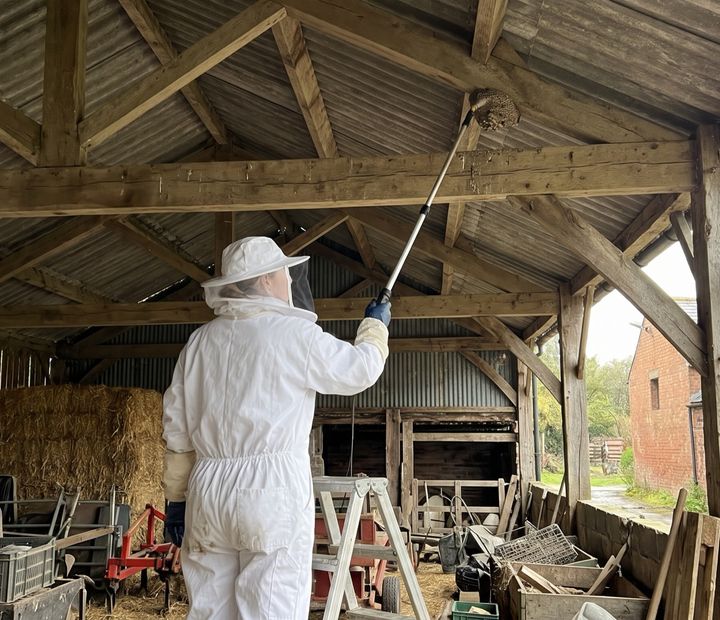
Wasp and hornet nests at houses, pubs, shops and schools in Stockton Heath, Grappenhall and Thelwall are treated by Northwest Environmental, normally in one visit. The technician tracks down the nest, applies insecticide into its entrance, and activity normally fades over the next day. Book by phone or the contact form; visits are scheduled from our Warrington base.
Why do wasps find so many nest sites around Stockton Heath and Grappenhall?
A wasp colony needs a dry, sheltered cavity, a supply of wood fibre to chew into nest paper, and plenty of insects and sugar through the summer. Older property supplies the first two in quantity. The early-19th-century cottages on London Road and Grappenhall Road, the rendered pair by St Wilfrid’s and the stuccoed Gothic rectory nearby have roof edges and joints that have weathered for close to two centuries, and fences, sheds and old outbuildings provide the timber. The formal gardens at Walton Hall, the walled garden at Grappenhall Heys and the green-belt land towards Appleton keep foraging workers fed.
A queen that survives the winter picks her spot in April or May, and by late August a successful nest can hold several thousand workers. That is why an odd wasp in the kitchen in June can turn into a steady stream from the eaves by the school holidays.
Which parts of these houses do nests turn up in?
In the older brick cottages, the favourite entry points are gaps under the lowest roof course, open joints where pointing has fallen out, and old airbricks. Rendered and stuccoed houses tend to crack where the render meets a window head or the eaves, giving a narrow slot into the wall or roof void. Where a house has newer soffits, the way in is usually a vent or a gap where a pipe passes through the wall into the loft.
Thelwall is a different picture. The timber-framed farmhouses and listed barns have cavities between beams, voids behind boarding and quiet lofts above stores, and these are the buildings where a European hornet nest is most likely. Gardens everywhere add compost bins, old rodent holes in banks and lawns, bird boxes and stacks of timber. On canal-side plots, a nest can turn up in the bank or in dense planting near the water.
Pubs, restaurants, schools and Walton Hall in late summer
Late in the summer the colony stops raising grubs, the workers lose the sugary secretion the larvae used to give them, and they go looking for sugar elsewhere, which is why they suddenly crowd around drinks and food. For the Parr Arms, the Ram’s Head and the Bellhouse in Grappenhall, the Pickering Arms in Thelwall and the bars and restaurants around Victoria Square, outdoor tables and open kitchen doors are where it tends to show. At Walton Hall and Gardens, the children’s zoo and crazy golf draw families outside at the height of the season, and weddings and functions in the hall add catering to the mix.
Schools need the same care. St Thomas C of E Primary sits next to Alexandra Park, St Wilfrid’s and Bradshaw Community Primary are north of Grappenhall village, and Chaigeley School occupies Thelwall Hall. For sites like these we agree a time before opening, after close or during the holidays, cone off the treated area if needed, and leave a written note of what was done for the site file.
How does a wasp job run here?
The first check is identification: a honeybee swarm is passed to a local beekeeper rather than treated. The technician then follows the wasps’ flight path to the nest and notes what is close by, from children, neighbours and pets to garden ponds and the canal. Treatment goes into the entrance itself as a professional dust or foam, applied with a long lance from the ground where the roof allows, so listed eaves and old tiles stay untouched. The hole is left open, the entrance gets busier for a short while as foragers come home, and traffic normally dies away within a day. Now and then a nest buried deep in an awkward old loft needs a return visit.
How can you stop a queen nesting in the same place next year?
By late October most colonies are dying back, and the old nest will not be reused. Winter is the time to seal the gap the wasps used: repoint open joints, put fine mesh over soffit vents while keeping the ventilation working, and close holes around pipes. On a listed property, check with the council before any repair that alters the building. Then look over sheds, lofts and outbuildings in April and May, when a fresh nest is small enough to sit in the palm of your hand and easy to deal with.
Wasp & Hornet Nest Removal in Stockton Heath & Grappenhall: what we see locally
- The early-19th-century brick cottages on London Road and Grappenhall Road, and the rendered cottages beside St Wilfrid's Church, have the kind of weathered eaves and joints where queens like to start a nest in spring.
- Thelwall's 17th-century timber-framed farmhouses and the listed barns of Home Farm and Old Village Farm offer sheltered cavities that suit common wasps and European hornets alike.
- Gardens backing onto the Bridgewater Canal need extra care at treatment time, since most nest-treatment products carry label warnings about harm to aquatic life.
- Outdoor tables at Grappenhall's three village pubs and at the bars and restaurants around Victoria Square are likely places for wasp trouble once workers turn to sugar in August and September.
- Nests near paths and play areas at Walton Hall and Gardens, or by the schools at Alexandra Park and north of Grappenhall village, are best treated when children are not about.
How we deal with it
- 1
Identify the insect and find the nest
We confirm it is wasps or hornets rather than bees, then follow the flight line back to the entrance, whether that is a gap under a tile, a soffit vent, an airbrick or a hole in the lawn.
- 2
Check the surroundings
Before treating we check for children, neighbours, pets, fish ponds, horses or livestock, staff and customers nearby, and ask whether anyone has a known sting allergy.
- 3
Treat the entrance
A professional-use insecticide dust or foam goes directly into the entrance, from the ground with an extension lance where possible. Returning wasps carry it inside, so hidden nests are reached too.
- 4
Leave the entrance open
We explain why the hole must not be blocked, how long to keep people and pets clear, and that a short burst of extra activity is normal while foragers return.
- 5
Remove the nest where it matters
Dead nests are usually left, because wasps never reuse them. Where a nest is in a living space, a well-used shed or a loft where it could draw other insects, we can take it out once inactive.
- 6
Confirm it has worked
Activity normally stops within 24 hours. If wasps are still using the same entrance after a couple of days, or a second nest appears, tell us and we will reassess.
Wasp & Hornet Nest Removal in Stockton Heath & Grappenhall: frequently asked questions
Will treating a nest in a listed cottage roof in Stockton Heath or Grappenhall damage it?
No. The product goes into the hole the wasps are using, usually applied from ground level on a telescopic lance, which means no tiles are lifted, no render is cut and no historic timber is disturbed. Once dead, the nest can normally stay put. Listing matters afterwards: if you want the gap sealed so a new queen cannot use it next spring, repairs that change the fabric of a listed building can need consent, so check with the council's planning department before that work goes ahead.
My garden backs onto the Bridgewater Canal. Is wasp treatment safe so close to the water?
It can be done safely, but the canal changes how we work. Nest treatments can harm fish and water insects, so we apply the product only inside the entrance hole and hold off dusting in a strong wind when the nest is near the bank. If the nest is in the bank itself or overhanging the water, we explain the options on site before doing anything. We also ask about garden ponds and pets before starting, and tell you how long the spot should be left alone afterwards.
Do wasps and hornets nest in Thelwall's old farmhouses and barns?
They can. Timber-framed buildings and old barns are full of sheltered cavities, gaps between old timbers and brickwork, and quiet roof spaces, which suit common wasps and the larger European hornet alike. Hornets often pick barns, hollow beams and dark outbuildings, and they keep flying later into the evening, so we may time the treatment for dusk when most foragers are home. If horses or other animals use the building, tell us when you book, because they need to be kept away from the treated area until activity stops.
I let a house in WA4. Will Warrington Borough Council treat a wasp nest there?
Many councils run a pest control service for residents, but what is covered, who can book and the charges all vary and can change, so check the council's own pest control pages before you book. If you rent, report the problem to your landlord first. If you would rather book a private firm, call or message us to arrange a visit.
Will my council remove a wasp nest for free?
Probably not. Councils across Cheshire, Merseyside, Lancashire and Greater Manchester handle wasps differently: many charge for the work, some do not treat wasps in homes at all (Cheshire East, for example, treats only rats and mice), and free wasp treatment is uncommon. Where a council does offer it, appointments may be harder to get in late summer, when demand peaks, and there may be limits on the nests it will treat. Your council's pest control page will say what is available. If it does not cover your nest, or you need it dealt with sooner, we can treat it privately.
What kills a wasp nest instantly?
Nothing reliably does. Sprays that promise instant results knock down the wasps you can see, not the colony inside, and spraying a visible nest at close range mainly provokes it. Professional treatment works by placing insecticide dust or foam in the nest entrance; foragers carry it in and spread it through the nest. Expect a burst of activity for an hour or two, then a steady decline. Most nests are dead within 24 hours, although a large nest in a roof space can take a little longer.
Is it a wasp, a hornet or a bee, and will you treat bees?
Wasps are smooth, bright yellow and black, with a narrow waist. European hornets are larger, chestnut-brown and yellow, and often turn up at lit windows after dark. Bees are rounder and hairier. We do not treat honeybees, because insecticide in a honeybee nest can be carried away by bees from other colonies; a local beekeeper may be able to collect a swarm. Bumblebee nests die off naturally by late summer and are usually best left alone. If you are unsure, send us a clear photo before booking.
More in Stockton Heath & Grappenhall
Last updated: