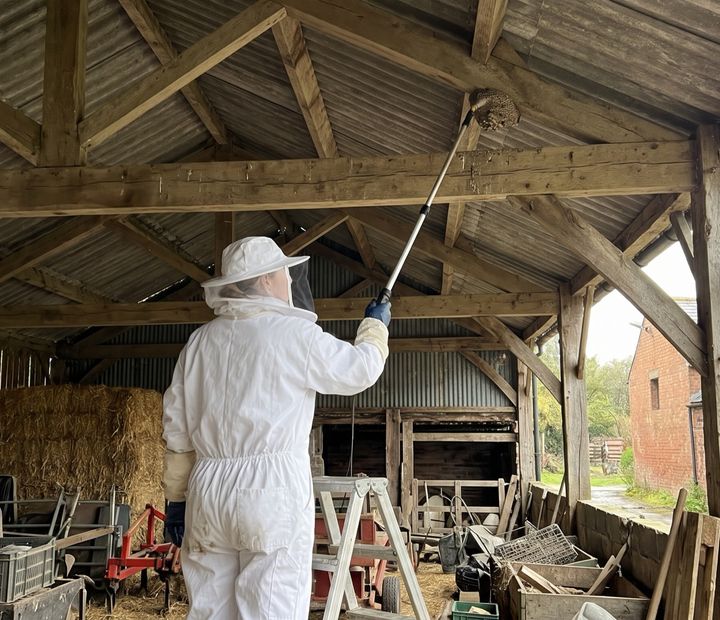
Northwest Environmental treats wasp and hornet nests at Lymm homes, farm buildings, pubs and shops, from the village centre out to Heatley and Statham. A technician traces the flight path, checks for nearby water, pets and livestock, then puts insecticide into the nest entrance, usually in one visit. Ring us or fill in the website form to arrange it.
Why are Lymm’s wasps so noticeable in late summer?
A colony’s behaviour changes in August. Through early summer the workers feed the grubs and get a sugary secretion back from them; as the nest turns to rearing next season’s queens and males, and then stops producing grubs altogether, that supply dwindles and thousands of foragers go looking for sweet food instead. Lymm gives them a great deal of it outdoors. A pub stands on the bank of the Bridgewater Canal, restaurants and cafés trade around The Cross, a bakery on Eagle Brow trades from a building dating to 1780, and the neighbourhood plan backs the visitor trade while recognising a distinctive evening economy in the village centre.
The nest those wasps come from is rarely far away. A large colony in a sheltered roof void can supply foragers to every beer garden and bin store within a few hundred metres, which is why swatting, sprays and jam-jar traps on the table make so little difference. Treating the nest is what stops the problem.
Where do we find nests in Lymm?
The village’s buildings give queens plenty of choice in spring. Cottages built for the fustian-cutting trade, some close to the Lower Dam, tend to have small, tight roof spaces where a nest builds up against the underside of the slates or tiles. The mid-Victorian Gothic and Italianate houses on the village edges, and the homes Manchester merchants built near the station after 1853, have bigger lofts, ornate eaves and gables with plenty of gaps behind the timber.
Out in the hamlets, the parish’s listed farmhouses come with barns, stables and stores that are dry and seldom disturbed, and both common wasps and hornets, which are bigger and favour hollow trees and old timber buildings, make use of them. In gardens that back onto the canal, Slitten Brook or the Dingle, we also find ground nests in old rodent burrows within banks and rockeries, which are easy to tread on by accident.
How does a wasp nest visit run here?
First comes a check on what the insect actually is, since bees are left alone; once it is clear the nest belongs to wasps or hornets, the technician tracks their flight path back to the way in. In Lymm that check of the surroundings often matters more than usual: we look for the canal, a brook or a pond close by, horses or livestock in a neighbouring field, and on business premises the staff and customers who will be using the space later that day.
Dust or foam insecticide is then applied into that opening, using a long lance from ground level whenever the position allows. Foragers coming home pick it up and take it in, which reaches a nest hidden in a wall cavity or under insulation with no need to open up the structure. The entrance has to stay open, there will be extra activity for an hour or two, and the colony normally dies within a day. Should wasps still be flying in and out two or three days later, tell us and we will come back.
For pubs, cafés and shops around The Cross, treatment can go in before the doors open or after the last customers leave, and Warrington is only about six miles away, so the visit can usually be fitted to a quiet part of the day. You get a note of the location, the product used and how long people should stay away from the spot, for your records.
How can Lymm properties stay clear next spring?
A treated nest dies over the winter and is never reused, but a new queen may pick the same spot. Once the season is over, close the gap the wasps used: re-bed a slipped tile, fit fine insect mesh to vents in a way that still lets air move, and repair the softened fascia or bargeboard they were getting behind. On a listed or timber-framed building, pick a repair that matches the existing materials.
Farm buildings and stables are worth a look in late spring, while a fresh nest has only a handful of workers and is quick to treat. Food businesses in the village centre can cut late-summer pressure by keeping bins lidded and emptied often, clearing glasses and plates from outdoor tables quickly, and fitting fly screens to kitchen windows. If a nest does appear, wasp nest removal early in the season is a quicker and calmer job than in late August, when the colony is at full strength.
Wasp & Hornet Nest Removal in Lymm: what we see locally
- Canal-side pubs such as the Barn Owl Inn, on the bank beside Warrington Road, draw foraging wasps wherever food and drink are served outdoors from August, when colonies stop raising new workers and foragers turn to sugar.
- Many Lymm nests sit within sight of water, whether the canal, the Lower Dam or Slitten Brook, so the insecticide goes inside the nest entrance and nowhere near the bank, because most wasp insecticides can poison fish and pond life.
- The fustian workers' cottages in the village and the larger Victorian houses on its edges give queens eaves, roof voids and loft corners to build in, which can usually be treated without a ladder, using a lance extended from the ground.
- Listed farmhouses, barns and stables across the rural parish offer dry, rarely disturbed cavities, and treating through the existing entrance leaves historic timber and stonework untouched.
How we deal with it
- 1
Identify the insect and find the nest
We confirm it is wasps or hornets rather than bees, then follow the flight line back to the entrance, whether that is a gap under a tile, a soffit vent, an airbrick or a hole in the lawn.
- 2
Check the surroundings
Before treating we check for children, neighbours, pets, fish ponds, horses or livestock, staff and customers nearby, and ask whether anyone has a known sting allergy.
- 3
Treat the entrance
A professional-use insecticide dust or foam goes directly into the entrance, from the ground with an extension lance where possible. Returning wasps carry it inside, so hidden nests are reached too.
- 4
Leave the entrance open
We explain why the hole must not be blocked, how long to keep people and pets clear, and that a short burst of extra activity is normal while foragers return.
- 5
Remove the nest where it matters
Dead nests are usually left, because wasps never reuse them. Where a nest is in a living space, a well-used shed or a loft where it could draw other insects, we can take it out once inactive.
- 6
Confirm it has worked
Activity normally stops within 24 hours. If wasps are still using the same entrance after a couple of days, or a second nest appears, tell us and we will reassess.
Wasp & Hornet Nest Removal in Lymm: frequently asked questions
I let a cottage in Lymm and my tenant has found a wasp nest. Can I book the council?
Many councils run a pest control service for residents, but what is covered, who can book and the charges all vary and can change, so check the council's own pest control pages before you book. If you rent, report the problem to your landlord first. If you would rather book a private firm, call or message us to arrange a visit.
Our garden runs down to the canal. Is wasp treatment safe for the water and wildlife?
Yes, when it is applied as it should be. The insecticide is placed inside the nest entrance in a small amount, not sprayed across the garden, so very little is exposed. Fish are sensitive to most wasp insecticides, so where a nest is in a bank, wall or shed close to the Bridgewater Canal, a brook or a garden pond, we choose the product and application to keep it away from the water. Tell us about ponds, beehives or animals nearby when you book.
Is it possible to treat a nest in a listed farmhouse, barn or timber-framed building?
Usually without touching the fabric at all. The treatment goes in through the hole the wasps already use, so nothing needs drilling, lifting or cutting. If the dead nest has to come out of a roof void or a wall, we remove it by hand from whatever access already exists. Sealing the entrance afterwards is a separate job: on a listed building, choose a repair that suits the materials, and check with Warrington Borough Council if the change could affect the building's character.
There is a wasp nest beside a path at Lymm Dam. Who should deal with it?
The dam and its park are managed by Warrington Borough Council, so a nest on that land should be reported to the council as the site manager. Keep children and dogs away from the entrance in the meantime. If the nest is in your own garden, fence, shed or roof next to the park, it is yours to deal with, and we can treat it from your side of the boundary.
Will my council remove a wasp nest for free?
Probably not. Councils across Cheshire, Merseyside, Lancashire and Greater Manchester handle wasps differently: many charge for the work, some do not treat wasps in homes at all (Cheshire East, for example, treats only rats and mice), and free wasp treatment is uncommon. Where a council does offer it, appointments may be harder to get in late summer, when demand peaks, and there may be limits on the nests it will treat. Your council's pest control page will say what is available. If it does not cover your nest, or you need it dealt with sooner, we can treat it privately.
What kills a wasp nest instantly?
Nothing reliably does. Sprays that promise instant results knock down the wasps you can see, not the colony inside, and spraying a visible nest at close range mainly provokes it. Professional treatment works by placing insecticide dust or foam in the nest entrance; foragers carry it in and spread it through the nest. Expect a burst of activity for an hour or two, then a steady decline. Most nests are dead within 24 hours, although a large nest in a roof space can take a little longer.
Is it a wasp, a hornet or a bee, and will you treat bees?
Wasps are smooth, bright yellow and black, with a narrow waist. European hornets are larger, chestnut-brown and yellow, and often turn up at lit windows after dark. Bees are rounder and hairier. We do not treat honeybees, because insecticide in a honeybee nest can be carried away by bees from other colonies; a local beekeeper may be able to collect a swarm. Bumblebee nests die off naturally by late summer and are usually best left alone. If you are unsure, send us a clear photo before booking.
More in Lymm
Last updated: