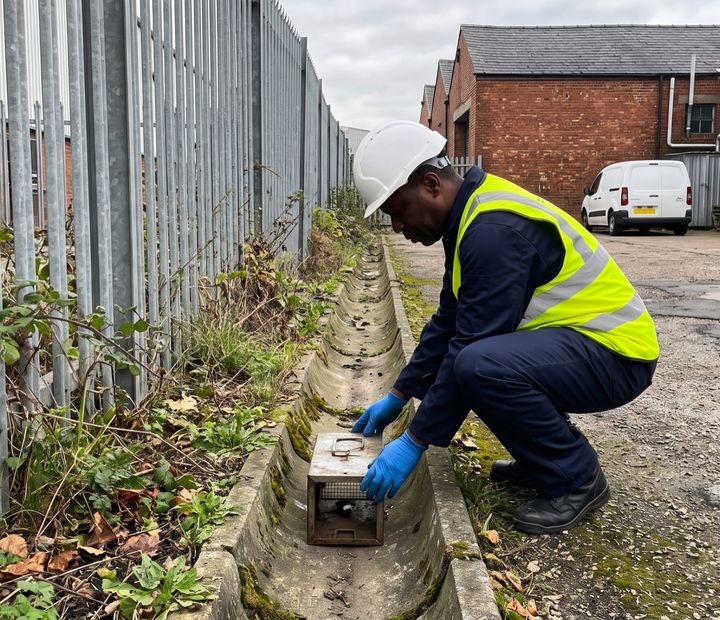
Northwest Environmental clears rats and mice from Warrington homes, rented properties and business premises, including riverside Latchford, Birchwood and Great Sankey. We survey first, find the way in, then set enclosed traps or locked bait boxes and seal entry points over visits a week apart. Phone the office or use our contact form to fix a date.
What brings rats and mice into Warrington homes?
Water does a lot of the work. The town sits on the Mersey, and when the river rises after heavy rain, rats living in its banks are flooded out towards the nearest gardens. Streets in Latchford and Howley flooded in 1990, and while the walls built since reduce the flood risk to houses, the bank habitat behind them is unchanged. On the west side the Sankey Canal winds through its valley park, the Bridgewater links Lymm with Walton, and the Ship Canal crosses Warrington’s southern districts. Each one gives rats cover, water and a route towards housing.
Housing does the rest. The town grew fast after it was made a new town in 1968, more than doubling its population, and semi-detached houses are now its most common home. Semis and terraces share lofts, party walls and drain runs, which suits mice in particular. Out on the green belt fringe, field-edge rats and wood mice head for garages and outbuildings once autumn sets in. Big redevelopment sites, such as the decommissioned Fiddlers Ferry Power Station and Unilever’s Soapworks, now becoming a data centre, disturb burrows and old drains while work goes on.
What do we usually find in Warrington properties?
On the post-1968 estates, mice tend to arrive through gaps around waste pipes, unmeshed airbricks and weep vents, or through an integral garage with no brush strip on the door. Once inside, they use boxed-in pipework behind kitchen units as a corridor. In semis, the shared loft is the second route, so we follow the party wall rather than stopping at the rooms where droppings turned up.
Rats are more often an outdoor problem first. In riverside and canal-side gardens the usual finds are burrows under decking, sheds and compost bins, runs worn along fence lines and fresh activity in inspection chambers. A rat inside the house points more often to a drain fault: a cracked pipe, an uncapped redundant branch or a loose chamber cover.
About three in ten Warrington households rent, split almost evenly between social and private landlords. In those homes we deal with the tenant over access, and our report spells out which repairs fall to the landlord. In the older centre, including the late Victorian shops on Bridge Street, mice move between units through floor voids, so neighbouring businesses often need checking together.
How does a rat or mouse job run here?
It begins with a survey. We identify the species, trace runs and droppings to the nest site, and check airbricks, pipe entries, door thresholds and drain covers. We then explain what the evidence shows and what we suggest, and only after that do traps or locked stations go out on the active runs, each position logged, and gaps are sealed or meshed on the day where that is practical.
Return visits are normally about a week apart. Because the work is scheduled from our Warrington base, those dates are set at the first appointment, and most homes need two to four visits in total. When activity stops, every trap, station and scrap of bait is collected and you receive a written summary.
What about warehouses, offices and shops?
Omega’s warehousing beside the M62 shares its edge with a large residential area, so rodents from a yard or bin compound can turn up in gardens, and the other way round. Birchwood Park, a 123-acre site with a workforce of about 4,200, has staff kitchens, plant rooms and service voids that mice exploit. Shopping centres and retail parks such as Golden Square and Gemini have shared bin stores and delivery bays to manage.
For sites like these we set out monitoring points on a site plan, fit brush strips to roller shutters and pedestrian doors where needed, brief staff on station positions and leave a report after every visit for your audit file.
How can Warrington households keep rodents out?
- Keep the outdoor food caddy latched and put it out on collection morning; the weekly service that began on 31 March 2026 only helps if the lid stays shut.
- With the black bin now emptied fortnightly, keep its lid closed and never stack bags beside it.
- Move bird feeders away from fences that back onto a canal or the valley park, and sweep up spilt seed.
- Skirt the base of sheds and decking with mesh dug into the ground.
- If dumped rubbish on private or housing association land is sheltering rats, the landowner has to clear it, not the council; activity on public land can be reported through the council’s ‘Report a rodent sighting’ service.
Rat & Mouse Control in Warrington: what we see locally
- Riverside streets in Latchford, Westy and Howley went under water in the 1990 Mersey flood, and high water still pushes rats out of the banks, so jobs there include a close look at boundaries and drain chambers.
- The Sankey Canal runs through Sankey Valley Park on the west side of town, and gardens backing onto the valley often show burrows under sheds and decking along the fence line.
- Four in ten Warrington households live in a semi, where mice tend to cross through the shared loft and party wall, so we inspect the attached side of the house as well as the rooms where droppings appear.
- Omega's warehousing beside the M62 backs onto a large housing area, so a colony around a loading bay or bin compound can easily reach domestic gardens.
- Since the weekly food caddy collection began on 31 March 2026, an unlatched or overfilled caddy is one of the first things we check when rats are working around a Warrington bin store.
How we deal with it
- 1
Survey and identification
We confirm whether it is rats, house mice or wood mice, follow runs and droppings back to where they are living, and map the ways in, from airbricks and pipe entries to drains and door thresholds.
- 2
A plan you understand
We explain what we found, which method we recommend and why, where traps or stations will go, and anything you need to do first, such as clearing a cupboard or moving pet food and animal feed.
- 3
Trapping or secured baiting
Enclosed traps or tamper-resistant bait stations are fixed on the active runs and every position is recorded. Products are used strictly to their label and to the CRRU UK code of best practice.
- 4
Proofing and drain checks
Gaps are sealed or meshed and door brushes fitted where needed. If drainage is the source, we show you the defect and recommend a rat blocker or repair so the route is closed.
- 5
Follow-up visits
We return, usually about a week apart, to check activity, remove any carcasses, move stations or traps to where the rodents are now working and confirm the proofing is holding.
- 6
Close-out and report
When activity stops, every station, trap and scrap of bait is taken away, and you receive a written summary of what was found, what was done and what to watch for.
Rat & Mouse Control in Warrington: frequently asked questions
Should I use the council's rat treatment or a private firm in Warrington?
Many councils run a pest control service for residents, but what is covered, who can book and the charges all vary and can change, so check the council's own pest control pages before you book. If you rent, report the problem to your landlord first. If you would rather book a private firm, call or message us to arrange a visit.
We back onto Sankey Valley Park. Will the rats keep coming however often you treat?
They can, unless your side of the fence is made less attractive than the park. Treatment clears the rats living on your property, but the valley is public open space with water and cover, so new animals will test the boundary. The lasting fix is on your side: mesh dug in around the shed and decking, feeders moved away from the fence, compost bins with closed bases and no spilt seed. We cannot treat land you do not control, so report activity in the park itself through the council's 'Report a rodent sighting' service.
I'm a landlord with a rented house in Warrington. Who should arrange rat treatment?
Usually the landlord, where the rodents are using a defect in the building or its drains to get in, which is how most cases start. Check Warrington Borough Council's website for current pest control services and charges. We can arrange access directly with your tenants, so you do not need to be there, and our report separates what was caused by repairs, such as a cracked drain or a missing airbrick cover, from anything down to how the home is kept.
Can you deal with mice in a warehouse at Omega without disrupting deliveries?
Yes. Most of the work happens around the edges of the building, so loading carries on. We fix monitoring points along walls, behind racking ends and beside dock doors, check roller shutters and dock seals for gaps, and agree visit times with the shift manager. Staff are shown where each station sits and why it must stay put. After each visit you get a report with a site plan, catches or bait take and any proofing still outstanding, which is what a customer audit or environmental health visit will ask to see.
Will rats leave on their own if I ignore them?
Rarely. While a building offers food, water and somewhere warm to nest, rats have no reason to move on, and they breed quickly: a female can mate again within a day or so of giving birth, and her young can breed within two to three months. Left in a loft or wall cavity, rats gnaw cables, which is a fire risk, foul insulation and stored belongings, and find their way to the kitchen through service voids. A problem that starts with a few droppings in autumn is often much larger by spring.
Can I legally put rat poison down in my garden?
Only in the way the product label allows. Rodenticides sold to householders are authorised for particular uses, usually indoors or outdoors close to buildings, and many may only be used inside a tamper-resistant bait station. Laying bait loose on open ground, in a hedge or by a compost heap risks poisoning pets, hedgehogs and birds of prey, and using a product against its label conditions can be an offence. Stronger professional products and larger packs are restricted to certified users under the UK rodenticide stewardship regime. In a garden used by children, dogs or hens, trapping is often the safer route.
Why do I keep getting rats under my decking or shed?
Decking and sheds give rats dry, hidden ground to burrow into, and most gardens have food nearby: bird feeders, dropped seed, compost bins, pet food or a hen run. Across much of the North West, a canal, brook or railway embankment close by adds a steady supply of new arrivals. Treating the burrows clears the current group, but others will move in unless the food is removed and the space under the structure is closed with buried mesh or a solid edge. We check the drains as well, because a broken pipe under a patio is often the real source.
More in Warrington
Last updated: