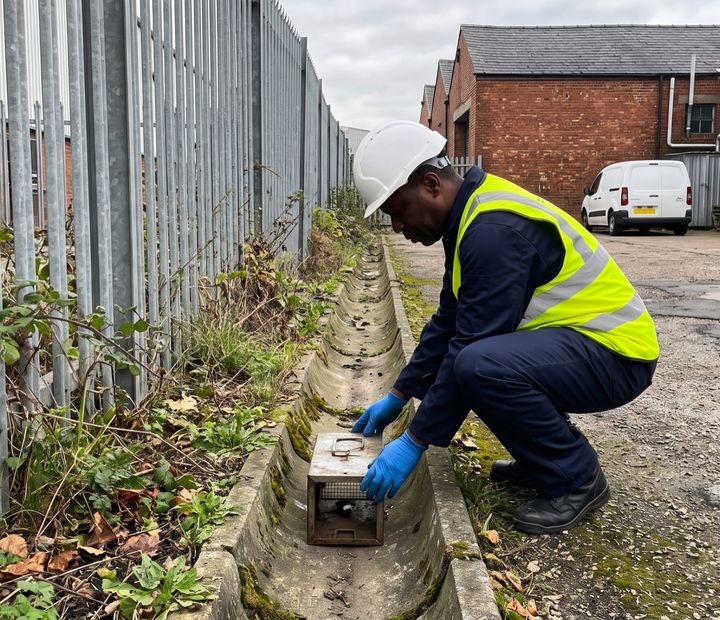
Northwest Environmental clears rats and mice from Bolton homes, rented properties and business premises, including Horwich, Farnworth and Breightmet, with visits planned from Warrington. We survey to find where rodents live and get in, set enclosed traps or locked bait stations, proof the gaps and return about weekly until activity stops. Ring or use the contact form to book.
Why do rats in Bolton travel underground?
Through the town centre, most of the River Croal runs in culverts beneath the streets rather than in the open. Brown rats use buried watercourses, sewers and old drain runs as protected corridors, and they surface wherever a cracked pipe, an open gully or an unsealed duct offers a way into a building. On a Bolton rodent job, whether the property is a terraced house or a town-centre shop, the drains get as much attention as the kitchen.
The valleys add open habitat as well. Moses Gate Country Park, between Farnworth and Little Lever, holds three lodges and one of the few stretches of the Manchester, Bolton and Bury Canal still in water, and the River Tonge joins the Croal at Darcy Lever after collecting its own brooks. Gardens close to these watercourses tend to show burrows under sheds and patios first, particularly after heavy rain raises the water or when colder nights draw rats towards warm buildings.
What do rodent problems look like in Bolton homes?
The two-up two-down brick terraces still lived in around Horwich were built for families drawn by the railway works and other industry. In rows like these, mice nest in floor voids and behind kitchen units, and rats usually arrive through the drainage: a displaced joint under a back yard, a gully missing its grate, or an old waste pipe left open after alterations. Semis, which outnumber terraces in Farnworth, more often show rats burrowing beside extensions, garden buildings and patios, with the way in traced to an airbrick or a gap around a pipe. Purpose-built flats concentrate the problem in bin stores and communal areas, where spilled waste can support rodents that then explore every ground-floor flat.
Council or private treatment?
According to its pages, Bolton Council’s free rat and mouse service is open to residents who own or privately rent their home. It allows one treatment, a first visit plus one follow-up, in each three-month period, runs on set postcode days and needs an adult in during the day. It does not cover housing association or social housing homes, and business premises are charged or placed on contract.
Private treatment therefore tends to suit a few situations: your landlord is a housing association that brings in a contractor; rodents have returned after the follow-up visit; nobody can be home on the set day; or the property is a business, the communal areas of a block, or a set of lets that needs proofing and written reports. The process below is the same in each case.
How does a rodent job run in Bolton?
The first visit is a survey: which species, roughly how many, where they are nesting and how they are getting in. We lift inspection covers where we can, check airbricks, pipe entries and thresholds, and then explain the plan before anything goes down. Enclosed traps or locked bait stations are placed on the active runs, with every position recorded. We return about a week later, and again as needed, typically two to four visits in all for a house, moving equipment to wherever the rodents are now working and fitting or recommending proofing. Return dates are agreed at the first visit and planned from Warrington alongside our other work in Bolton, Wigan and Chorley, so follow-ups do not drift. Once signs stop, everything is removed and you receive a written summary. Businesses also get a site plan of monitoring points and a visit log; landlords get a note of any repair that falls to the owner.
How can you keep rodents out of a Bolton property?
Prevention here mostly means closing the routes this housing offers. In a terrace, agree with neighbours to seal pipe gaps through party walls and loft spaces at the same time. Near a brook, lodge or the old canal, close off the ground under sheds and decking with buried mesh, and bring bird seed and pet food in overnight. Check that back-yard drain covers sit flush and that any redundant pipe is capped. In retail and industrial units, such as those at Middlebrook, keep loading doors shut between deliveries and fit brush strips to shutters. If you are next to a site where ground is about to be broken, ask for monitoring before work starts rather than after the first sighting.
Rat & Mouse Control in Bolton: what we see locally
- Much of the River Croal runs in culverts under Knowsley Street, Market Place and Bridge Street, so town-centre premises can face rats that move through buried watercourses and drains rather than across open ground.
- Bolton Council treats rats and mice free for owner-occupiers and private tenants, but refers housing association and social housing tenants, about one household in five at the 2021 Census, to their landlord.
- The council's free service covers a treatment visit and up to one follow-up, so drain-led or recurring infestations often need a longer private programme.
- In the Victorian and Edwardian two-up two-down terraces still lived in around Horwich, mice can move along a row through shared voids, so adjoining houses are best surveyed together.
- Moses Gate Country Park, between Farnworth and Little Lever, holds three lodges in the Croal and Irwell valleys, and one of the few watered sections of the Manchester, Bolton and Bury Canal, giving rats water's-edge cover.
How we deal with it
- 1
Survey and identification
We confirm whether it is rats, house mice or wood mice, follow runs and droppings back to where they are living, and map the ways in, from airbricks and pipe entries to drains and door thresholds.
- 2
A plan you understand
We explain what we found, which method we recommend and why, where traps or stations will go, and anything you need to do first, such as clearing a cupboard or moving pet food and animal feed.
- 3
Trapping or secured baiting
Enclosed traps or tamper-resistant bait stations are fixed on the active runs and every position is recorded. Products are used strictly to their label and to the CRRU UK code of best practice.
- 4
Proofing and drain checks
Gaps are sealed or meshed and door brushes fitted where needed. If drainage is the source, we show you the defect and recommend a rat blocker or repair so the route is closed.
- 5
Follow-up visits
We return, usually about a week apart, to check activity, remove any carcasses, move stations or traps to where the rodents are now working and confirm the proofing is holding.
- 6
Close-out and report
When activity stops, every station, trap and scrap of bait is taken away, and you receive a written summary of what was found, what was done and what to watch for.
Rat & Mouse Control in Bolton: frequently asked questions
The council treated our rats in Bolton but they came back. What now?
The council's free service covers one treatment, a first visit and one follow-up, in a three-month period, so a problem that returns inside that window needs another route. Rats coming back usually means the way in is still open. We start again with a full survey, lift inspection covers, look for displaced joints or redundant pipes and check airbricks and door gaps, then treat and proof together. Follow-up visits continue until there is no fresh activity, and you get a written note of any drain defect that needs repair.
I rent from a housing association in Bolton. Who sorts out rats or mice?
Your housing provider. Bolton Council does not treat rodents in housing association or social housing homes and asks tenants to report them to their landlord. Report it promptly and in writing, with dates, photos of droppings or damage and where you hear activity, because the repairs that let rodents in, such as broken drains or airbricks, are generally the landlord's to fix. If the problem is in shared areas of a block, say so too. Housing providers can bring in a private contractor such as us to survey and treat.
Do the neighbours in my Bolton terrace need treating as well?
Often they do, particularly for mice. In the older terraces, including the two-up two-down rows around Horwich, mice can travel along the row through roof spaces, floor voids and gaps around shared services. Treating one house can clear it for a while, but mice from next door soon move into the space. Where neighbours agree, we survey the adjoining houses and treat them in step, and we look for the shared entry points, such as a pipe running through a party wall, that need sealing in each home.
Can rats reach a Bolton town-centre shop from the culverted river?
They can arrive by underground routes, although the way into a building is usually a drain or sewer defect rather than the river itself. Much of the Croal runs in culverts beneath the central streets, and rats use buried watercourses, sewers and old drains to move about unseen. In a shop, café or office we check floor gullies, drain covers, service ducts and the back-door threshold, fit monitoring points along walls and log every visit, so you have records ready for an environmental health inspection.
Will rats leave on their own if I ignore them?
Rarely. While a building offers food, water and somewhere warm to nest, rats have no reason to move on, and they breed quickly: a female can mate again within a day or so of giving birth, and her young can breed within two to three months. Left in a loft or wall cavity, rats gnaw cables, which is a fire risk, foul insulation and stored belongings, and find their way to the kitchen through service voids. A problem that starts with a few droppings in autumn is often much larger by spring.
Can I legally put rat poison down in my garden?
Only in the way the product label allows. Rodenticides sold to householders are authorised for particular uses, usually indoors or outdoors close to buildings, and many may only be used inside a tamper-resistant bait station. Laying bait loose on open ground, in a hedge or by a compost heap risks poisoning pets, hedgehogs and birds of prey, and using a product against its label conditions can be an offence. Stronger professional products and larger packs are restricted to certified users under the UK rodenticide stewardship regime. In a garden used by children, dogs or hens, trapping is often the safer route.
Why do I keep getting rats under my decking or shed?
Decking and sheds give rats dry, hidden ground to burrow into, and most gardens have food nearby: bird feeders, dropped seed, compost bins, pet food or a hen run. Across much of the North West, a canal, brook or railway embankment close by adds a steady supply of new arrivals. Treating the burrows clears the current group, but others will move in unless the food is removed and the space under the structure is closed with buried mesh or a solid edge. We check the drains as well, because a broken pipe under a patio is often the real source.
More in Bolton
Last updated: