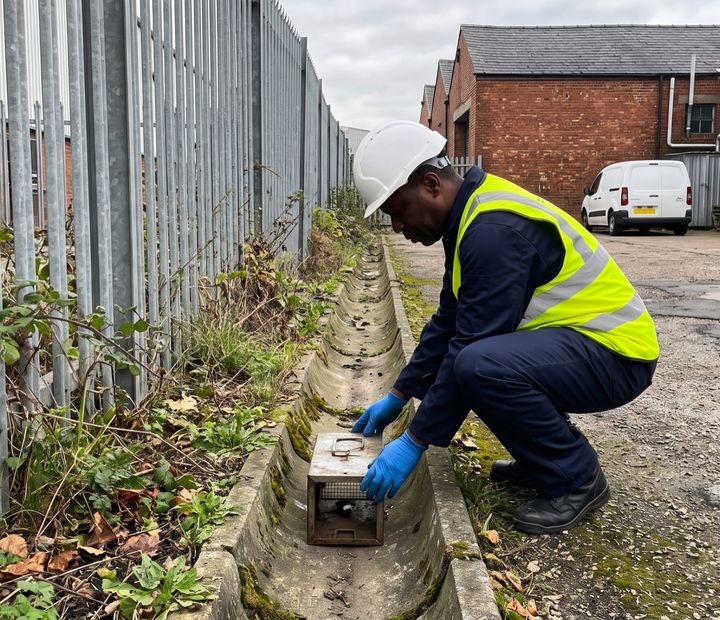
Northwest Environmental treats rats and mice in Preston homes, shops, business units and farms, including Plungington, Deepdale, Ashton-on-Ribble and the city's rural parishes. We survey the property, trace entry points and drains, trap or bait in locked stations, proof the gaps and return about weekly until activity stops. Book a survey by phone or online.
Why do Preston homes and businesses get rats and mice?
Two settings explain much of Preston’s rodent pressure. The first is the band of terraced streets close to the centre, where Plungington’s rows date from the late 1880s and Deepdale ward is largely terraced too. The second is the water running along and through the city: the tidal Ribble on its southern boundary, the dock basin, the Lancaster Canal finishing at Ashton basin, and Savick Brook, which the Ribble Link follows up to the canal. Rats live comfortably in both, and wherever the two meet, in older housing within reach of a bank or towpath, they have a way in as well as somewhere to live.
Season adds to the pressure. As autumn sets in, mice and rats move from gardens, verges and field margins into buildings, and on the dairy farmland in the north and east of the district, barns, calf sheds and feed stores draw rodents in as the weather turns. Wet spells raise water levels in the river and the brook, flood bank burrows and bring rats into gardens that have not seen them before.
What do we find in Preston terraces and rented homes?
A terrace rarely has a rodent problem confined to one address. Mice cross from house to house via the lofts and under-floor spaces a row has in common, and the rear drains of older rows were often laid as one shared run, so a single failed joint can feed rats into several homes. Typical evidence includes droppings behind kitchen plinths, chewed insulation around boxed-in pipework and a smell of ammonia in an under-stairs cupboard.
Rented housing complicates the logistics more than the treatment. More than one in five Preston households rented privately at the 2021 census, and many students live in the nearer parts of Plungington, so jobs often involve a landlord or agent, several tenants and a shared kitchen. We agree access in advance, show every occupant where traps and stations are, and ask the household to agree one sealed food store rather than open packets in each room.
What about riverside, canal and docklands homes?
Homes near the Ribble, around the Albert Edward Basin and close to the canal at Ashton basin can see rats travelling in from the banks. The survey here concentrates on the garden boundary, decking, sheds and the drain runs nearest the water. Burrows are treated, then the ground beneath outbuildings is sealed off with buried mesh or solid edging, because fresh rats will arrive from the bank if it is left open.
On the docklands, homes such as the Victoria Quay estate share the area with a cinema and restaurant complex, the Riversway retail park and business units. Clearing one plot while the next keeps feeding rodents achieves little, so we suggest that neighbouring occupiers and management companies compare notes and line up their proofing.
How do we handle shops, food units, industrial estates and farms?
Commercial sites in Preston run from stalls in the Market Hall and food vendors in the Box Market to units on the industrial estate east of the M6 and at Anchorage Business Park. Food traders need a monitoring plan with recorded checks and a clear response to any sighting. Industrial units beside farmland need their perimeter defences in place before autumn. On dairy farms the focus falls on feed stores, calf housing and silage areas, with traps and stations placed out of reach of stock and dogs, and baiting brought to an end once activity stops.
How does a rodent job in Preston run?
The first visit is a survey of the building and its surroundings, followed by a plain account of what we found and what we propose. Traps or locked bait stations go on the active runs, and any entry points we can close are proofed on the day or written up for a builder or drainage contractor. We return at roughly weekly intervals; because Preston follow-ups are planned in advance from our Warrington base, you know the dates from the start. When the signs stop, everything is removed and a written summary follows.
How do you keep rodents out of a Preston home?
Small jobs make the biggest difference in this housing. Check that airbricks on rear walls and gable ends are intact and meshed, fill gaps where waste pipes leave the kitchen, keep wheelie bin lids shut, and in shared houses store food in sealed containers in one agreed place. Near the river, the dock or the canal, keep sheds raised or sealed at the base and put bird food in a feeder rather than on the ground.
Rat & Mouse Control in Preston: what we see locally
- Terraced rows such as Plungington's late-1880s streets and largely terraced Deepdale often share loft and under-floor spaces, so mice reported in one home may be feeding in the next.
- Rats can travel along the tidal Ribble, the Lancaster Canal at Ashton basin and Savick Brook, and heavy rain or high tides that flood bank burrows push them into nearby gardens and outbuildings.
- With 22.4% of Preston households renting privately in 2021, rodent jobs often involve a landlord, an agent and several tenants, so our reports are written to be passed between them.
- Box Market vendors trade from converted shipping containers set close together, which makes recorded monitoring across neighbouring units more useful than treating one stall in isolation.
- East of the M6 at Ribbleton a large industrial estate shares the land with farmland, and across the dairy country in the north and east of the district, field rodents press towards units, barns and feed stores each autumn.
How we deal with it
- 1
Survey and identification
We confirm whether it is rats, house mice or wood mice, follow runs and droppings back to where they are living, and map the ways in, from airbricks and pipe entries to drains and door thresholds.
- 2
A plan you understand
We explain what we found, which method we recommend and why, where traps or stations will go, and anything you need to do first, such as clearing a cupboard or moving pet food and animal feed.
- 3
Trapping or secured baiting
Enclosed traps or tamper-resistant bait stations are fixed on the active runs and every position is recorded. Products are used strictly to their label and to the CRRU UK code of best practice.
- 4
Proofing and drain checks
Gaps are sealed or meshed and door brushes fitted where needed. If drainage is the source, we show you the defect and recommend a rat blocker or repair so the route is closed.
- 5
Follow-up visits
We return, usually about a week apart, to check activity, remove any carcasses, move stations or traps to where the rodents are now working and confirm the proofing is holding.
- 6
Close-out and report
When activity stops, every station, trap and scrap of bait is taken away, and you receive a written summary of what was found, what was done and what to watch for.
Rat & Mouse Control in Preston: frequently asked questions
Rats reach our garden from the Lancaster Canal bank. Who deals with the bank itself?
We can treat and proof land you own or control, but not the towpath or canal banks beyond your boundary. The Lancaster Canal's navigation authority is the Canal & River Trust, so that is the body to tell about burrows or heavy activity on its side of the fence; a note of what you have seen, with dates, helps. On your side, we site secured stations where rats cross the boundary, close off the ground under sheds and decking and check the drain runs, so your garden stops being a stopping point even if the bank stays busy.
Mice are coming through from next door in our Deepdale terrace. Do both houses need treating?
Usually, yes. In a terrace the roof space and floor voids are often continuous, so mice treat the row as one building. Treating only your house clears the animals on your side while the colony carries on next door and returns. With your neighbour's agreement we survey both properties on the same visit, place traps or stations where the runs cross the party wall and proof the shared gaps. If they will not take part, we concentrate on sealing your side thoroughly.
I rent a shared house near the university. Who should arrange rodent treatment?
Tell your landlord or letting agent in writing as soon as you see droppings or hear noises, with dates and where you saw them. Where rodents get in through a defect in the structure or drains, putting that right normally falls to the landlord, and in most lets the landlord arranges treatment too, while tenants are expected to keep food sealed and bins closed. We can deal with the landlord or agent directly, agree access with everyone in the house and send a report covering our findings, the work carried out and the follow-up each party is responsible for.
Our unit backs onto fields east of the M6. How do we stop mice getting in every autumn?
Start before the weather turns. We fit a ring of secured stations around the outside of the building, check that roller shutters close to the floor with intact brushes or seals, and look for gaps where pipes, cables and cladding meet. Inside, pallets and deliveries are a common way in, so goods-in areas get extra monitoring points and staff are shown what droppings and gnawed packaging look like. Visits run at agreed intervals on our planned Preston runs from Warrington, and each one ends with a written report you can show an auditor, client or landlord.
Will rats leave on their own if I ignore them?
Rarely. While a building offers food, water and somewhere warm to nest, rats have no reason to move on, and they breed quickly: a female can mate again within a day or so of giving birth, and her young can breed within two to three months. Left in a loft or wall cavity, rats gnaw cables, which is a fire risk, foul insulation and stored belongings, and find their way to the kitchen through service voids. A problem that starts with a few droppings in autumn is often much larger by spring.
Can I legally put rat poison down in my garden?
Only in the way the product label allows. Rodenticides sold to householders are authorised for particular uses, usually indoors or outdoors close to buildings, and many may only be used inside a tamper-resistant bait station. Laying bait loose on open ground, in a hedge or by a compost heap risks poisoning pets, hedgehogs and birds of prey, and using a product against its label conditions can be an offence. Stronger professional products and larger packs are restricted to certified users under the UK rodenticide stewardship regime. In a garden used by children, dogs or hens, trapping is often the safer route.
Why do I keep getting rats under my decking or shed?
Decking and sheds give rats dry, hidden ground to burrow into, and most gardens have food nearby: bird feeders, dropped seed, compost bins, pet food or a hen run. Across much of the North West, a canal, brook or railway embankment close by adds a steady supply of new arrivals. Treating the burrows clears the current group, but others will move in unless the food is removed and the space under the structure is closed with buried mesh or a solid edge. We check the drains as well, because a broken pipe under a patio is often the real source.
More in Preston
Last updated: