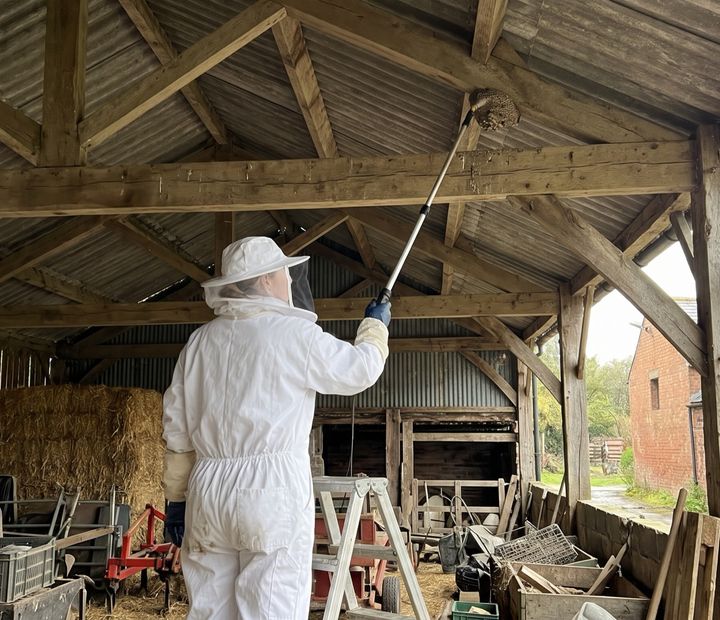
Wasp and hornet nests across Culcheth, Newchurch and Glazebury are dealt with by Northwest Environmental at houses, farm buildings, shops and business units. A technician traces the flight line and treats the nest entrance with a professional insecticide; most nests need one visit. Phone us or send the online form and we will set a day from Warrington.
What makes Culcheth attractive to nesting wasps?
A wasp colony needs three things close together: a dry cavity for the nest, wood to chew into nest paper, and a steady supply of insects to feed the grubs. Culcheth packs all three into a small area. Estate gardens with sheds and timber fences sit beside farmland, the hedges and trees of the Linear Park follow the old railway line through the village, and paths lead from the village to Crow Wood and on to Windy Bank Wood. By late summer, with the brood nearly raised, workers turn to sugar instead, and that is when picnics on the village green, fallen fruit in gardens and the bins behind food shops start drawing them in.
Where do we usually find nests in Culcheth?
On the Culcheth Hall estate, built after the war on the grounds of the old hall, the usual spots are behind fascias and soffits, under roof tiles, in garage roofs and in garden sheds. Lawns and banks that back onto open ground often hide ground nests in old mouse or vole holes, which are easy to mow over without noticing until the colony is large.
The converted cottage homes at Newchurch date from 1903, and houses of that age often have chimneys and roof voids that suit a queen looking for shelter. Because the site is a Conservation Area, we treat from the ground at the entrance and leave the fabric of the building alone.
Out in the rural parish, farmhouses, cottages and barns offer the quiet, dry spaces that wasps and European hornets both like: hay stores, stable roofs and gaps in old brick and timber. Commercial premises have their own favourite spots: shop canopies and signage in the village centre, the units on Taylor Business Park and the eaves of school buildings, where the treatment has to be timed around pupils coming and going.
How does a wasp visit in Culcheth run?
When you book, tell us where the wasps are going in and out and anything nearby we should know about, such as a garden pond with fish, horses grazing next door or someone at home with a sting allergy. We schedule the visit from Warrington, about six miles away, and give you a day.
The technician first confirms whether the insects are wasps, hornets or bees, then applies a professional-use dust or foam into the entrance, using an extension lance so the work stays on the ground wherever possible. Expect more wasps for a short while as foragers come back, and leave the hole open so they take the product inside with them. Activity usually stops within a day. For a nest in a barn or stable, we agree in advance when animals should be moved and when they can come back.
Check Warrington Borough Council’s website for current pest control services and charges. A private visit tends to suit people who want a time agreed around work or livestock, a nest dealt with on a farm or business site, or proofing advice once the colony has died.
What about hornets near the woods and mosses?
European hornets are native, larger than wasps and chestnut and yellow, and they nest in hollow trees, old outbuildings and wall cavities near woodland. With woods and two protected mosses, Holcroft Moss and Risley Moss, close to the village, a big brown insect bumping a lit window at night is more likely to be a hornet here than in a town centre. Hornet nests are treated in much the same way as wasp nests, with the timing chosen around their later flying hours. If an insect looks much darker, with a single orange band, it may be the invasive yellow-legged hornet, which should be reported rather than disturbed; our main wasp page explains how.
How can Culcheth homes and businesses cut the risk next year?
Once a nest has died off in autumn, look at how the queen got in. On estate houses that usually means refixing a loose soffit board, fitting insect mesh over vents without blocking airflow, or sealing a gap around a pipe. Owners at Newchurch should keep repairs like for like and check with the council’s planning team before changing anything visible outside. Farm owners can look over barns and stables in April and May, while any new nest is still small and easy to treat. Shops and food businesses do best with lidded bins, cleared spillages and a short written note of any nest treated, kept with their pest records.
Wasp & Hornet Nest Removal in Culcheth: what we see locally
- On the post-war Culcheth Hall estate, nests are most often found behind fascias and soffits, under roof tiles and in garden sheds and garage roofs.
- The converted cottage homes at Newchurch sit in a Conservation Area, so nests there are treated at the entrance from the ground, with no disturbance to roofs or chimneys.
- Farmhouses, cottages and barns across the rural parish give wasps and European hornets dry, undisturbed cavities, and horses or livestock nearby shape when and how we treat.
- Gardens that back onto Culcheth Linear Park, laid along the old Wigan Junction Railways, can hide ground nests in banks and hedges on the boundary.
- In late summer foraging wasps can gather around bins at the two village-centre supermarkets and the CPS shopping centre, which is when shopkeepers tend to notice a nest nearby.
How we deal with it
- 1
Identify the insect and find the nest
We confirm it is wasps or hornets rather than bees, then follow the flight line back to the entrance, whether that is a gap under a tile, a soffit vent, an airbrick or a hole in the lawn.
- 2
Check the surroundings
Before treating we check for children, neighbours, pets, fish ponds, horses or livestock, staff and customers nearby, and ask whether anyone has a known sting allergy.
- 3
Treat the entrance
A professional-use insecticide dust or foam goes directly into the entrance, from the ground with an extension lance where possible. Returning wasps carry it inside, so hidden nests are reached too.
- 4
Leave the entrance open
We explain why the hole must not be blocked, how long to keep people and pets clear, and that a short burst of extra activity is normal while foragers return.
- 5
Remove the nest where it matters
Dead nests are usually left, because wasps never reuse them. Where a nest is in a living space, a well-used shed or a loft where it could draw other insects, we can take it out once inactive.
- 6
Confirm it has worked
Activity normally stops within 24 hours. If wasps are still using the same entrance after a couple of days, or a second nest appears, tell us and we will reassess.
Wasp & Hornet Nest Removal in Culcheth: frequently asked questions
The nest is on the Linear Park side of my fence. Can you treat it?
Only where you are entitled to treat. If the entrance is in your garden, in your own hedge or under your shed, we can deal with it in the normal way, even though the wasps forage over the park. If the nest itself is on park land, it is not yours to treat, so report it to Warrington Borough Council and keep children and dogs off that part of the garden for now. When the entrance sits right on the boundary, we will look at it with you and explain the options before doing anything.
Can you treat a nest in a barn or stable on the edge of Culcheth?
Yes. Barns, stables and old farm buildings around the parish are frequent nest sites, both for wasps and for European hornets. When you book, tell us which animals use the building and whether feed or bedding is stored near the nest. We put the insecticide into the entrance rather than spraying the building, and agree with you when horses or livestock should be moved out and when they can return, usually once activity has stopped. Covering water troughs and feed close to the entrance during treatment is sensible.
Will treating a wasp nest at a Newchurch conversion involve any work on the building?
Normally not. The treatment goes into the entrance the wasps are using, applied from the ground with a lance wherever we can reach, so no tiles, slates or chimney pots need to come off. Because the former cottage homes sit in a Conservation Area, any later proofing, such as mesh over a vent or sealing a gap in the eaves, should be discreet and like for like. If you plan visible changes, check with Warrington Borough Council's planning team first. We can show you where the queen got in so your builder knows what to repair.
There is a wasp nest at a house I rent out in Culcheth. Should I book the council?
Many councils run a pest control service for residents, but what is covered, who can book and the charges all vary and can change, so check the council's own pest control pages before you book. If you rent, report the problem to your landlord first. If you would rather book a private firm, call or message us to arrange a visit.
Will my council remove a wasp nest for free?
Probably not. Councils across Cheshire, Merseyside, Lancashire and Greater Manchester handle wasps differently: many charge for the work, some do not treat wasps in homes at all (Cheshire East, for example, treats only rats and mice), and free wasp treatment is uncommon. Where a council does offer it, appointments may be harder to get in late summer, when demand peaks, and there may be limits on the nests it will treat. Your council's pest control page will say what is available. If it does not cover your nest, or you need it dealt with sooner, we can treat it privately.
What kills a wasp nest instantly?
Nothing reliably does. Sprays that promise instant results knock down the wasps you can see, not the colony inside, and spraying a visible nest at close range mainly provokes it. Professional treatment works by placing insecticide dust or foam in the nest entrance; foragers carry it in and spread it through the nest. Expect a burst of activity for an hour or two, then a steady decline. Most nests are dead within 24 hours, although a large nest in a roof space can take a little longer.
Is it a wasp, a hornet or a bee, and will you treat bees?
Wasps are smooth, bright yellow and black, with a narrow waist. European hornets are larger, chestnut-brown and yellow, and often turn up at lit windows after dark. Bees are rounder and hairier. We do not treat honeybees, because insecticide in a honeybee nest can be carried away by bees from other colonies; a local beekeeper may be able to collect a swarm. Bumblebee nests die off naturally by late summer and are usually best left alone. If you are unsure, send us a clear photo before booking.
More in Culcheth
Last updated: